Fontanella Marco, Benevello Chiara, Panciani Pier Panciani, Ronchetti Gabriele, Bacigaluppi Susanna, Stefini Roberto, Spena Giannantonio, Garbossa Diego, Ducati Alessandro
Department of Neuroscience, Division of Neurosurgery, University of Brescia, Italy ; Department of Neuroscience, Division of Neurosurgery, University of Turin, Italy.
Asian J Neurosurg. 2013 Apr;8(2):74-7. doi: 10.4103/1793-5482.116377.
Anastomosis to the superficial temporal artery is suitable in patients with functional and structural impairment of the middle cerebral artery (i.e., complex aneurysms and skull base tumors), as either definitive treatment or an additional safety measure. A shorter occlusion time or a non-occlusive technique is expected to reduce the risk of cerebral ischemia following the procedure. In this cadaver study, we assessed the fitness of C-Port xA(®) device for use in superficial temporal artery (STA)-middle cerebral artery (MCA) bypass.
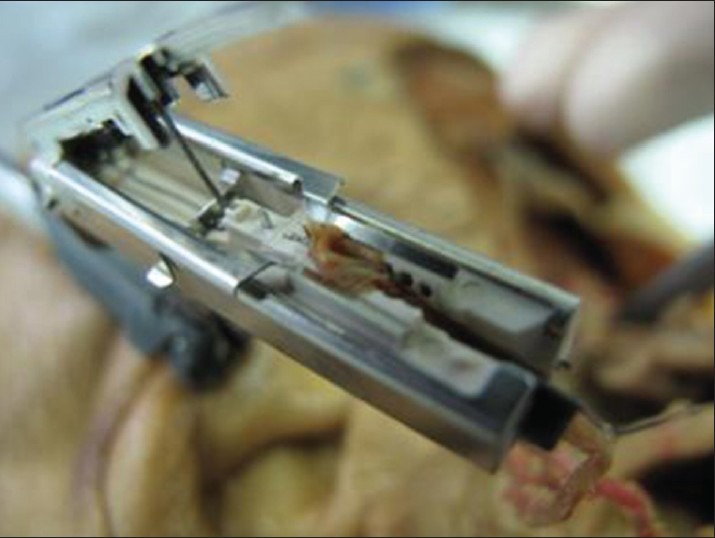
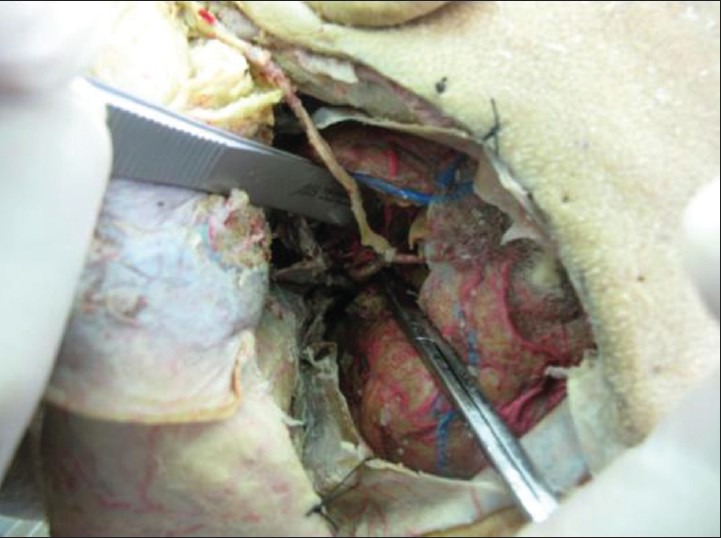
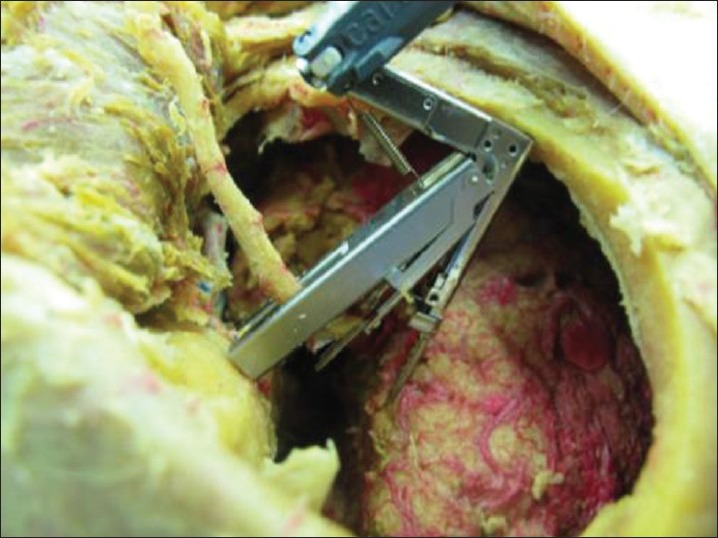
Seven fixed human head specimens were prepared through eight pterional craniotomies. The superficial temporal artery was dissected and the sylvian fissure was opened to access the MCA. The C-Port xA was tested on each of the eight exposures. We recorded the lengths of both donor and recipient vessel, the durations of the procedure and the craniotomy, and sylvian scissure opening sizes. The bypass was then assessed by pressure injection of methylene blue in the donor vessel.
C-Port xA-assisted STA-MCA anastomosis was successfully accomplished in seven dissections. A minimum STA length of 7 cm, a sylvian scissure opening larger than 5 cm, and a craniotomy size of at least 6 × 6 cm appeared to be the requisites for a safe maneuverability of the device. The MCA occlusion time lasted in all cases less than 4.5 min, and we observed a clear improvement in time performance with growing experience.
The results suggest that the C-Port xA device is suitable for STA-MCA bypass. We experienced a shorter occlusion time and a shorter learning curve compared to conventional techniques. Further miniaturization and special adaptation of this device may allow a future application even to deeper intracranial vessels. Clinical trials will have to assess the long-term results and benefits of this minimal occlusive technique.
对于大脑中动脉存在功能和结构损害的患者(即复杂动脉瘤和颅底肿瘤患者),颞浅动脉吻合术作为确定性治疗或额外的安全措施是合适的。预期较短的阻断时间或非阻断技术可降低术后脑缺血风险。在本尸体研究中,我们评估了C-Port xA(®)装置用于颞浅动脉(STA)-大脑中动脉(MCA)搭桥术的适用性。
通过八次翼点开颅术制备了七个固定的人头标本。解剖颞浅动脉并打开外侧裂以显露MCA。在八次暴露中的每一次上测试C-Port xA。我们记录了供体和受体血管的长度、手术和开颅的持续时间以及外侧裂开口大小。然后通过向供体血管内注射亚甲蓝进行压力注射来评估搭桥情况。
在七次解剖中成功完成了C-Port xA辅助的STA-MCA吻合术。至少7 cm的STA长度、大于5 cm的外侧裂开口以及至少6×6 cm的开颅大小似乎是该装置安全操作的必要条件。所有病例中MCA阻断时间均持续不到4.5分钟,并且随着经验的增加我们观察到时间性能有明显改善。
结果表明C-Port xA装置适用于STA-MCA搭桥术。与传统技术相比,我们经历了更短的阻断时间和更短的学习曲线。该装置的进一步小型化和特殊适应性调整可能使未来甚至可应用于更深的颅内血管。临床试验将必须评估这种最小化阻断技术的长期结果和益处。