Yoo Hongseok, Song Jae-Uk, Koh Won-Jung, Jeon Kyeongman, Um Sang-Won, Suh Gee Young, Chung Man Pyo, Kim Hojoong, Kwon O Jung, Lee Nam Yong, Woo Sookyoung, Park Hye Yun
Division of Pulmonary and Critical Care Medicine, Department of Medicine, Samsung Medical Center, Sungkyunkwan University School of Medicine, 81 Irwon-ro, Gangnam-gu, Seoul, Republic of Korea.
BMC Infect Dis. 2013 Sep 2;13:404. doi: 10.1186/1471-2334-13-404.
Flexible bronchoscopy with bronchial washing is a useful procedure for diagnosis of pulmonary tuberculosis (TB), when a patient cannot produce sputum spontaneously or when sputum smears are negative. However, the benefit of gaining serial bronchial washing specimens for diagnosis of TB has not yet been studied. Therefore, we conducted a retrospective study to determine the diagnostic utility of additional bronchial washing specimens for the diagnosis of pulmonary TB in suspected patients.
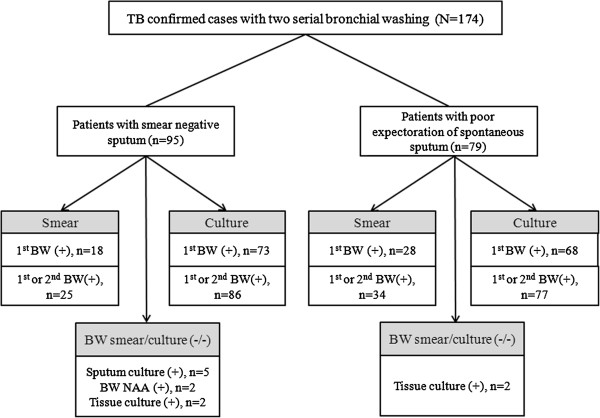
A retrospective analysis was performed on 174 patients [sputum smear-negative, n = 95 (55%); lack of sputum specimen, n = 79 (45%)] who received flexible bronchoscopy with two bronchial washing specimens with microbiological confirmation of pulmonary TB in Samsung Medical Center, between January, 2010 and December, 2011.
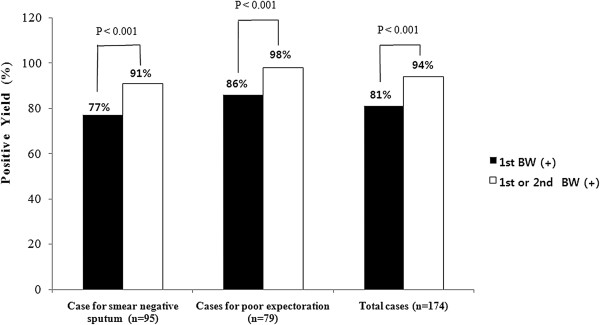
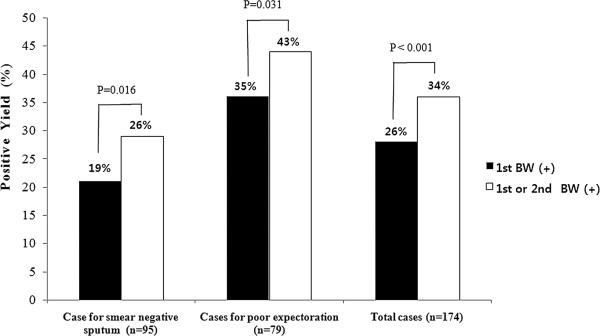
Pulmonary TB was diagnosed by first bronchial washing specimen in 141 patients (81%) out of 174 enrolled patients, and an additional bronchial washing specimen established diagnosis exclusively in 22 (13%) patients. Smear for acid-fast bacilli (AFB) was positive in 46 patients (26%) for the first bronchial washing specimen. Thirteen patients (7%) were positive only on smear of an additional bronchial washing specimen. Combined smear positivity of the first and second bronchial washing specimens was significantly higher compared to first bronchial washing specimen alone [Total cases: 59 (34%) vs. 46 (26%), p < 0.001; cases for smear negative sputum: 25 (26%) vs. 18 (19%), p = 0.016; cases for poor expectoration: 34 (43%) vs. 28 (35%), p = 0.031]. The diagnostic yield determined by culture was also significantly higher in combination of the first and second bronchial washing specimens compared to the first bronchial washing. [Total cases: 163 (94%) vs. 141 (81%), p < 0.001; cases for smear negative sputum: 86 (91%) vs. 73 (77%), p < 0.001; cases for poor expectoration: 77 (98%) vs. 68 (86%), p = 0.004].
Obtaining an additional bronchial washing specimen could be a beneficial and considerable option for diagnosis of TB in patients with smear-negative sputum or who cannot produce sputum samples.
当患者无法自行咳痰或痰涂片为阴性时,可弯曲支气管镜检查及支气管灌洗术是诊断肺结核(TB)的一种有用方法。然而,获取系列支气管灌洗标本对肺结核诊断的益处尚未得到研究。因此,我们进行了一项回顾性研究,以确定在疑似患者中额外的支气管灌洗标本对肺结核诊断的效用。
对2010年1月至2011年12月期间在三星医疗中心接受可弯曲支气管镜检查并获取两份支气管灌洗标本且经微生物学确诊为肺结核的174例患者[痰涂片阴性,n = 95例(55%);无痰标本,n = 79例(45%)]进行回顾性分析。
在174例纳入患者中,141例(81%)通过首次支气管灌洗标本确诊为肺结核,另外22例(13%)仅通过额外的支气管灌洗标本确诊。首次支气管灌洗标本中46例(26%)抗酸杆菌(AFB)涂片阳性。13例(7%)仅在额外支气管灌洗标本涂片上呈阳性。与仅首次支气管灌洗标本相比,首次和第二次支气管灌洗标本的联合涂片阳性率显著更高[总病例数:59例(34%)对46例(26%),p < 0.001;痰涂片阴性病例:25例(26%)对18例(19%),p = 0.016;咳痰不佳病例:34例(43%)对28例(35%),p = 0.031]。与首次支气管灌洗相比,首次和第二次支气管灌洗标本联合培养确定的诊断率也显著更高。[总病例数:163例(94%)对141例(81%),p < 0.001;痰涂片阴性病例:86例(91%)对73例(77%),p < 0.001;咳痰不佳病例:77例(98%)对68例(86%),p = 0.004]。
对于痰涂片阴性或无法咳出痰标本的患者,获取额外的支气管灌洗标本可能是诊断肺结核的一种有益且重要的选择。