Faculty of Health and Social Care, University of Hull, Cottingham Road, Hull, UK.
Implement Sci. 2013 Sep 23;8:111. doi: 10.1186/1748-5908-8-111.
A theoretical approach to assessing the barriers and levers to evidence-based practice (EBP) with subsequent tailoring of theoretically informed strategies to address these may go some way to positively influencing the delay in implementing research findings into practice. Hand hygiene is one such example of EBP, chosen for this study due to its importance in preventing death through healthcare associated infections (HCAI). The development of an instrument to assess barriers and levers to hand hygiene and to allow the subsequent tailoring of theoretically informed implementation strategies is reported here.
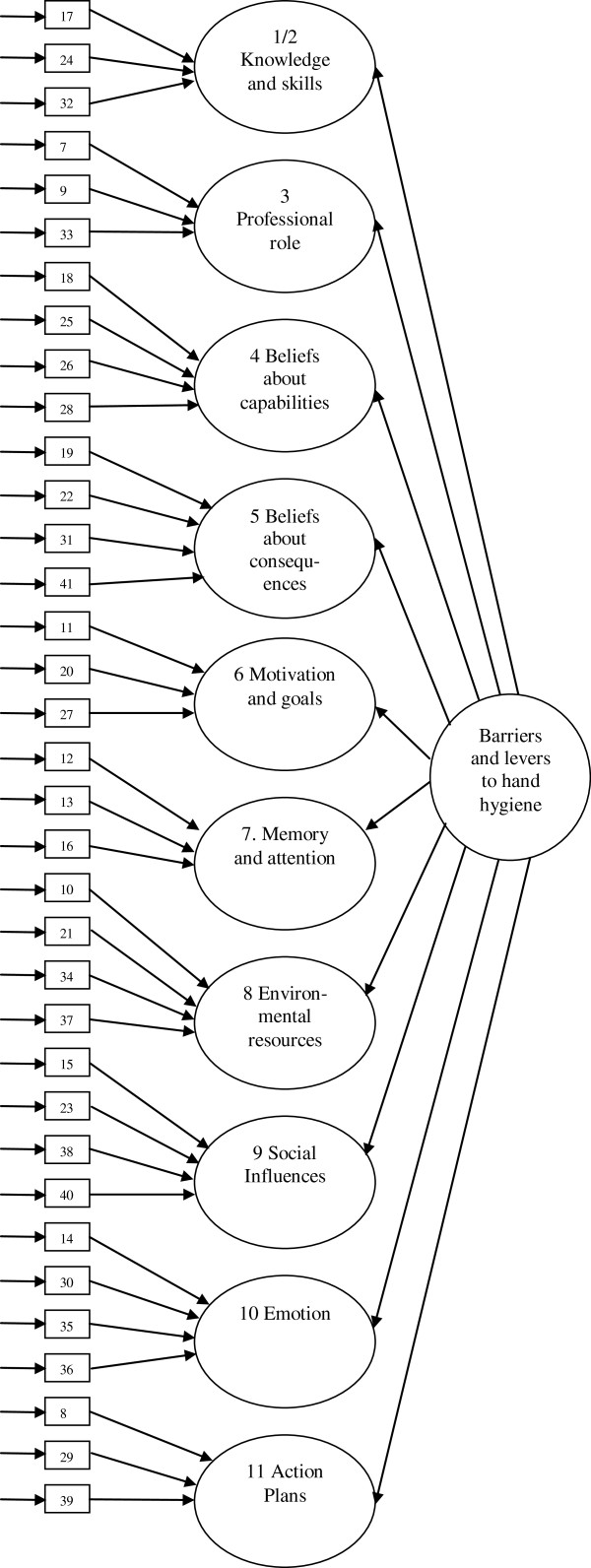
A comprehensive list of barriers and levers to hand hygiene were categorised to the Theoretical Domains Framework (TDF) in a Delphi survey. These items formed the basis of an instrument that was tested to establish validity and reliability. The relationship between self-reported compliance with hand hygiene and barriers and levers to hand hygiene was also examined along with compliance according to where the barriers and levers fit within the domains of the TDF framework.
A 33-item instrument that tested well for internal consistency (α = 0.84) and construct validity (χ²/df = 1.9 [p < 0.01], RMSEA = 0.05 and CFA = 0.84) was developed. The relationship between self-reported compliance with hand hygiene moderately correlated with barriers identified by participants (total barrier score) (r = 0.41, n = 276, p <0.001). The greater the number of barriers reported, the lower the level of compliance. A one-way between groups multivariate analysis of variance was performed to investigate differences between those adopting high or low compliance with hand hygiene. Compliance was highest for this sample of participants among practitioners with high levels of motivation, strong beliefs about capabilities, when there were positive social influences, when hand hygiene was central to participants' sense of professional identity and was easier to remember to do.
This study has produced encouraging findings suggesting the potential for improved hand hygiene and resulting effects on the human and financial costs of healthcare associated infection. This study identifies a further potential use for the TDF.
一种评估基于证据的实践(EBP)障碍和促进因素的理论方法,并随后针对这些因素制定理论指导的策略,可能会在一定程度上积极影响将研究结果延迟应用于实践的情况。手卫生就是 EBP 的一个例子,由于它在预防与医疗保健相关的感染(HCAI)导致的死亡方面的重要性,因此选择了该研究。本文报告了一种评估手卫生障碍和促进因素的工具的开发,并允许随后针对这些因素制定理论指导的实施策略。
在一项德尔菲调查中,将手卫生的障碍和促进因素进行了全面分类,归入到理论领域框架(TDF)中。这些项目构成了一个工具的基础,该工具经过测试,以确定其有效性和可靠性。还检查了自我报告的手卫生依从性与手卫生障碍和促进因素之间的关系,以及根据障碍和促进因素在 TDF 框架的领域中的位置来判断的依从性。
开发了一种 33 项的工具,该工具具有良好的内部一致性(α=0.84)和结构有效性(χ²/df = 1.9 [p < 0.01],RMSEA = 0.05 和 CFA = 0.84)。自我报告的手卫生依从性与参与者确定的障碍之间存在中度相关性(总障碍得分)(r = 0.41,n = 276,p <0.001)。报告的障碍越多,依从性越低。进行了单向组间多变量方差分析,以调查在高或低手卫生依从性之间的差异。在该参与者样本中,高动机的从业者、对能力有强烈信念、有积极的社会影响、手卫生是参与者职业认同感的核心,以及更容易记住执行手卫生操作时,手卫生的依从性最高。
这项研究的结果令人鼓舞,表明有可能提高手卫生水平,并对与医疗保健相关的感染的人力和财务成本产生积极影响。这项研究进一步确定了 TDF 的另一种潜在用途。