Sakata Yoshinori, Hadeishi Hiromu, Moroi Junta
Deparment of Neurosurgery, Kameda Medical Center.
Neurol Med Chir (Tokyo). 2013;53(9):635-7. doi: 10.2176/nmc.tn2012-0347.
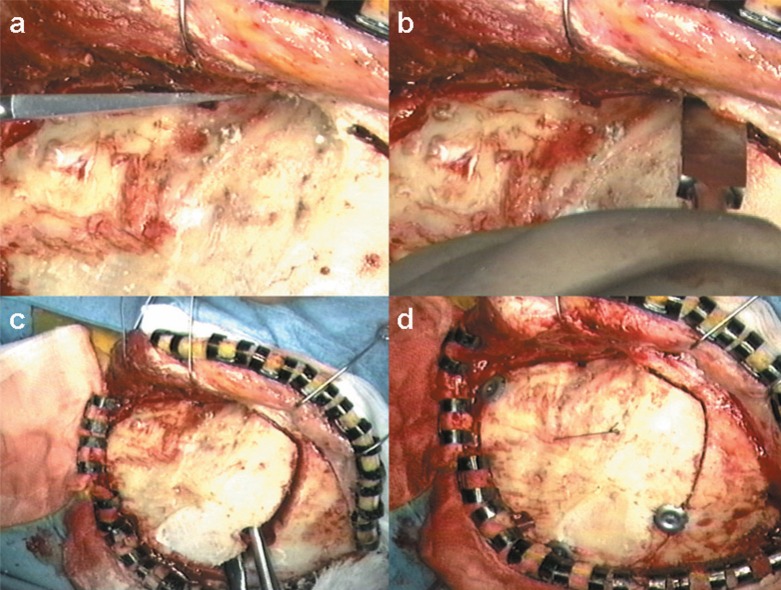
A frontotemporal craniotomy is usually performed using a "keyhole," made at the union of the zygomatic arch and frontal bone. Consequently, skull depression may occur postoperatively, leading to temporal area deformities and poor cosmetic results. To prevent these complications, we describe our technique for frontotemporal craniotomy using an osteotome to prevent cosmetic deformities. After the temporal muscle is dissected and reflected with the scalp flap, a total of 3 burr holes are made in the frontal and temporal bones. In the lateral greater wing of the sphenoid, where a keyhole is usually made, a bone incision is made anteriorly-posteriorly with an osteotome. The bone flap is lifted upward, and the osteotome is inserted from behind to continue the incision. At craniotomy closure, the bone flap is fixed using a cranial bone flap fixation clamp. This procedure involves almost no removal of frontal or inferior temporal bone, resulting in virtually no bone defect. The absence of skull depression or deformity in the temples postoperatively leads to excellent cosmetic results. Our technique for frontotemporal craniotomy using an osteotome does not create bone defects, and use of titanium clamps for bone flap fixation provides normal skull bone alignment. This procedure provides excellent postoperative cosmetic results.
额颞开颅术通常通过在颧弓与额骨交界处制作的“锁孔”进行。因此,术后可能会出现颅骨凹陷,导致颞部区域畸形和美容效果不佳。为预防这些并发症,我们描述了一种使用骨凿进行额颞开颅术以防止美容畸形的技术。在颞肌与头皮瓣一起被解剖并翻开后,在额骨和颞骨上共制作3个钻孔。在通常制作锁孔的蝶骨大翼外侧,用骨凿从前向后进行骨切口。将骨瓣向上提起,然后从后面插入骨凿继续切口。在开颅术关闭时,使用颅骨瓣固定夹固定骨瓣。此操作几乎不切除额骨或颞下骨,几乎不会造成骨缺损。术后颞部无颅骨凹陷或畸形,美容效果极佳。我们使用骨凿进行额颞开颅术的技术不会造成骨缺损,并且使用钛夹固定骨瓣可使颅骨正常对齐。该操作术后美容效果极佳。