Department of Biology, University of Nevada, Reno, Nevada, United States of America.
PLoS Genet. 2013;9(9):e1003710. doi: 10.1371/journal.pgen.1003710. Epub 2013 Sep 12.
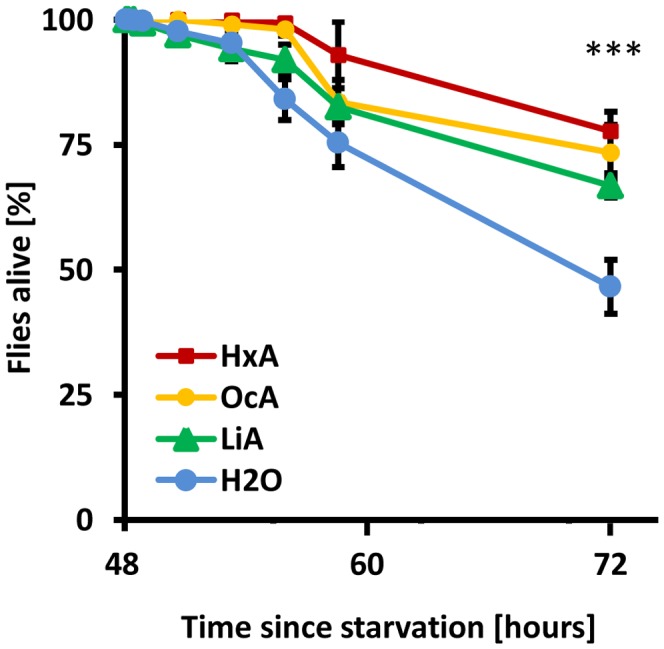
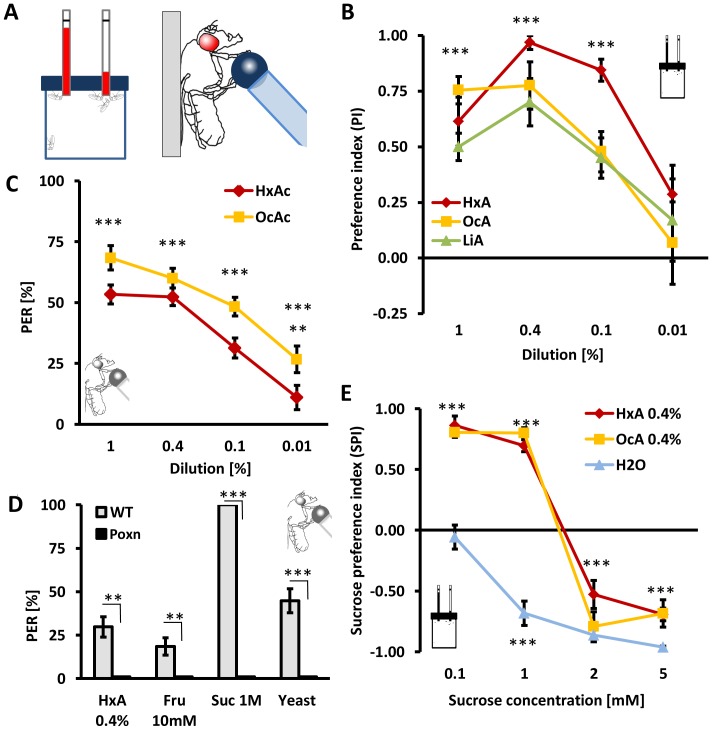
Taste is the primary sensory system for detecting food quality and palatability. Drosophila detects five distinct taste modalities that include sweet, bitter, salt, water, and the taste of carbonation. Of these, sweet-sensing neurons appear to have utility for the detection of nutritionally rich food while bitter-sensing neurons signal toxicity and confer repulsion. Growing evidence in mammals suggests that taste for fatty acids (FAs) signals the presence of dietary lipids and promotes feeding. While flies appear to be attracted to fatty acids, the neural basis for fatty acid detection and attraction are unclear. Here, we demonstrate that a range of FAs are detected by the fly gustatory system and elicit a robust feeding response. Flies lacking olfactory organs respond robustly to FAs, confirming that FA attraction is mediated through the gustatory system. Furthermore, flies detect FAs independent of pH, suggesting the molecular basis for FA taste is not due to acidity. We show that low and medium concentrations of FAs serve as an appetitive signal and they are detected exclusively through the same subset of neurons that sense appetitive sweet substances, including most sugars. In mammals, taste perception of sweet and bitter substances is dependent on phospholipase C (PLC) signaling in specialized taste buds. We find that flies mutant for norpA, a Drosophila ortholog of PLC, fail to respond to FAs. Intriguingly, norpA mutants respond normally to other tastants, including sucrose and yeast. The defect of norpA mutants can be rescued by selectively restoring norpA expression in sweet-sensing neurons, corroborating that FAs signal through sweet-sensing neurons, and suggesting PLC signaling in the gustatory system is specifically involved in FA taste. Taken together, these findings reveal that PLC function in Drosophila sweet-sensing neurons is a conserved molecular signaling pathway that confers attraction to fatty acids.
味觉是检测食物质量和口感的主要感官系统。果蝇检测到五种不同的味觉模式,包括甜、苦、咸、水和碳酸味。在这些味觉中,甜味感知神经元似乎对检测营养丰富的食物有用,而苦味感知神经元则表示毒性并引起排斥。越来越多的哺乳动物研究证据表明,对脂肪酸(FAs)的味觉信号表明存在膳食脂质,并促进进食。虽然果蝇似乎被脂肪酸吸引,但脂肪酸检测和吸引力的神经基础尚不清楚。在这里,我们证明了一系列脂肪酸被果蝇味觉系统检测到,并引起强烈的进食反应。缺乏嗅觉器官的果蝇对脂肪酸表现出强烈的反应,这证实了脂肪酸的吸引力是通过味觉系统介导的。此外,果蝇可以独立于 pH 值检测到 FAs,这表明 FA 味觉的分子基础不是由于酸度。我们表明,低浓度和中等浓度的 FAs 作为一种开胃信号,它们仅通过感知开胃甜味物质的同一组神经元被检测到,包括大多数糖。在哺乳动物中,对甜和苦物质的味觉感知依赖于特定味觉感受器中的磷脂酶 C (PLC)信号。我们发现,norpA 突变体果蝇(PLC 的果蝇同源物)对 FAs 没有反应。有趣的是,norpA 突变体对其他味觉剂,包括蔗糖和酵母,反应正常。norpA 突变体的缺陷可以通过选择性地在甜味感知神经元中恢复 norpA 表达来挽救,这证实了 FAs 通过甜味感知神经元发出信号,并且 PLC 信号在味觉系统中的特定参与了 FA 味觉。综上所述,这些发现揭示了 PLC 在果蝇甜味感知神经元中的功能是一种保守的分子信号通路,赋予了对脂肪酸的吸引力。