Institute of Medical Microbiology and Hospital Epidemiology, Hannover Medical School, Hannover, Germany.
PLoS Genet. 2013;9(9):e1003775. doi: 10.1371/journal.pgen.1003775. Epub 2013 Sep 19.
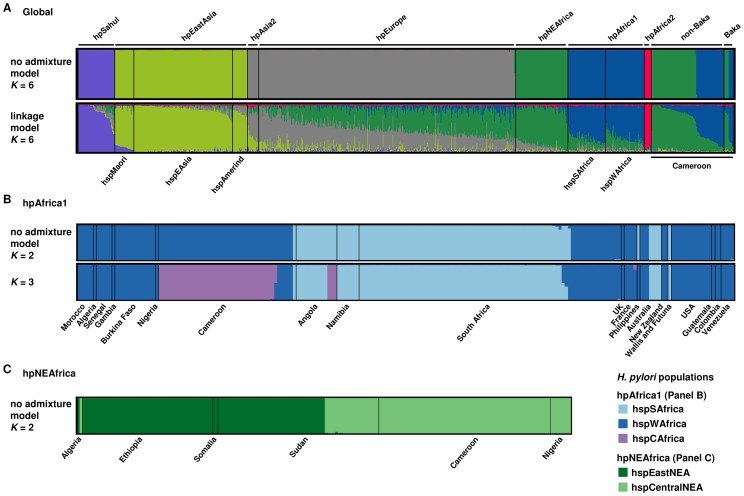
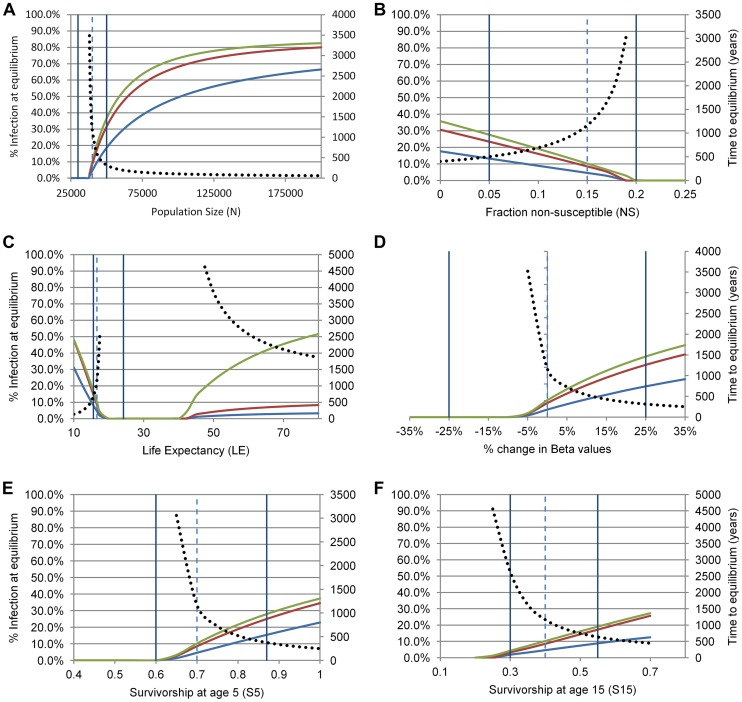
Both anatomically modern humans and the gastric pathogen Helicobacter pylori originated in Africa, and both species have been associated for at least 100,000 years. Seven geographically distinct H. pylori populations exist, three of which are indigenous to Africa: hpAfrica1, hpAfrica2, and hpNEAfrica. The oldest and most divergent population, hpAfrica2, evolved within San hunter-gatherers, who represent one of the deepest branches of the human population tree. Anticipating the presence of ancient H. pylori lineages within all hunter-gatherer populations, we investigated the prevalence and population structure of H. pylori within Baka Pygmies in Cameroon. Gastric biopsies were obtained by esophagogastroduodenoscopy from 77 Baka from two geographically separated populations, and from 101 non-Baka individuals from neighboring agriculturalist populations, and subsequently cultured for H. pylori. Unexpectedly, Baka Pygmies showed a significantly lower H. pylori infection rate (20.8%) than non-Baka (80.2%). We generated multilocus haplotypes for each H. pylori isolate by DNA sequencing, but were not able to identify Baka-specific lineages, and most isolates in our sample were assigned to hpNEAfrica or hpAfrica1. The population hpNEAfrica, a marker for the expansion of the Nilo-Saharan language family, was divided into East African and Central West African subpopulations. Similarly, a new hpAfrica1 subpopulation, identified mainly among Cameroonians, supports eastern and western expansions of Bantu languages. An age-structured transmission model shows that the low H. pylori prevalence among Baka Pygmies is achievable within the timeframe of a few hundred years and suggests that demographic factors such as small population size and unusually low life expectancy can lead to the eradication of H. pylori from individual human populations. The Baka were thus either H. pylori-free or lost their ancient lineages during past demographic fluctuations. Using coalescent simulations and phylogenetic inference, we show that Baka almost certainly acquired their extant H. pylori through secondary contact with their agriculturalist neighbors.
无论是解剖学上的现代人类还是胃病原体幽门螺杆菌,都起源于非洲,并且这两个物种已经共存了至少 10 万年。存在着七种地理上不同的幽门螺杆菌种群,其中三种是非洲本土的:hpAfrica1、hpAfrica2 和 hpNEAfrica。最古老和最具差异的种群 hpAfrica2,是在桑族狩猎采集者中进化而来的,他们代表了人类种群树中最深的分支之一。考虑到所有狩猎采集者群体中都存在古老的幽门螺杆菌谱系,我们调查了喀麦隆巴卡俾格米人胃中的幽门螺杆菌流行率和种群结构。通过食管胃十二指肠镜从两个地理上分开的巴卡人群中获得了 77 例胃活检,以及从邻近农业人口中的 101 例非巴卡个体中获得了胃活检,随后对这些胃活检进行了幽门螺杆菌培养。出乎意料的是,巴卡俾格米人的幽门螺杆菌感染率(20.8%)明显低于非巴卡人(80.2%)。我们通过 DNA 测序为每个幽门螺杆菌分离株生成了多基因座单倍型,但未能确定巴卡特有的谱系,我们样本中的大多数分离株被分配到 hpNEAfrica 或 hpAfrica1。人口 hpNEAfrica 是尼罗-撒哈拉语系扩张的标志,分为东非和中非西部两个亚群。同样,一个新的 hpAfrica1 亚群,主要在喀麦隆人中发现,支持了班图语向东和向西的扩张。一个年龄结构的传播模型表明,巴卡俾格米人中幽门螺杆菌的低流行率在几百年的时间内是可以实现的,这表明人口规模小和异常低的预期寿命等人口因素可能导致幽门螺杆菌从个体人群中被根除。因此,巴卡人要么没有感染幽门螺杆菌,要么在过去的人口波动中失去了他们的古老谱系。通过使用合并模拟和系统发育推断,我们表明巴卡人几乎可以肯定是通过与农业邻居的二次接触获得了现有的幽门螺杆菌。