Mandapathil Magis, Visus Carmen, Finn Olivera J, Lang Stephan, Whiteside Theresa L
Department of Otorhinolaryngology; University of Giessen-Marburg; Marburg, Germany.
Oncoimmunology. 2013 Jul 1;2(7):e25514. doi: 10.4161/onci.25514. Epub 2013 Jul 3.
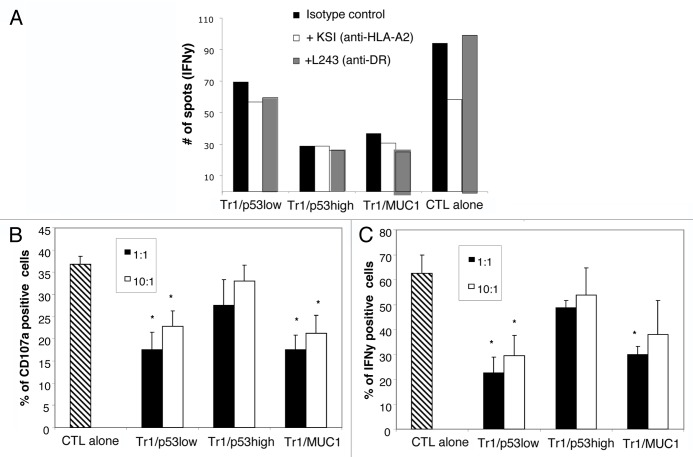
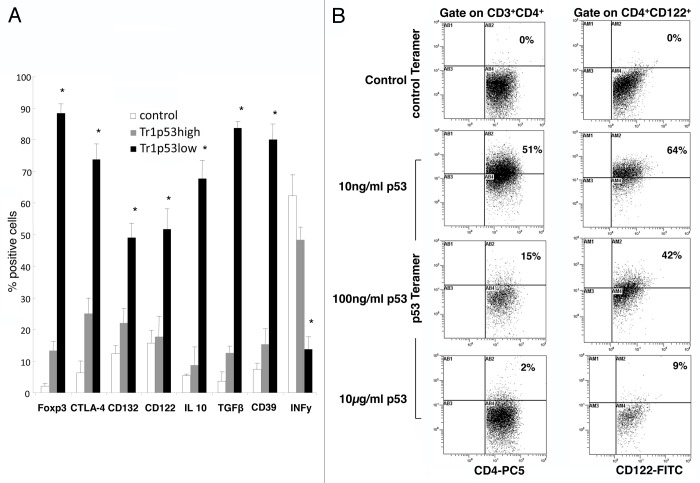
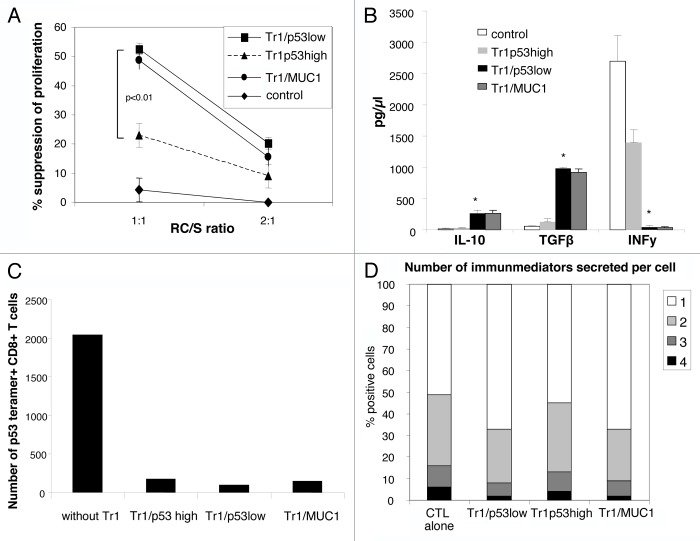
Inducible regulatory T cells (iTregs, also called Tr1 cells) are generated in the periphery (circulation or tissue) of cancer patients upon the encounter of naïve CD4 T cells with tumor-associated antigens. As p53 is often inactivated by genetic or epigenetic events during oncogenesis, p53-induced Tr1 cells might play a key role in establishing immunosuppressive networks in cancer patients. Tr1 cells were generated by co-culturing circulating CD4CD25 T cells with autologous immature dendritic cells pulsed with a wild-type (WT) p53-derived peptide or an unrelated peptide derived from mucin 1 (MUC1). The Tr1 phenotype and the specificity for p53 of these cells were confirmed by multicolor flow cytometry. Moreover, the Tr1 cell-mediated suppression of T-cell proliferation was evaluated by CFSE-based flow cytometry, while their ability to alter the T-cell cytokine profile by ELISA and Luminex assays. The capacity of p53-induced Tr1 cells to suppress the generation and function of cytotoxic T lymphcoytes (CTLs) was assessed by flow cytometry and ELISPOT. Of note, low doses of the p53-derived peptide (p53) induced greater numbers of Tr1 cells than the same peptide employed at high doses (p53). Moreover, Tr1/p53 cells not secreted higher levels of interleukin-10 and transforming growth factor β1, but also mediated more robust suppressive effects on CTL proliferation than Tr1/p53 cells. Tr1/p53 cells, Tr1/p53 cells, as well as Tr1 cells generated with low doses of an unrelated MUC1-derived peptide were equally effective in suppressing the expansion and antitumor activity of p53-reactive CTLs. p53 induced the expansion of highly suppressive p53-reactive Tr1 cells. However, the capacity of these Tr1 cells to suppress the generation and function of p53-reactive CTLs was independent of their antigen-specificity.
诱导性调节性T细胞(iTregs,也称为Tr1细胞)在癌症患者的外周(循环系统或组织)中产生,由初始CD4 T细胞与肿瘤相关抗原相遇而诱导产生。由于p53在肿瘤发生过程中常因基因或表观遗传事件而失活,p53诱导的Tr1细胞可能在癌症患者免疫抑制网络的建立中起关键作用。通过将循环CD4CD25 T细胞与用野生型(WT)p53衍生肽或粘蛋白1(MUC1)衍生的无关肽脉冲处理的自体未成熟树突状细胞共培养来生成Tr1细胞。通过多色流式细胞术确认了这些细胞的Tr1表型和对p53的特异性。此外,通过基于CFSE的流式细胞术评估Tr1细胞介导的T细胞增殖抑制作用,同时通过ELISA和Luminex检测评估其改变T细胞细胞因子谱的能力。通过流式细胞术和ELISPOT评估p53诱导的Tr1细胞抑制细胞毒性T淋巴细胞(CTLs)产生和功能的能力。值得注意的是,低剂量的p53衍生肽(p53)比高剂量使用相同肽(p53)诱导产生更多数量的Tr1细胞。此外,Tr1/p53细胞不仅分泌更高水平的白细胞介素-10和转化生长因子β1,而且比Tr1/p53细胞对CTL增殖介导更强的抑制作用。Tr1/p53细胞、Tr1/p53细胞以及用低剂量无关MUC1衍生肽产生的Tr1细胞在抑制p53反应性CTLs的扩增和抗肿瘤活性方面同样有效。p53诱导了高度抑制性的p53反应性Tr1细胞的扩增。然而,这些Tr1细胞抑制p53反应性CTLs产生和功能的能力与其抗原特异性无关。