Department of Biology, Ashland University, 401 College Avenue, Ashland, OH 44805, USA.
Exp Eye Res. 2013 Nov;116:227-33. doi: 10.1016/j.exer.2013.09.007. Epub 2013 Sep 25.
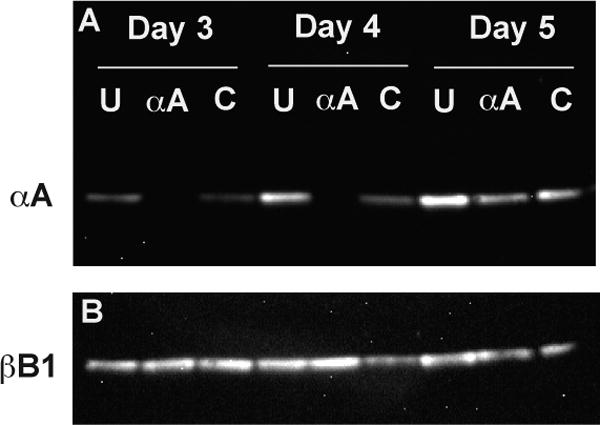
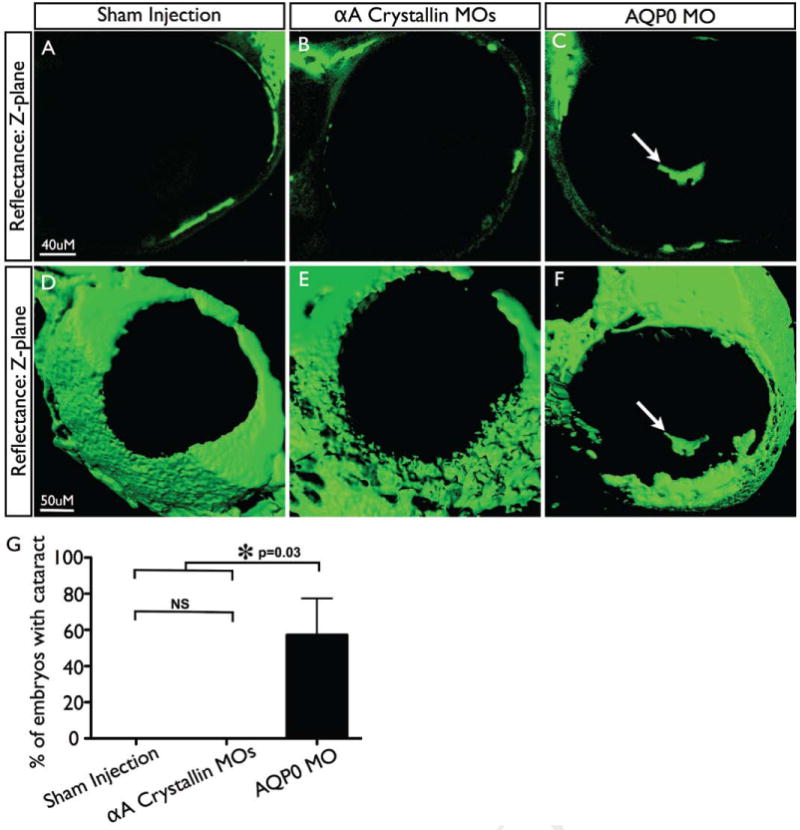
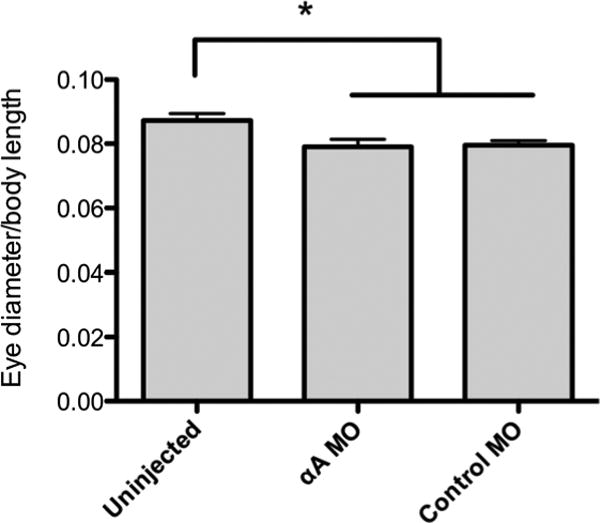
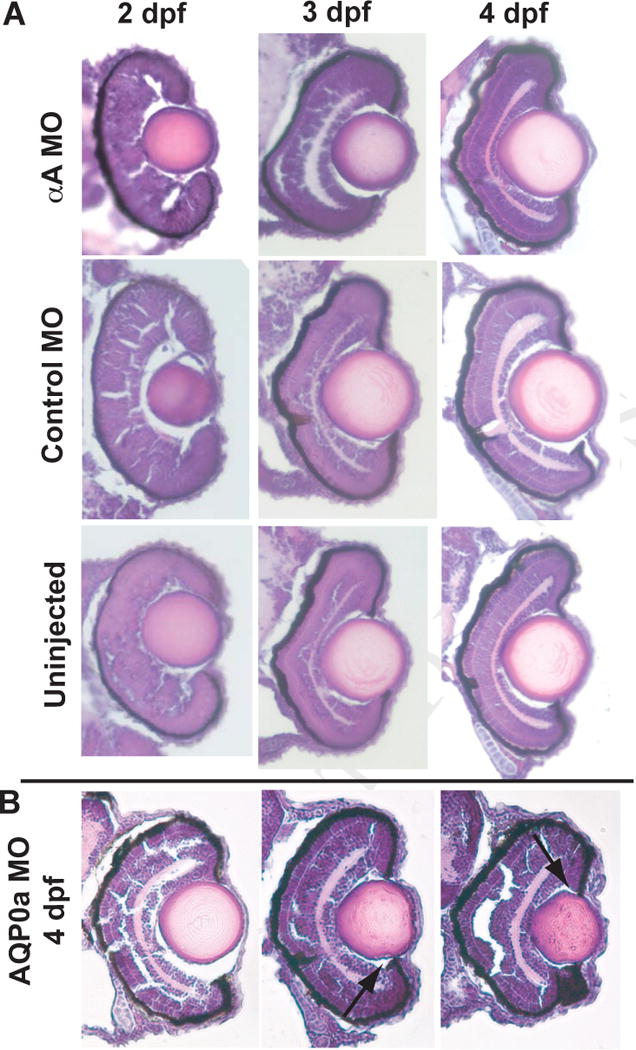
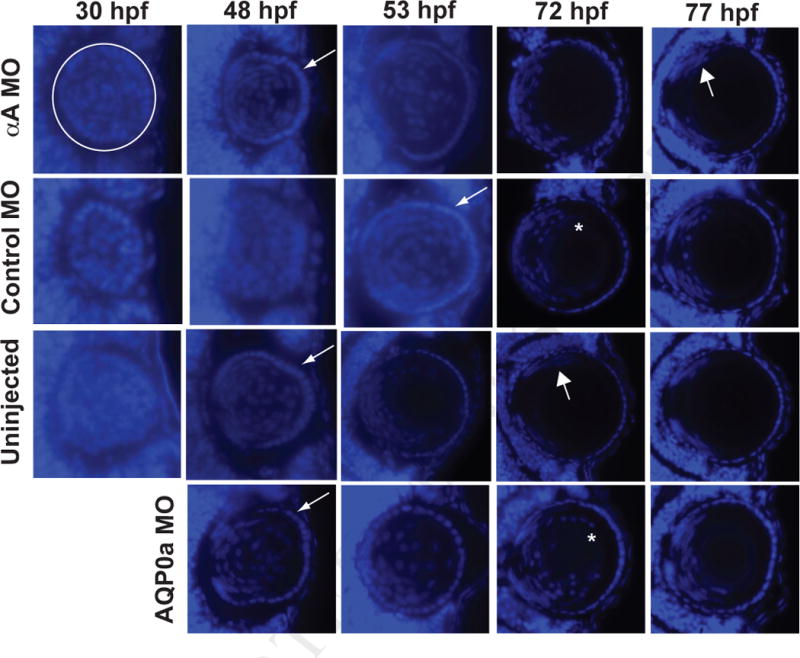
Alpha crystallins are small heat shock proteins essential to normal ocular lens function. They also help maintain homeostasis in many non-ocular vertebrate tissues and their expression levels change in multiple diseases of the nervous and cardiovascular system and during cancer. The specific roles that α-crystallins may play in eye development are unclear. Studies with knockout mice suggested that only one of the two mammalian α-crystallins is required for normal early lens development. However, studies in two fish species suggested that reduction of αA-crystallin alone could inhibit normal fiber cell differentiation, cause cataract and contribute to lens degeneration. In this study we used synthetic antisense morpholino oligomers to suppress the expression of zebrafish αA-crystallin to directly test the hypothesis that, unlike mammals, the zebrafish requires αA-crystallin for normal early lens development. Despite the reduction of zebrafish αA-crystallin protein to undetectable levels by western analysis through 4 days of development we found no changes in fiber cell differentiation, lens morphology or transparency. In contrast, suppression of AQP0a expression, previously shown to cause lens cataract, produced irregularly shaped lenses, delay in fiber cell differentiation and lens opacities detectable by confocal microscopy. The normal development observed in αA-crystallin deficient zebrafish embryos may reflect similarly non-essential roles for this protein in the early stages of both zebrafish and mammalian lens development. This finding has ramifications for a growing number of researchers taking advantage of the zebrafish's transparent external embryos to study vertebrate eye development. Our demonstration that lens cataracts can be visualized in three-dimensions by confocal microscopy in a living zebrafish provides a new tool for studying the causes, development and prevention of lens opacities.
α 晶状体蛋白是小热休克蛋白,对正常的眼晶状体功能至关重要。它们还有助于维持许多非眼脊椎动物组织的内稳态,并且在神经和心血管系统的多种疾病以及癌症期间其表达水平会发生变化。α 晶状体蛋白在眼睛发育中可能发挥的具体作用尚不清楚。敲除小鼠的研究表明,两种哺乳动物 α 晶状体蛋白中只有一种对于正常的早期晶状体发育是必需的。然而,两种鱼类的研究表明,仅降低αA-晶状体蛋白就可以抑制正常的纤维细胞分化,导致白内障并导致晶状体变性。在这项研究中,我们使用合成的反义 morpholino 寡核苷酸来抑制斑马鱼αA-晶状体蛋白的表达,以直接检验这样一个假设,即与哺乳动物不同,斑马鱼需要αA-晶状体蛋白才能正常进行早期晶状体发育。尽管通过 Western 分析将斑马鱼αA-晶状体蛋白的蛋白水平降低到无法检测的水平,但我们发现纤维细胞分化、晶状体形态或透明度没有变化。相比之下,AQP0a 表达的抑制,先前已被证明会导致晶状体白内障,产生形状不规则的晶状体,纤维细胞分化延迟以及通过共聚焦显微镜可检测到的晶状体混浊。在αA-晶状体蛋白缺陷的斑马鱼胚胎中观察到的正常发育可能反映了该蛋白在斑马鱼和哺乳动物晶状体发育的早期阶段同样是非必需的作用。这一发现对越来越多的利用斑马鱼透明的外部胚胎来研究脊椎动物眼睛发育的研究人员具有重要意义。我们证明了可以通过共聚焦显微镜在活体斑马鱼中以三维方式可视化晶状体白内障,为研究晶状体混浊的原因、发展和预防提供了新工具。