Department of Pathology, Case Western Reserve University School of Medicine, Cleveland, OH 44106;
J Immunol. 2013 Nov 1;191(9):4789-803. doi: 10.4049/jimmunol.1300645. Epub 2013 Sep 27.
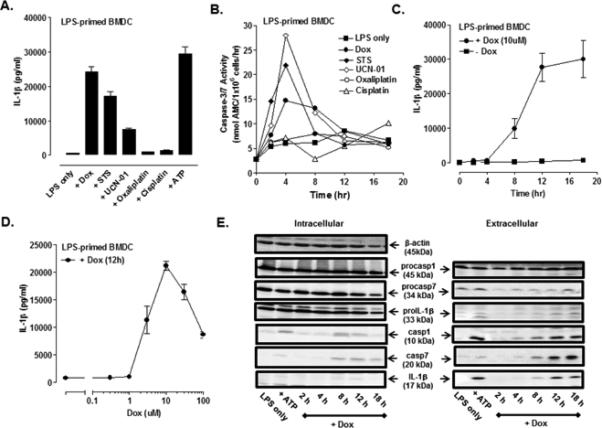
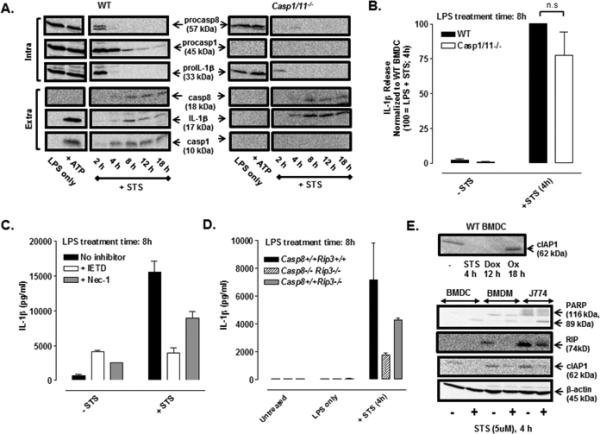
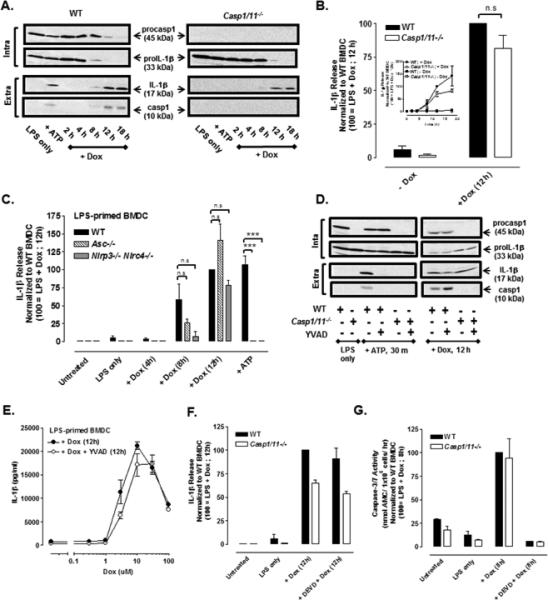
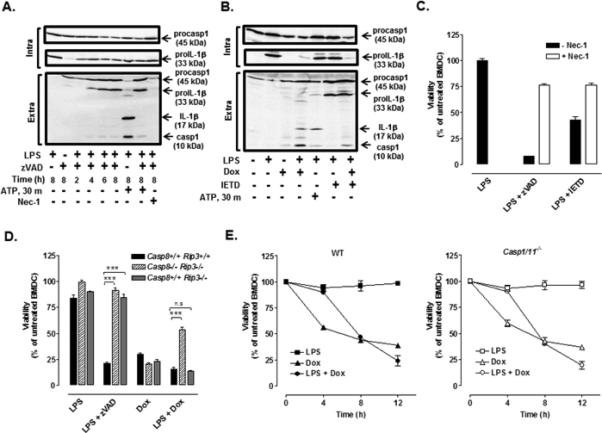
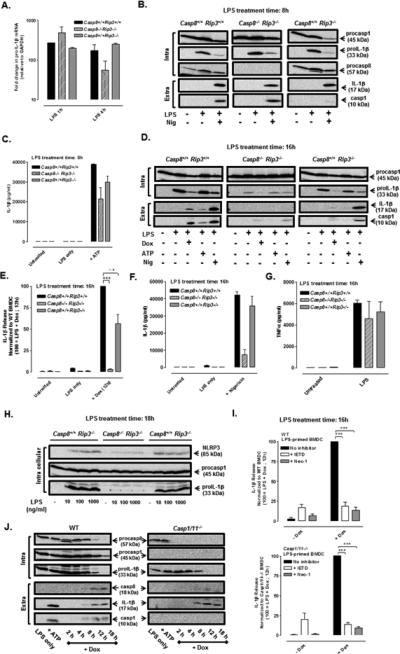
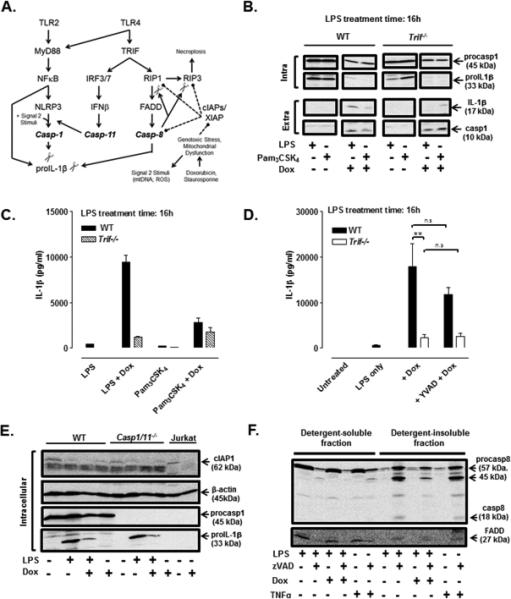
The identification of noncanonical (caspase-1-independent) pathways for IL-1β production has unveiled an intricate interplay between inflammatory and death-inducing signaling platforms. We found a heretofore unappreciated role for caspase-8 as a major pathway for IL-1β processing and release in murine bone marrow-derived dendritic cells (BMDC) costimulated with TLR4 agonists and proapoptotic chemotherapeutic agents such as doxorubicin (Dox) or staurosporine (STS). The ability of Dox to stimulate release of mature (17-kDa) IL-1β was nearly equivalent in wild-type (WT) BMDC, Casp1(-/-)Casp11(-/-) BMDC, WT BMDC treated with the caspase-1 inhibitor YVAD, and BMDC lacking the inflammasome regulators ASC, NLRP3, or NLRC4. Notably, Dox-induced production of mature IL-1β was temporally correlated with caspase-8 activation in WT cells and greatly suppressed in Casp8(-/-)Rip3(-/-) or Trif(-/-) BMDC, as well as in WT BMDC treated with the caspase-8 inhibitor, IETD. Similarly, STS stimulated robust IL-1β processing and release in Casp1(-/-)Casp11(-/-) BMDC that was IETD sensitive. These data suggest that TLR4 induces assembly of caspase-8-based signaling complexes that become licensed as IL-1β-converting enzymes in response to Dox and STS. The responses were temporally correlated with downregulation of cellular inhibitor of apoptosis protein 1, suggesting suppressive roles for this and likely other inhibitor of apoptosis proteins on the stability and/or proteolytic activity of the caspase-8 platforms. Thus, proapoptotic chemotherapeutic agents stimulate the caspase-8-mediated processing and release of IL-1β, implicating direct effects of such drugs on a noncanonical inflammatory cascade that may modulate immune responses in tumor microenvironments.
细胞凋亡蛋白酶-1(caspase-1)非依赖性(非典型)途径的鉴定揭示了炎症和诱导死亡信号平台之间复杂的相互作用。我们发现,细胞凋亡蛋白酶-8(caspase-8)在 TLR4 激动剂和促凋亡化疗药物(如阿霉素(Dox)或司他丁(STS))刺激的骨髓来源树突状细胞(BMDC)中作为 IL-1β 加工和释放的主要途径发挥了迄今为止尚未被认识的作用。Dox 刺激成熟(17kDa)IL-1β释放的能力在 WT BMDC、Casp1(-/-)Casp11(-/-)BMDC、用 caspase-1 抑制剂 YVAD 处理的 WT BMDC 和缺乏 ASC、NLRP3 或 NLRC4 的炎性体调节剂的 BMDC 中几乎相等。值得注意的是,Dox 诱导的成熟 IL-1β 的产生与 WT 细胞中 caspase-8 的激活时间相关,并在 Casp8(-/-)Rip3(-/-)或 Trif(-/-)BMDC 以及用 caspase-8 抑制剂 IETD 处理的 WT BMDC 中受到极大抑制。同样,STS 刺激 Casp1(-/-)Casp11(-/-)BMDC 中强大的 IL-1β 加工和释放,该过程对 IETD 敏感。这些数据表明,TLR4 诱导 caspase-8 为基础的信号复合物的组装,这些复合物在响应 Dox 和 STS 时成为 IL-1β 转化酶的许可证。这些反应与细胞凋亡蛋白抑制剂 1 的下调时间相关,表明该蛋白和可能其他凋亡蛋白抑制剂在 caspase-8 平台的稳定性和/或蛋白水解活性上具有抑制作用。因此,促凋亡化疗药物刺激 caspase-8 介导的 IL-1β 加工和释放,这暗示了此类药物对可能调节肿瘤微环境中免疫反应的非典型炎症级联的直接影响。