Department of Global Health and Development, London School of Hygiene & Tropical Medicine, 15-17 Tavistock Place, WC1H 9SH, London, UK.
Implement Sci. 2013 Sep 30;8:113. doi: 10.1186/1748-5908-8-113.
Despite significant investments into health improvement programmes in Uganda, health indicators and access to healthcare remain poor across the country. The PRIME trial aims to evaluate the impact of a complex intervention delivered in public health centres on health outcomes of children and management of malaria in rural Uganda. The intervention consists of four components: Health Centre Management; Fever Case Management; Patient- Centered Services; and support for supplies of malaria diagnostics and antimalarial drugs.
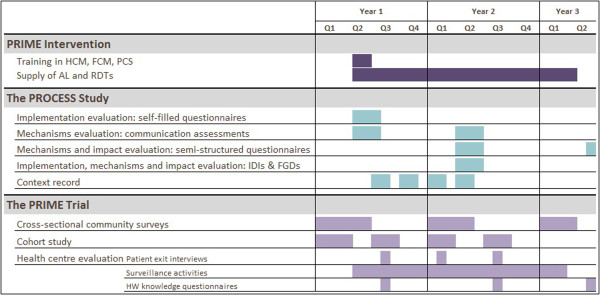
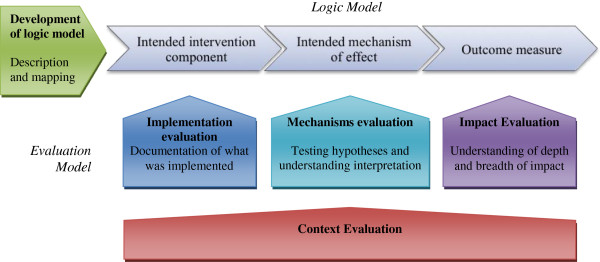
The PROCESS study will use mixed methods to evaluate the processes, mechanisms of change, and context of the PRIME intervention by addressing five objectives. First, to develop a comprehensive logic model of the intervention, articulating the project's hypothesised pathways to trial outcomes. Second, to evaluate the implementation of the intervention, including health worker training, health centre management tools, and the supply of artemether-lumefantrine (AL) and rapid diagnostic tests (RDTs) for malaria. Third, to understand mechanisms of change of the intervention components, including testing hypotheses and interpreting realities of the intervention, including resistance, in context. Fourth, to develop a contextual record over time of factors that may have affected implementation of the intervention, mechanisms of change, and trial outcomes, including factors at population, health centre and district levels. Fifth, to capture broader expected and unexpected impacts of the intervention and trial activities among community members, health centre workers, and private providers. Methods will include intervention logic mapping, questionnaires, recorded consultations, in-depth interviews, focus group discussions, and contextual data documentation.
The findings of this PROCESS study will be interpreted alongside the PRIME trial results. This will enable a greater ability to generalise the findings of the main trial. The investigators will attempt to assess which methods are most informative in such evaluations of complex interventions in low-resource settings.
Clinicaltrials.gov, NCT01024426.
尽管乌干达在改善健康状况的项目上投入了大量资金,但该国的健康指标和获得医疗保健的机会仍然很差。PRIME 试验旨在评估在公共卫生中心实施的一项复杂干预措施对乌干达农村儿童健康结果和疟疾管理的影响。该干预措施由四个部分组成:卫生中心管理;发热病例管理;以患者为中心的服务;以及支持疟疾诊断和抗疟药物的供应。
PROCESS 研究将采用混合方法评估 PRIME 干预措施的过程、变化机制和背景,以实现五个目标。首先,制定干预措施的综合逻辑模型,阐明项目对试验结果的假设途径。其次,评估干预措施的实施情况,包括卫生工作者培训、卫生中心管理工具以及青蒿素-哌喹(AL)和疟疾快速诊断检测试剂(RDTs)的供应。第三,了解干预措施各组成部分的变化机制,包括检验假设和解释干预措施的现实情况,包括在背景下的阻力。第四,随着时间的推移,建立一个可能影响干预措施实施、变化机制和试验结果的因素的背景记录,包括人口、卫生中心和地区各级的因素。第五,了解干预措施和试验活动对社区成员、卫生中心工作人员和私人提供者的预期和意外影响。方法将包括干预措施逻辑映射、问卷调查、记录咨询、深入访谈、焦点小组讨论和背景数据记录。
该 PROCESS 研究的结果将与 PRIME 试验结果一起解释。这将使人们能够更好地概括主要试验的结果。研究人员将尝试评估在资源匮乏的环境中评估复杂干预措施时哪些方法最具信息性。
Clinicaltrials.gov,NCT01024426。