Department of Epidemiology and Biostatistics and the Ministry of Education Key Laboratory of Environment and Health, School of Public Health, Tongji Medical College, Huazhong University of Science and Technology, Wuhan, Hubei, China.
PLoS One. 2013 Sep 26;8(9):e72633. doi: 10.1371/journal.pone.0072633. eCollection 2013.
O(6)-methylguanine-DNA methyltransferase (MGMT) is one of most important DNA repair enzyme against common carcinogens such as alkylate and tobacco. Aberrant promoter methylation of the gene is frequently observed in non-small cell lung cancer (NSCLC). However, the importance of epigenetic inactivation of the gene in NSCLC published in the literature showed inconsistence. We quantified the association between MGMT promoter methylation and NSCLC using a meta-analysis method.
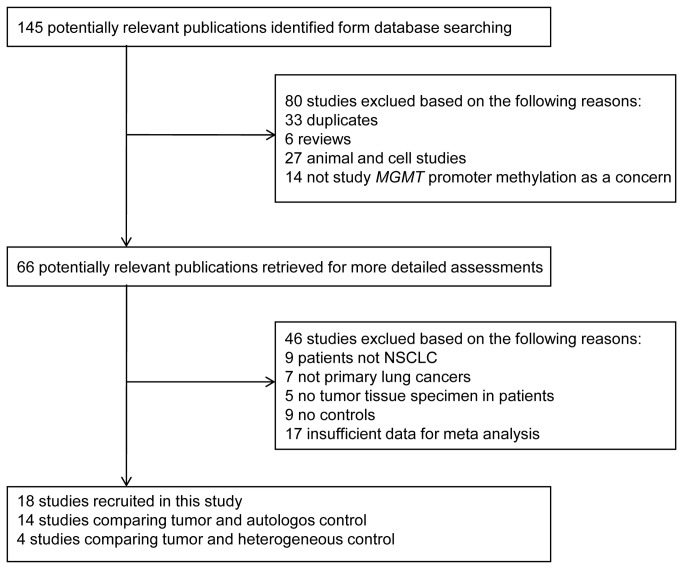
We systematically reviewed studies of MGMT promoter methylation and NSCLC in PubMed, EMBASE, Ovid, ISI Web of Science, Elsevier and CNKI databases and quantified the association between MGMT promoter methylation and NSCLC using meta-analysis method. Odds ratio (OR) and corresponding 95% confidence interval (CI) were calculated to evaluate the strength of association. Potential sources of heterogeneity were assessed by subgroup analysis and meta-regression.
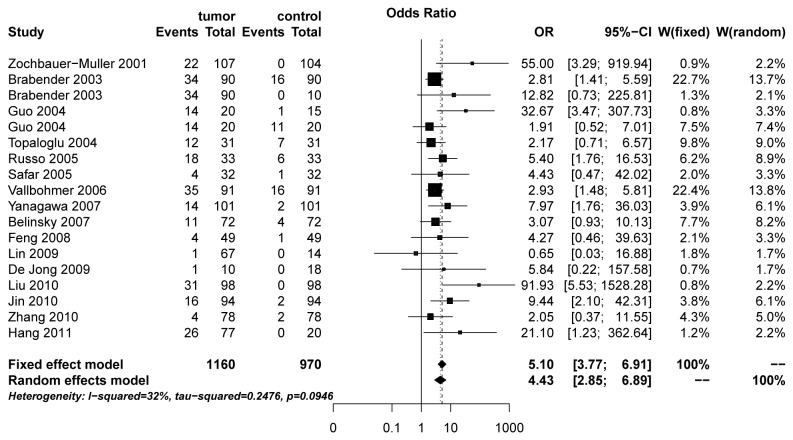
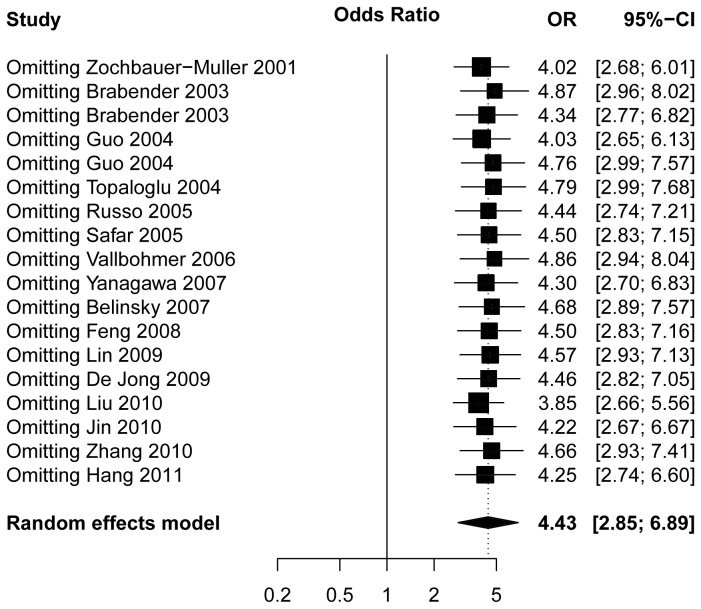
A total of 18 studies from 2001 to 2011, with 1, 160 tumor tissues and 970 controls, were involved in the meta-analysis. The frequencies of MGMT promote methylation ranged from 1.5% to 70.0% (median, 26.1%) in NSCLC tissue and 0.0% to 55.0% (median, 2.4%) in non-cancerous control, respectively. The summary of OR was 4.43 (95% CI: 2.85, 6.89) in the random-effects model. With stratification by potential source of heterogeneity, the OR was 20.45 (95% CI: 5.83, 71.73) in heterogeneous control subgroup, while it was 4.16 (95% CI: 3.02, 5.72) in the autologous control subgroup. The OR was 5.31 (95% CI: 3.00, 9.41) in MSP subgroup and 3.06 (95% CI: 1.75, 5.33) in Q-MSP subgroup.
This meta-analysis identified a strong association between methylation of MGMT gene and NSCLC. Prospective studies should be required to confirm the results in the future.
O(6)-甲基鸟嘌呤-DNA 甲基转移酶(MGMT)是一种最重要的 DNA 修复酶,可抵抗常见的烷化剂和烟草等致癌物质。在非小细胞肺癌(NSCLC)中经常观察到基因启动子的异常甲基化。然而,文献中报道的基因表观遗传失活在 NSCLC 中的重要性存在不一致性。我们使用荟萃分析方法定量评估了 MGMT 启动子甲基化与 NSCLC 之间的关联。
我们系统地检索了 PubMed、EMBASE、Ovid、ISI Web of Science、Elsevier 和中国知网(CNKI)数据库中关于 MGMT 启动子甲基化与 NSCLC 的研究,并使用荟萃分析方法定量评估了 MGMT 启动子甲基化与 NSCLC 之间的关联。使用优势比(OR)和相应的 95%置信区间(CI)来评估关联的强度。通过亚组分析和荟萃回归评估潜在的异质性来源。
共有 2001 年至 2011 年的 18 项研究,涉及 1160 个肿瘤组织和 970 个对照,纳入荟萃分析。在 NSCLC 组织中,MGMT 启动子甲基化的频率范围为 1.5%至 70.0%(中位数为 26.1%),在非癌对照中为 0.0%至 55.0%(中位数为 2.4%)。随机效应模型的汇总 OR 为 4.43(95%CI:2.85,6.89)。根据潜在异质性来源进行分层,在异质性对照亚组中,OR 为 20.45(95%CI:5.83,71.73),而在自身对照亚组中,OR 为 4.16(95%CI:3.02,5.72)。在 MSP 亚组中,OR 为 5.31(95%CI:3.00,9.41),在 Q-MSP 亚组中,OR 为 3.06(95%CI:1.75,5.33)。
本荟萃分析确定了 MGMT 基因甲基化与 NSCLC 之间存在强烈关联。未来需要进行前瞻性研究来证实这些结果。