Department of Urology, Dresden University of Technology, Dresden, Germany.
PLoS One. 2013 Sep 27;8(9):e76386. doi: 10.1371/journal.pone.0076386. eCollection 2013.
Patients with metastatic clear cell renal cell carcinoma (ccRCC) are frequently treated with tyrosine kinase inhibitors (TKI) such as sunitinib. It inhibits angiogenic pathways by mainly targeting the receptors of VEGF and PDGF. In ccRCC, angiogenesis is characterized by the inactivation of the von Hippel-Lindau gene (VHL) which in turn leads to the induction of HIF1α target genes such as CA9 and VEGF. Furthermore, the angiogenic phenotype of ccRCC is also reflected by endothelial markers (CD31, CD34) or other tumor-promoting factors like Ki67 or survivin.
Tissue microarrays from primary tumor specimens of 42 patients with metastatic ccRCC under sunitinib therapy were immunohistochemically stained for selected markers related to angiogenesis. The prognostic and predictive potential of theses markers was assessed on the basis of the objective response rate which was evaluated according to the RECIST criteria after 3, 6, 9 months and after last report (12-54 months) of sunitinib treatment. Additionally, VHL copy number and mutation analyses were performed on DNA from cryo-preserved tumor tissues of 20 ccRCC patients.
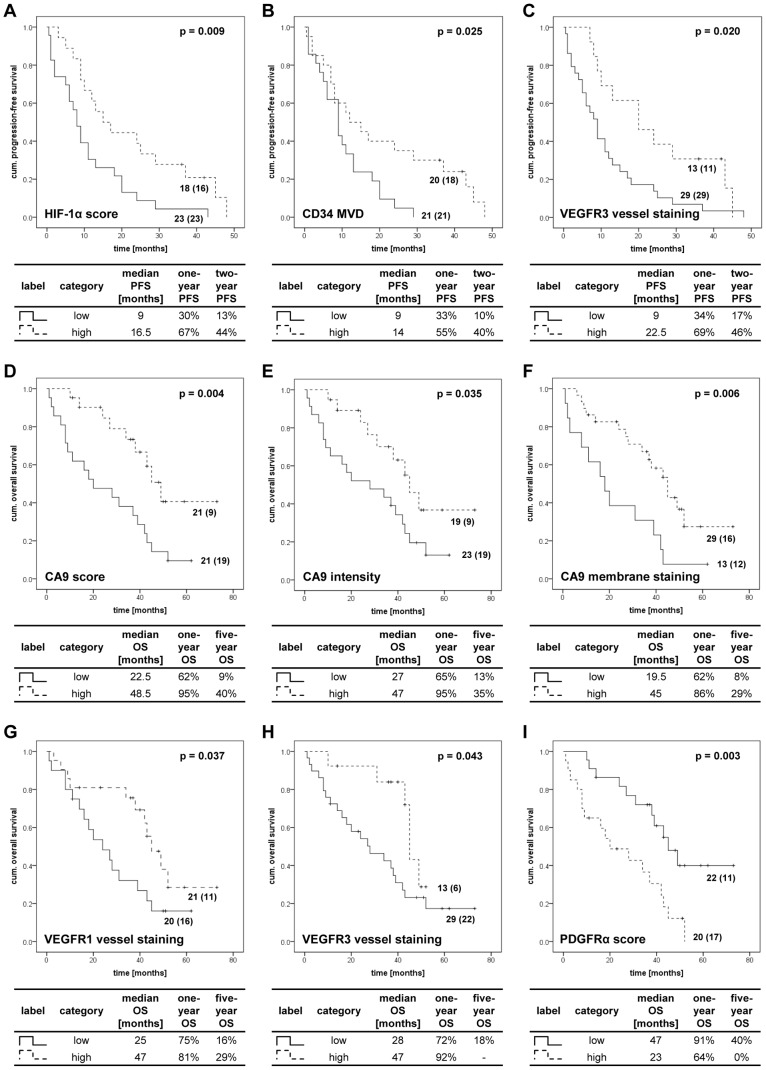
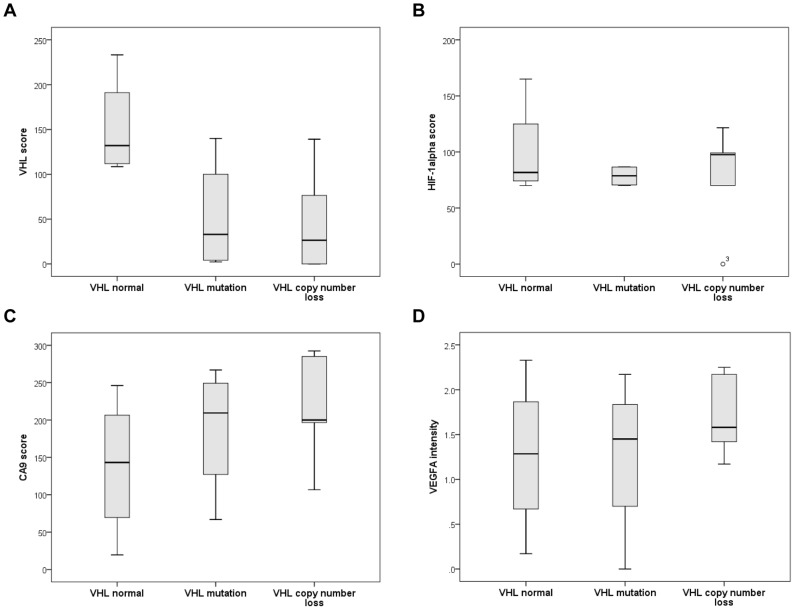
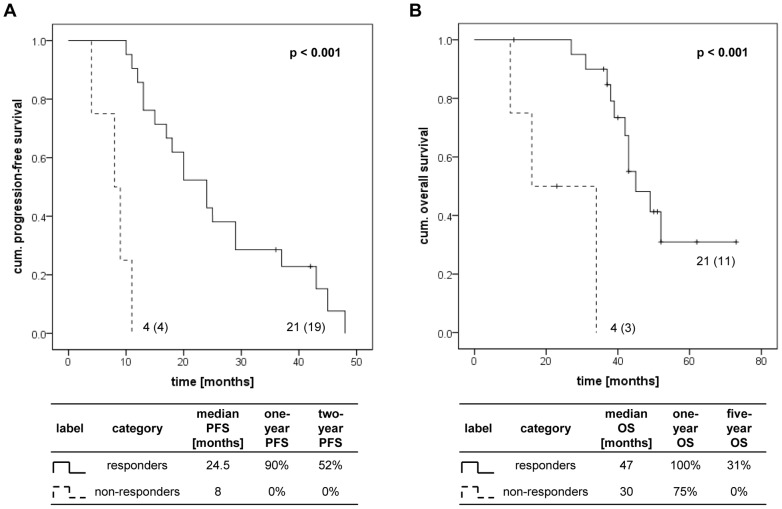
Immunostaining of HIF-1α, CA9, Ki67, CD31, pVEGFR1, VEGFR1 and -2, pPDGFRα and -β was significantly associated with the sunitinib response after 6 and 9 months as well as last report under therapy. Furthermore, HIF-1α, CA9, CD34, VEGFR1 and -3 and PDGRFα showed significant associations with progression-free survival (PFS) and overall survival (OS). In multivariate Cox proportional hazards regression analyses high CA9 membrane staining and a response after 9 months were independent prognostic factors for longer OS. Frequently observed copy number loss and mutation of VHL gene lead to altered expression of VHL, HIF-1α, CA9, and VEGF.
Immunoexpression of HIF-1α, CA9, Ki67, CD31, pVEGFR1, VEGFR1 and -2, pPDGFRα and -β in the primary tumors of metastatic ccRCC patients might support the prediction of a good response to sunitinib treatment.
转移性透明细胞肾细胞癌(ccRCC)患者常接受酪氨酸激酶抑制剂(TKI)治疗,如舒尼替尼。它主要通过靶向 VEGF 和 PDGF 的受体来抑制血管生成途径。在 ccRCC 中,血管生成的特征是 von Hippel-Lindau 基因(VHL)失活,进而导致 HIF1α 靶基因如 CA9 和 VEGF 的诱导。此外,ccRCC 的血管生成表型还反映在内皮标记物(CD31、CD34)或其他促进肿瘤的因子,如 Ki67 或 survivin 上。
对 42 例接受舒尼替尼治疗的转移性 ccRCC 患者的原发肿瘤标本进行组织微阵列分析,并用选定的与血管生成相关的标志物进行免疫组织化学染色。根据 RECIST 标准,在治疗后 3、6、9 个月和最后一次报告(12-54 个月)评估客观缓解率,评估这些标志物的预后和预测潜力。此外,对 20 例 ccRCC 患者冷冻保存肿瘤组织的 DNA 进行 VHL 拷贝数和突变分析。
HIF-1α、CA9、Ki67、CD31、pVEGFR1、VEGFR1 和 -2、pPDGFRα 和 -β 的免疫染色与治疗后 6 个月和 9 个月以及治疗期间的最后报告的舒尼替尼反应显著相关。此外,HIF-1α、CA9、CD34、VEGFR1 和 -3 和 PDGFRFα 与无进展生存期(PFS)和总生存期(OS)显著相关。在多变量 Cox 比例风险回归分析中,高 CA9 膜染色和 9 个月后的反应是 OS 延长的独立预后因素。VHL 基因的频繁观察到的拷贝数缺失和突变导致 VHL、HIF-1α、CA9 和 VEGF 的表达改变。
转移性 ccRCC 患者原发肿瘤中 HIF-1α、CA9、Ki67、CD31、pVEGFR1、VEGFR1 和 -2、pPDGFRα 和 -β 的免疫表达可能支持对舒尼替尼治疗反应的预测。