Prasetyono Theddeus O H, Adianto Senja
Division of Plastic Surgery, Department of Surgery, Faculty of Medicine, University of Indonesia and Cipto Mangunkusumo Hospital, Jakarta, Indonesia.
Arch Plast Surg. 2013 Sep;40(5):505-9. doi: 10.5999/aps.2013.40.5.505. Epub 2013 Sep 13.
The aim of this study was to collect important data on the time of oxygen saturation change in relation to skin flap color alteration using non-invasive pulse oximetry to evaluate its ability to provide continuous monitoring of skin flap perfusion.
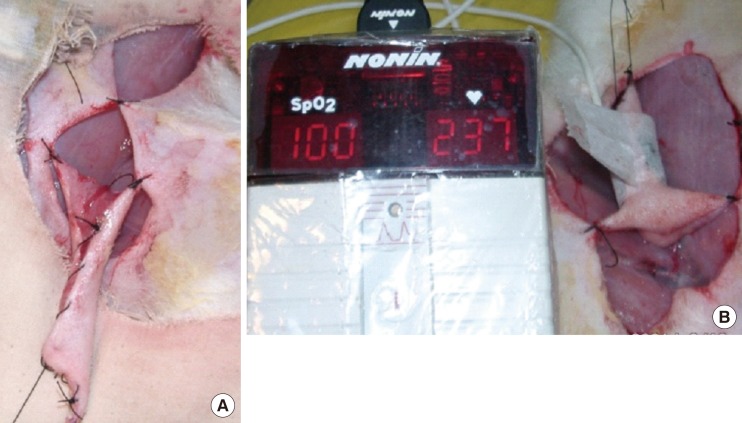
An experimental study on the monitoring of blood perfusion of 20 tube-island groin flaps of 10 male New Zealand rabbits was performed using pulse oximetry. The animals were randomly assigned to one of two groups representing a blockage of either arterial or venous blood flow. The oxygen saturation change and clinical color alteration were monitored from the beginning of vessel clamping until the saturation became undetectable. The result was analyzed by the t-test using SSPS ver. 10.0.
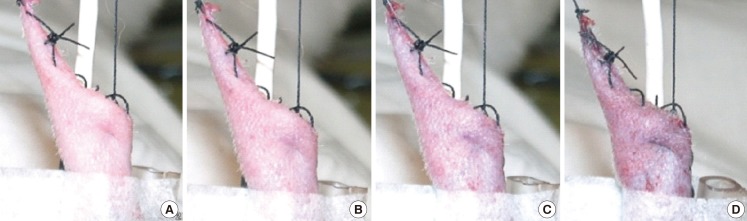
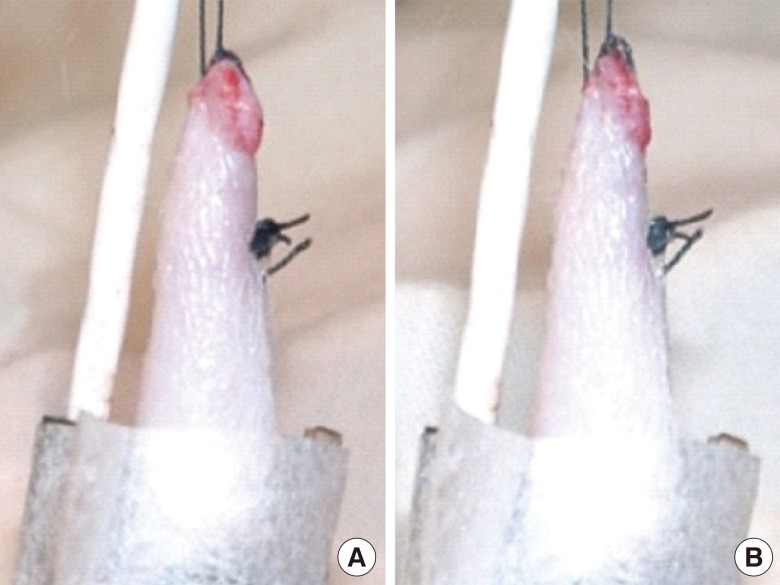
The mean times from the vessel clamping until the saturation became undetectable were 20.19±2.13 seconds and 74.91±10.57 seconds for the artery and vein clamping groups, respectively. The mean time of the clinical alteration from the beginning of vein clamping was 34.5±11.72 minutes, while the alteration in flaps with artery clamping could not be detected until 2.5 hours after clamping.
The use of neonate-type reusable flex sensor-pulse oximetry is objective and effective in early detection of arterial and vein blockage. It provides real-time data on vessel occlusion, which in turn will allow for early salvaging. The detection periods of both arterial occlusion and venous congestion are much earlier than the color alteration one may encounter clinically.
本研究旨在通过无创脉搏血氧饱和度测定法收集有关皮瓣颜色改变时血氧饱和度变化时间的重要数据,以评估其对皮瓣灌注进行连续监测的能力。
对10只雄性新西兰兔的20个管状岛状腹股沟皮瓣的血液灌注进行监测的实验研究采用了脉搏血氧饱和度测定法。将动物随机分为两组,分别代表动脉血流或静脉血流的阻断。从血管夹闭开始直至饱和度无法检测到,监测血氧饱和度变化和临床颜色改变。使用SPSS 10.0版本通过t检验分析结果。
动脉夹闭组和静脉夹闭组从血管夹闭到饱和度无法检测到的平均时间分别为20.19±2.13秒和74.91±10.57秒。从静脉夹闭开始的临床改变平均时间为34.5±11.72分钟,而动脉夹闭皮瓣的改变在夹闭后2.5小时才能够检测到。
使用新生儿型可重复使用的柔性传感器 - 脉搏血氧饱和度测定法在早期检测动脉和静脉阻塞方面客观有效。它提供了关于血管闭塞的实时数据,这反过来将有助于早期挽救。动脉闭塞和静脉充血的检测期比临床上可能遇到的颜色改变要早得多。