Laboratoire Pathogenèse des Bactéries Anaérobies, Institut Pasteur, Paris, France ; Université Paris Diderot, Sorbonne Paris Cité, Cellule Pasteur, Paris, France.
PLoS Genet. 2013;9(10):e1003756. doi: 10.1371/journal.pgen.1003756. Epub 2013 Oct 3.
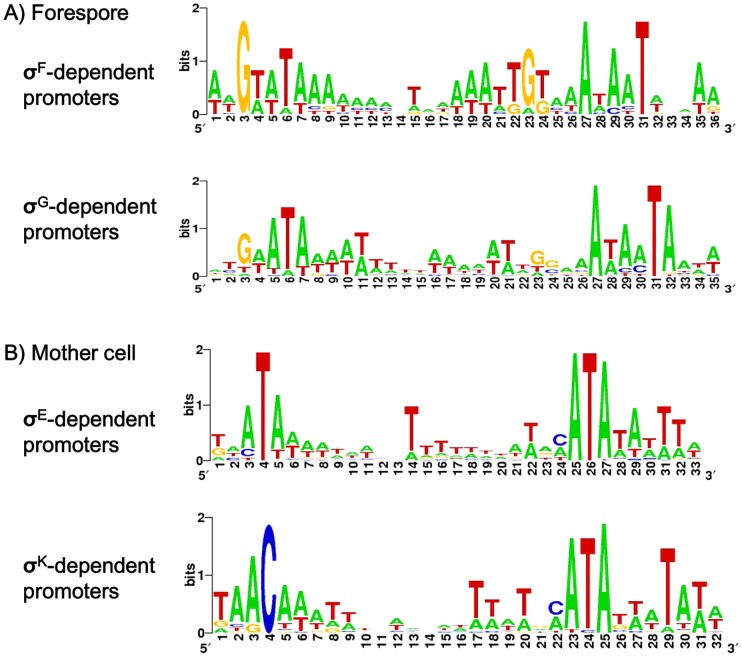
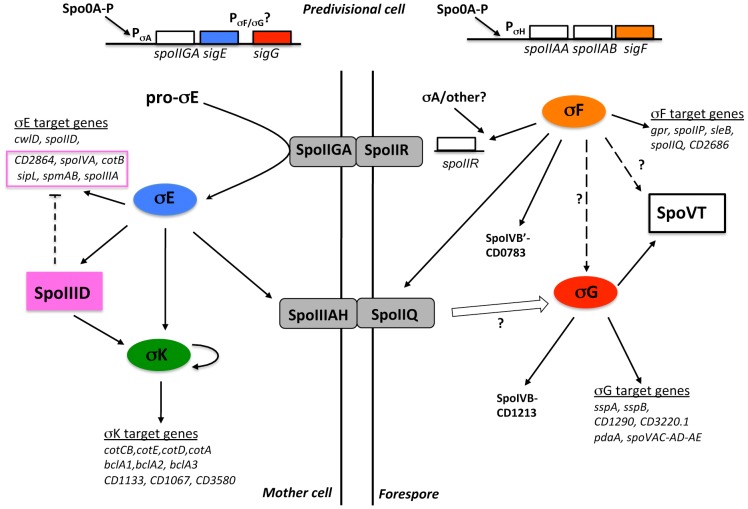
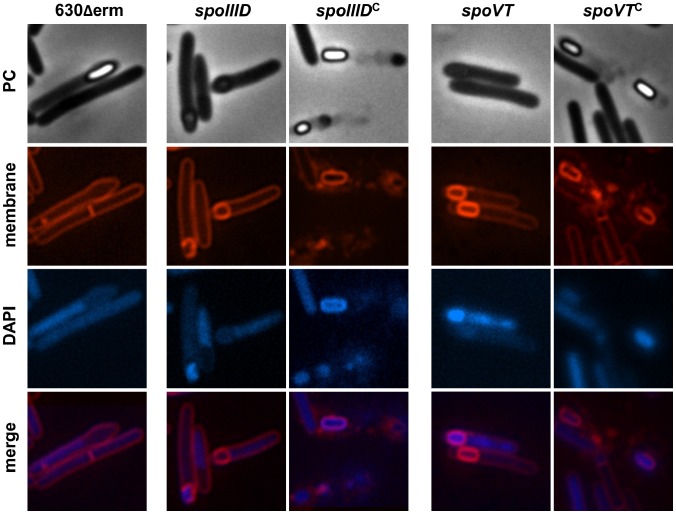
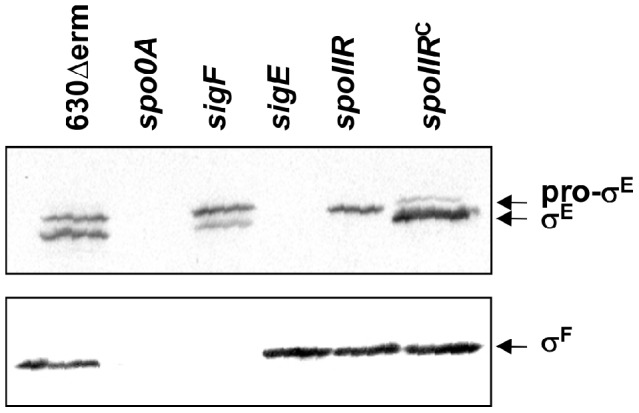
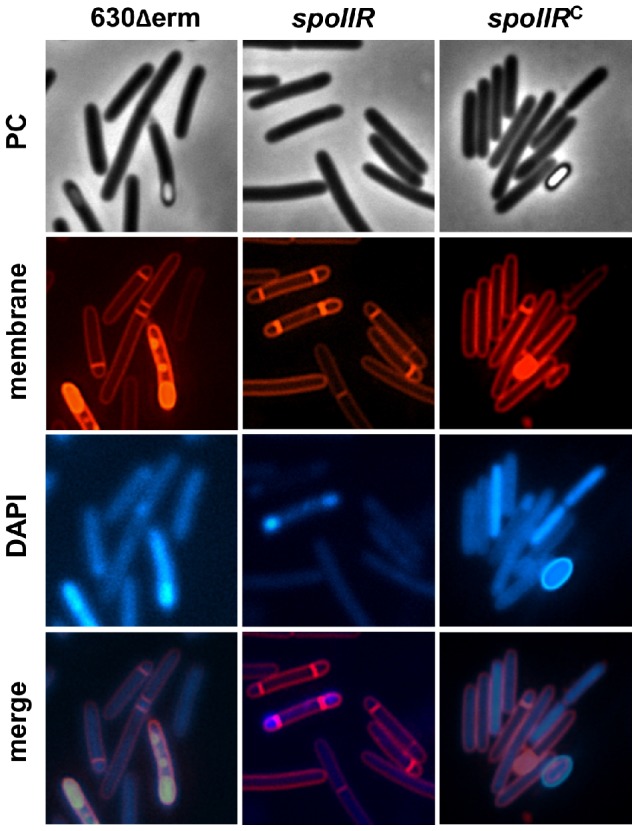
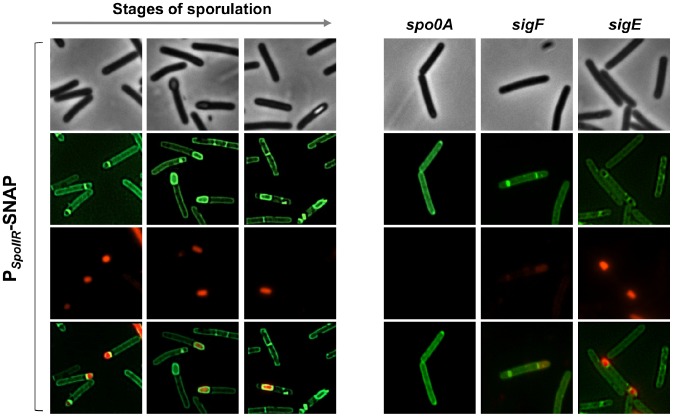
Clostridium difficile, a Gram positive, anaerobic, spore-forming bacterium is an emergent pathogen and the most common cause of nosocomial diarrhea. Although transmission of C. difficile is mediated by contamination of the gut by spores, the regulatory cascade controlling spore formation remains poorly characterized. During Bacillus subtilis sporulation, a cascade of four sigma factors, σ(F) and σ(G) in the forespore and σ(E) and σ(K) in the mother cell governs compartment-specific gene expression. In this work, we combined genome wide transcriptional analyses and promoter mapping to define the C. difficile σ(F), σ(E), σ(G) and σ(K) regulons. We identified about 225 genes under the control of these sigma factors: 25 in the σ(F) regulon, 97 σ(E)-dependent genes, 50 σ(G)-governed genes and 56 genes under σ(K) control. A significant fraction of genes in each regulon is of unknown function but new candidates for spore coat proteins could be proposed as being synthesized under σ(E) or σ(K) control and detected in a previously published spore proteome. SpoIIID of C. difficile also plays a pivotal role in the mother cell line of expression repressing the transcription of many members of the σ(E) regulon and activating sigK expression. Global analysis of developmental gene expression under the control of these sigma factors revealed deviations from the B. subtilis model regarding the communication between mother cell and forespore in C. difficile. We showed that the expression of the σ(E) regulon in the mother cell was not strictly under the control of σ(F) despite the fact that the forespore product SpoIIR was required for the processing of pro-σ(E). In addition, the σ(K) regulon was not controlled by σ(G) in C. difficile in agreement with the lack of pro-σ(K) processing. This work is one key step to obtain new insights about the diversity and evolution of the sporulation process among Firmicutes.
艰难梭菌是一种革兰氏阳性、厌氧、产芽孢的细菌,是一种新兴的病原体,也是医院获得性腹泻的最常见原因。虽然艰难梭菌通过芽孢污染肠道传播,但控制芽孢形成的调节级联仍知之甚少。在枯草芽孢杆菌孢子形成过程中,四个σ因子( forespore 中的σ(F)和σ(G)以及母细胞中的σ(E)和σ(K))的级联控制着特定隔间的基因表达。在这项工作中,我们结合了全基因组转录分析和启动子作图,定义了艰难梭菌的σ(F)、σ(E)、σ(G)和σ(K)调控子。我们确定了大约 225 个基因受这些σ因子的控制:σ(F)调控子中有 25 个基因,σ(E)依赖性基因有 97 个,σ(G)调控子中有 50 个基因,σ(K)调控子中有 56 个基因。每个调控子中有相当一部分基因的功能未知,但可以提出作为σ(E)或σ(K)控制下合成并在以前发表的孢子蛋白质组中检测到的新孢子外壳蛋白候选物。艰难梭菌的 SpoIID 也在母细胞系的表达中起着关键作用,它抑制许多σ(E)调控子成员的转录,并激活 sigK 的表达。受这些σ因子控制的发育基因表达的全局分析显示,在艰难梭菌中,母细胞和前孢子之间的通信与枯草芽孢杆菌模型存在偏差。我们表明,尽管前孢子产物 SpoIIR 是前体-σ(E)加工所必需的,但σ(E)调控子在母细胞中的表达并不严格受σ(F)控制。此外,在艰难梭菌中,σ(K)调控子不受σ(G)控制,这与缺乏前体-σ(K)加工一致。这项工作是获得关于厚壁菌门孢子形成过程多样性和进化的新见解的关键步骤之一。