Berlin-Brandenburg Center for Regenerative Therapies (BCRT), Charité - Universitätsmedizin Berlin, Berlin, Germany ; Berlin-Brandenburg School for Regenerative Therapies (BSRT), Charité - Universitätsmedizin Berlin, Berlin, Germany.
PLoS Genet. 2013;9(10):e1003846. doi: 10.1371/journal.pgen.1003846. Epub 2013 Oct 3.
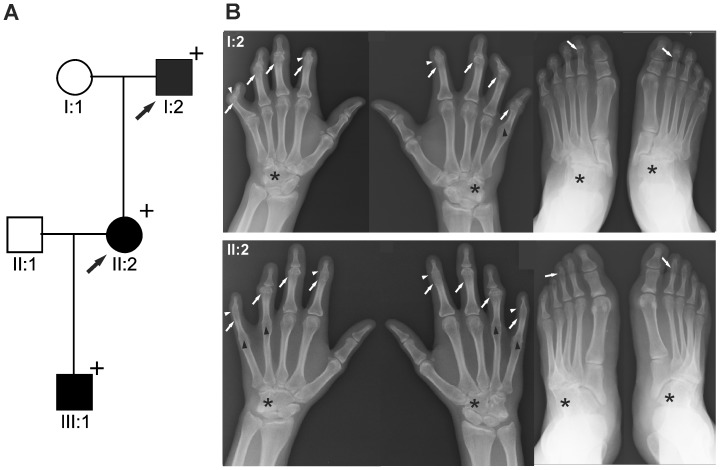
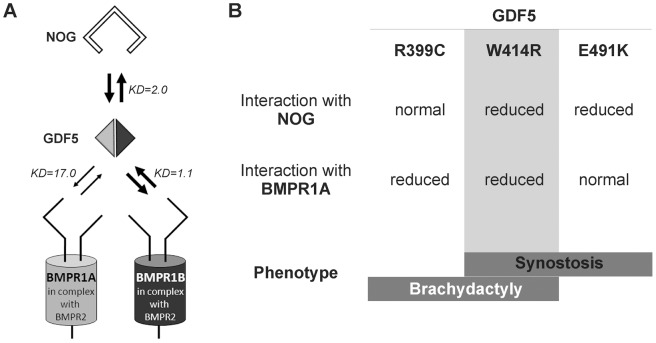
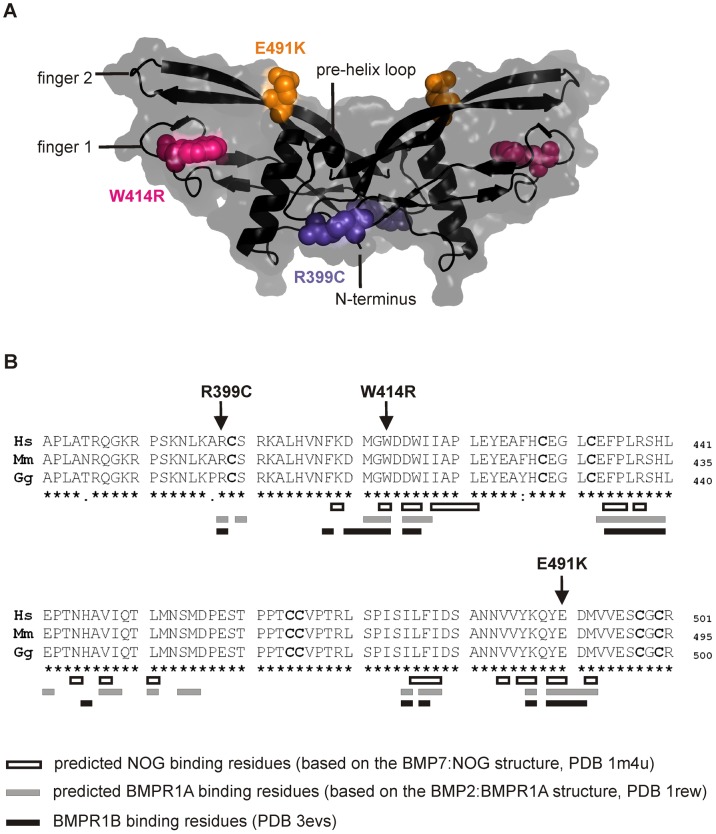
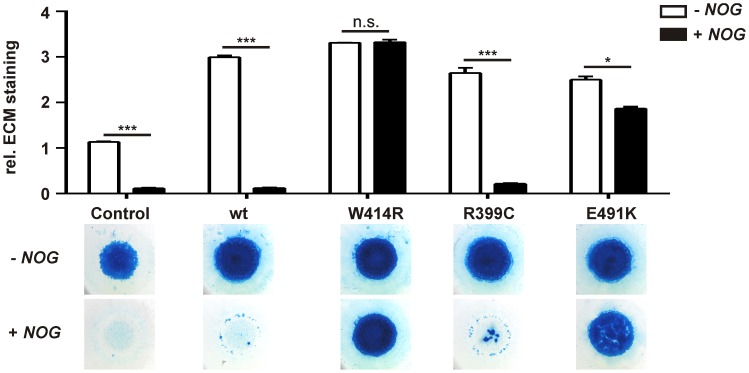
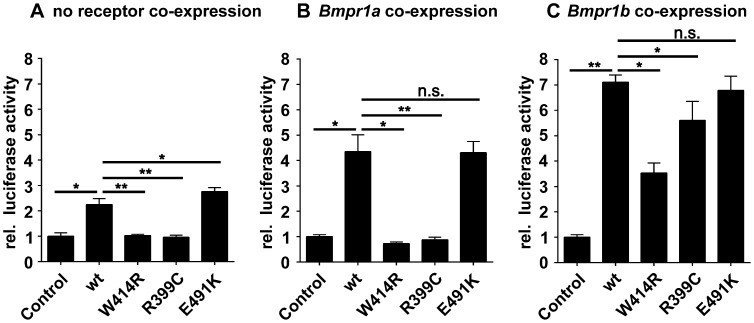
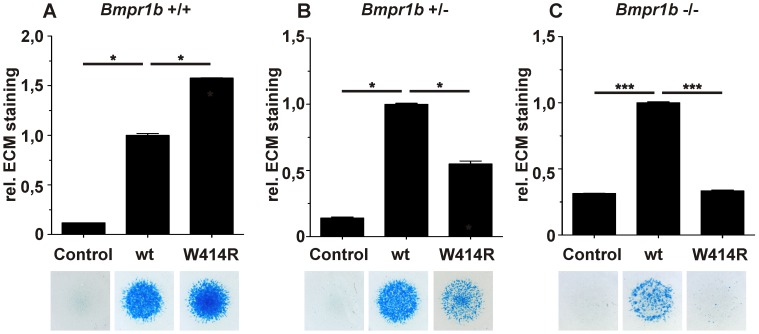
Growth and Differentiation Factor 5 (GDF5) is a secreted growth factor that belongs to the Bone Morphogenetic Protein (BMP) family and plays a pivotal role during limb development. GDF5 is a susceptibility gene for osteoarthritis (OA) and mutations in GDF5 are associated with a wide variety of skeletal malformations ranging from complex syndromes such as acromesomelic chondrodysplasias to isolated forms of brachydactylies or multiple synostoses syndrome 2 (SYNS2). Here, we report on a family with an autosomal dominant inherited combination of SYNS2 and additional brachydactyly type A1 (BDA1) caused by a single point mutation in GDF5 (p.W414R). Functional studies, including chondrogenesis assays with primary mesenchymal cells, luciferase reporter gene assays and Surface Plasmon Resonance analysis, of the GDF5(W414R) variant in comparison to other GDF5 mutations associated with isolated BDA1 (p.R399C) or SYNS2 (p.E491K) revealed a dual pathomechanism characterized by a gain- and loss-of-function at the same time. On the one hand insensitivity to the main GDF5 antagonist NOGGIN (NOG) leads to a GDF5 gain of function and subsequent SYNS2 phenotype. Whereas on the other hand, a reduced signaling activity, specifically via the BMP receptor type IA (BMPR1A), is likely responsible for the BDA1 phenotype. These results demonstrate that one mutation in the overlapping interface of antagonist and receptor binding site in GDF5 can lead to a GDF5 variant with pathophysiological relevance for both, BDA1 and SYNS2 development. Consequently, our study assembles another part of the molecular puzzle of how loss and gain of function mutations in GDF5 affect bone development in hands and feet resulting in specific types of brachydactyly and SYNS2. These novel insights into the biology of GDF5 might also provide further clues on the pathophysiology of OA.
生长分化因子 5(GDF5)是一种分泌型生长因子,属于骨形态发生蛋白(BMP)家族,在肢体发育过程中发挥关键作用。GDF5 是骨关节炎(OA)的易感基因,GDF5 突变与各种骨骼畸形有关,从复杂的综合征,如肢端骨软骨发育不良,到孤立的短指畸形或多发性颅缝早闭综合征 2(SYNS2)。在这里,我们报告了一个家族,该家族存在常染色体显性遗传的 SYNS2 和附加的 A1 型短指畸形(BDA1),由 GDF5 中的单个点突变(p.W414R)引起。包括原代间充质细胞的软骨生成测定、荧光素酶报告基因测定和表面等离子体共振分析在内的 GDF5(W414R)变异与其他与孤立性 BDA1(p.R399C)或 SYNS2(p.E491K)相关的 GDF5 突变的功能研究表明,存在一种双重发病机制,同时表现为获得功能和丧失功能。一方面,对主要 GDF5 拮抗剂 NOGGIN(NOG)的不敏感性导致 GDF5 获得功能,随后出现 SYNS2 表型。另一方面,信号转导活性降低,特别是通过 BMP 受体 IA 型(BMPR1A),可能是导致 BDA1 表型的原因。这些结果表明,GDF5 中拮抗剂和受体结合位点重叠界面的一个突变可导致 GDF5 变体具有与 BDA1 和 SYNS2 发育相关的病理生理学意义。因此,我们的研究为 GDF5 中缺失和获得功能突变如何影响手足骨骼发育从而导致特定类型的短指畸形和 SYNS2 提供了另一个分子拼图。这些关于 GDF5 生物学的新见解也可能为 OA 的病理生理学提供更多线索。