Health Outcomes Practice, Kantar Health, Princeton, NJ, USA.
Health Qual Life Outcomes. 2013 Oct 8;11:167. doi: 10.1186/1477-7525-11-167.
The availability of the tyrosine-kinase inhibitor (TKI), imatinib, and later introduction of second generation TKIs, dasatinib and nilotinib, have not only improved clinical outcomes of patients with chronic myeloid leukemia (CML), but also provide multiple therapeutic options for CML patients. Despite the widespread use of these oral therapies, little is known about the impact of different treatment regimens on patient-reported outcomes (PROs) among CML patients. The objective of this study was to assess the impact of patient-reported treatment restrictions and negative medication experiences (NMEs) on satisfaction and other health outcomes among patients with CML treated with oral TKIs.
Participants recruited from survey panels and patient networks in the United States (US) and Europe completed an online questionnaire. Respondents included adults (≥ 18 years) with chronic-phase CML currently on TKI treatment. Study variables included treatment difficulty (i.e., difficulty in following treatment regimens), CML dietary/dosing requirements, NMEs, and validated PROs assessing treatment satisfaction, health-related quality of life (HRQoL), activity impairment, and non-adherence. Structural equation models assessed associations among variables, controlling for covariates.
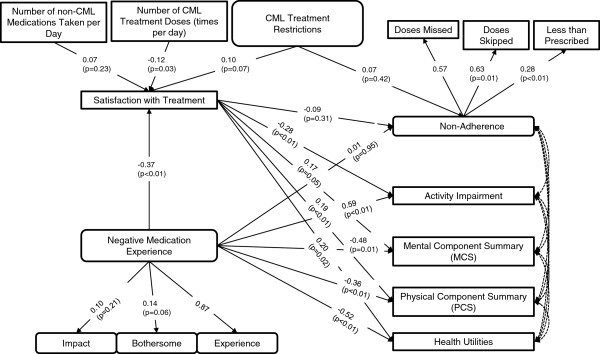
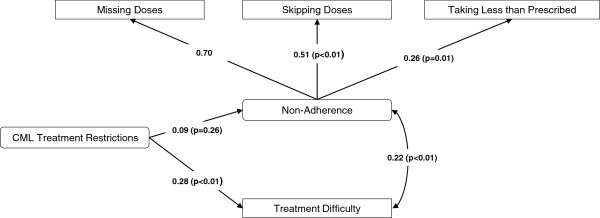
303 patients with CML (US n=152; Europe n=151; mean age 51.5 years; 46.2% male) completed the questionnaire. Approximately 30% of patients reported treatment difficulties; treatment difficulty was higher among nilotinib (63.3%) than among dasatinib (2.6%) or imatinib (19.2%) treated patients (p<0.0001). Non-adherence was generally low; however, patients on nilotinib vs. imatinib reported missing doses more often (p<0.05). Treatment satisfaction was associated with significantly increased HRQoL (p<0.05) and lower activity impairment (p<0.01). NMEs were associated with decreased treatment satisfaction (p<0.01) and HRQoL (p<0.05), and greater activity impairment (p<0.01). Higher overall treatment restrictions were associated with greater treatment difficulty (p<0.001), which correlated with non-adherence (p<0.01).
Treatment satisfaction and NMEs are important factors associated with HRQoL among patients with CML. Increased treatment restrictions and associated difficulty may affect adherence with TKIs. Choosing a CML treatment regimen that is simple and conveniently adaptable in patients' normal routine can be an important determinant of HRQoL and adherence.
酪氨酸激酶抑制剂(TKI)伊马替尼的出现,以及随后第二代 TKI 达沙替尼和尼洛替尼的引入,不仅改善了慢性髓系白血病(CML)患者的临床结局,而且为 CML 患者提供了多种治疗选择。尽管这些口服疗法得到了广泛应用,但对于不同治疗方案对 CML 患者报告的治疗结局(PROs)的影响知之甚少。本研究的目的是评估患者报告的治疗限制和药物不良体验(NMEs)对接受口服 TKI 治疗的 CML 患者的满意度和其他健康结局的影响。
本研究从美国(US)和欧洲的调查小组和患者网络招募参与者,参与者完成了在线问卷。受访者包括目前正在接受 TKI 治疗的慢性期 CML 成年患者(≥18 岁)。研究变量包括治疗难度(即遵循治疗方案的难度)、CML 饮食/剂量要求、NMEs 和评估治疗满意度、健康相关生活质量(HRQoL)、活动能力受损和不依从的验证性 PROs。结构方程模型评估了变量之间的关联,同时控制了协变量。
303 名 CML 患者(美国 n=152;欧洲 n=151;平均年龄 51.5 岁;46.2%为男性)完成了问卷。约 30%的患者报告治疗困难;与达沙替尼(2.6%)或伊马替尼(19.2%)相比,尼洛替尼(63.3%)治疗的患者治疗难度更高(p<0.0001)。不依从通常较低;然而,与伊马替尼相比,服用尼洛替尼的患者漏服的频率更高(p<0.05)。治疗满意度与显著增加的 HRQoL(p<0.05)和较低的活动能力受损(p<0.01)相关。NMEs 与治疗满意度降低(p<0.01)和 HRQoL 降低(p<0.05)以及活动能力受损增加(p<0.01)相关。较高的整体治疗限制与治疗难度增加相关(p<0.001),这与不依从相关(p<0.01)。
治疗满意度和 NMEs 是 CML 患者 HRQoL 的重要影响因素。增加的治疗限制和相关的难度可能会影响 TKI 的依从性。选择一种简单且方便适应患者日常生活的 CML 治疗方案,可能是 HRQoL 和依从性的重要决定因素。