
(2E)-3-(6-氯-2-甲氧基喹啉-3-基)-1-(2,4-二甲基喹啉-3-基)丙-2-烯-1-酮
(2E)-3-(6-Chloro-2-meth-oxy-quinolin-3-yl)-1-(2,4-di-methyl-quinolin-3-yl)prop-2-en-1-one.
作者信息
Prasath R, Sarveswari S, Ng Seik Weng, Tiekink Edward R T
机构信息
Department of Chemistry, BITS, Pilani - K. K. Birla Goa Campus, Goa 403 726, India.
出版信息
Acta Crystallogr Sect E Struct Rep Online. 2013 Jul 20;69(Pt 8):o1274. doi: 10.1107/S1600536813019399. eCollection 2013.
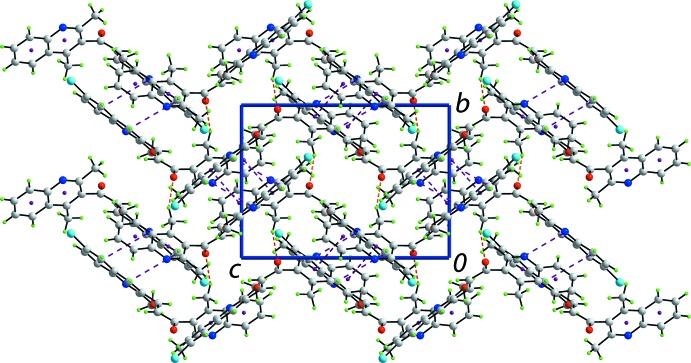
The mol-ecule of the title compound, C24H19ClN2O2, is bent, with the dihedral angle between the terminal quinoline ring systems being 63.30 (5)°. The quinolinyl residues are connected by an almost planar prop-2-en-1-one bridge (r.m.s. deviation = 0.022 Å), with the dihedral angles between this plane and the appended quinolinyl residues being 75.86 (7) and 38.54 (7)°. The C atom of the meth-oxy group is close to coplanar with its attached ring [deviation = 0.116 (2) Å]. In the crystal, a three-dimensional architecture is constructed by meth-yl-carbonyl C-H⋯O inter-actions and π-π inter-actions between centrosymmetrically related quinolinyl residues [centroid-to-centroid separations 3.5341 (10) and 3.8719 (9) Å].
标题化合物C₂₄H₁₉ClN₂O₂的分子呈弯曲状,末端喹啉环系统之间的二面角为63.30 (5)°。喹啉基残基通过一个几乎平面的丙-2-烯-1-酮桥相连(均方根偏差 = 0.022 Å),该平面与相连的喹啉基残基之间的二面角分别为75.86 (7)°和38.54 (7)°。甲氧基的C原子与其相连的环接近共平面[偏差 = 0.116 (2) Å]。在晶体中,通过甲基羰基C—H⋯O相互作用以及中心对称相关的喹啉基残基之间的π-π相互作用构建了三维结构[质心到质心间距为3.5341 (10) 和3.8719 (9) Å]。

 Zotero 插件