Department of Biology, Augustana College , Rock Island, IL , USA.
PeerJ. 2013 Sep 17;1:e169. doi: 10.7717/peerj.169. eCollection 2013.
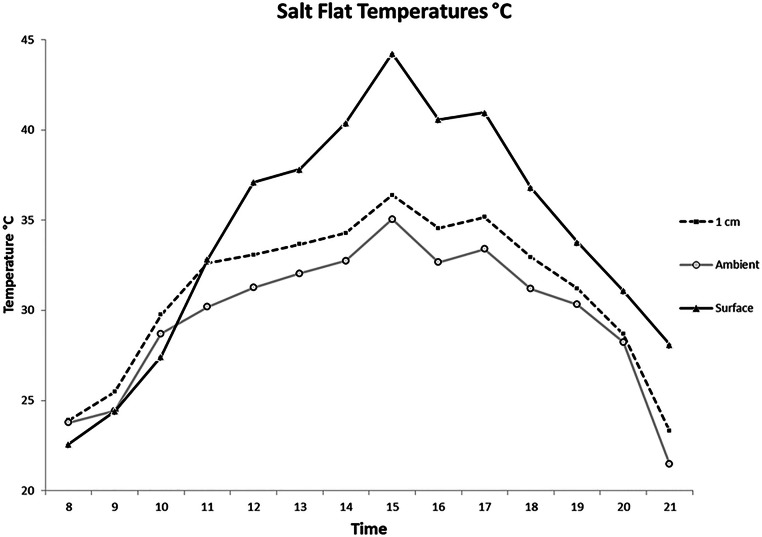
How behavioral patterns are related to niche partitioning is an important question in understanding how closely related species within ecological communities function. Behavioral niche partitioning associated with thermoregulation is well documented in tiger beetles as a group. Co-occurring species of salt flat tiger beetles have adapted many thermoregulatory behaviors to cope with this harsh ecosystem. On first examination these beetles appear to occur in overlapping microhabitats and therefore compete for resources. To determine if behavioral niche partitioning is allowing multiple species to occur within the same harsh salt flat ecosystem we observed Cicindela nevadica lincolniana, Cicindela circumpicta, Cicindela fulgida, and Cicindela togata between 8:00 h and 21:00 h and recorded all behaviors related to thermoregulation using a digital voice recorder. Results of this study strongly indicate that competition among these species for resources has been reduced by the adaptation of different thermoregulatory behaviors such as spending time in shallow water, avoiding the sun during the hottest parts of the day, and by positioning their body against or away from the soil. The endangered C. n. lincolniana appears to rely most heavily on the shallow water of seeps for their diurnal foraging behavior (potentially limiting their foraging habitat), but with the advantage of allowing foraging during the hottest times of the day when potential competitors are less frequent. Ironically, this association also may help explain C. n. lincolniana's susceptibility to extinction: beyond the loss of saline wetlands generally, limited seeps and pools even within remaining saline habitat may represent a further habitat limitation within an already limited habitat.
行为模式与生态位分化的关系是理解生态群落中密切相关的物种如何发挥作用的一个重要问题。在虎甲虫这一类群中,与体温调节相关的生态位分化行为已有充分的记载。在盐沼地区,共生的虎甲虫物种已经适应了许多体温调节行为,以应对这种恶劣的生态系统。乍一看,这些甲虫似乎出现在重叠的微生境中,因此会争夺资源。为了确定行为生态位分化是否允许多个物种在同一个恶劣的盐沼生态系统中共存,我们观察了 Cicindela nevadica lincolniana、Cicindela circumpicta、Cicindela fulgida 和 Cicindela togata 在 8:00 到 21:00 之间的活动,并使用数字语音记录器记录了所有与体温调节相关的行为。这项研究的结果强烈表明,这些物种之间为争夺资源而进行的竞争已经通过适应不同的体温调节行为而减少,例如在浅水中度过时间、在一天中最热的时候避开太阳,以及将身体与土壤保持或远离。濒临灭绝的 C. n. lincolniana 似乎最依赖于泉水中的浅水来进行白天的觅食行为(可能限制了它们的觅食栖息地),但优势在于可以在一天中最热的时候觅食,而潜在的竞争者则较少。具有讽刺意味的是,这种关联也可能有助于解释 C. n. lincolniana 容易灭绝的原因:除了一般的盐沼湿地丧失之外,即使在剩余的盐生栖息地内,有限的泉眼和水池也可能代表着已经有限的栖息地内的进一步栖息地限制。