Laboratory of Molecular Endocrinology, Centro de Investigación Príncipe Felipe, Valencia, Spain.
PLoS One. 2013 Oct 7;8(10):e76761. doi: 10.1371/journal.pone.0076761. eCollection 2013.
Neuroblastma cell lines contain a side-population of cells which express stemness markers. These stem-like cells may represent the potential underlying mechanism for resistance to conventional therapy and recurrence of neuroblastoma in patients.
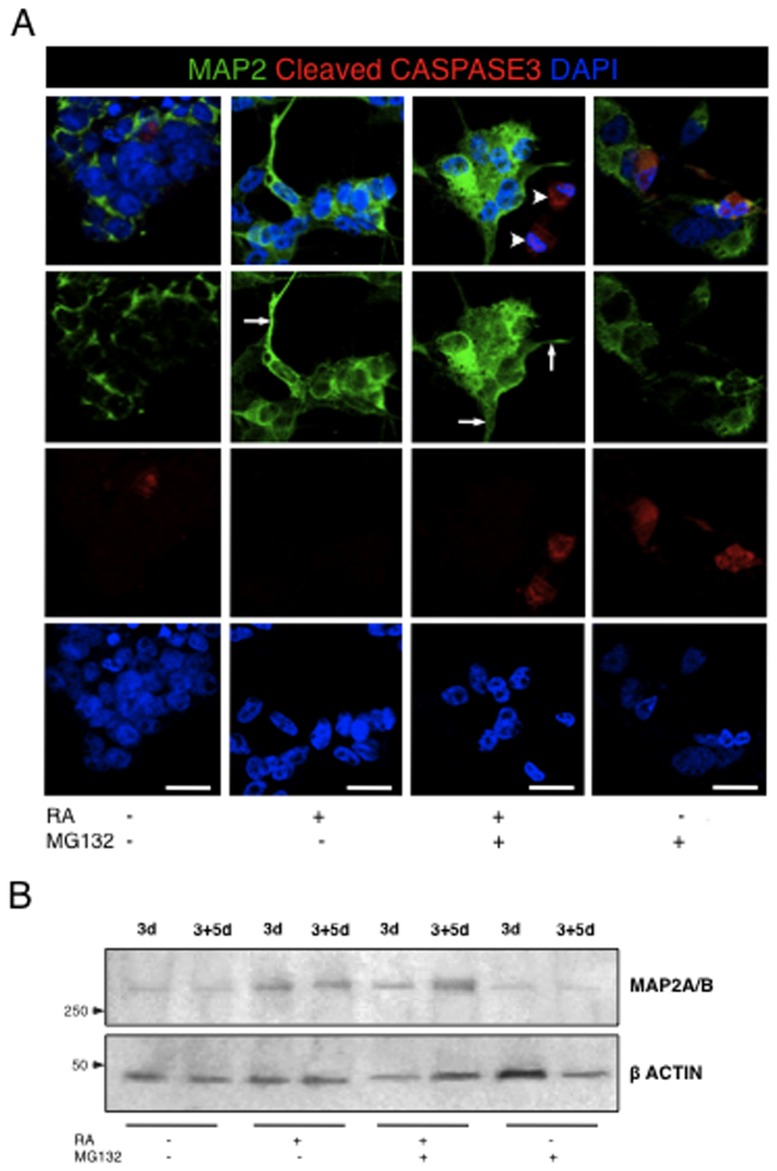
METHODOLOGY/PRINCIPAL FINDINGS: To develop novel strategies for targeting the side-population of neurobastomas, we analyzed the effects of 13-cis-retinoic acid (RA) combined with the proteasome inhibitor MG132. The short-term action of the treatment was compared with effects after a 5-day recovery period during which both chemicals were withdrawn. RA induced growth arrest and differentiation of SH-SY5Y and SK-N-BE(2) neuroblastoma cell lines. Inhibition of the proteasome caused apoptosis in both cell lines, thus, revealing the critical role of this pathway in the regulated degradation of proteins involved in neuroblastoma proliferation and survival. The combination of RA with MG132 induced apoptosis in a dose-dependent manner, in addition to promoting G2/M arrest in treated cultures. Interestingly, expression of stem cell markers such as Nestin, Sox2, and Oct4 were reduced after the recovery period of combined treatment as compared with untreated cells or treated cells with either compound alone. Consistent with this, neurosphere formation was significantly impaired by the combined treatment of RA and MG132.
Given that stem-like cells are associated with resistant to conventional therapy and are thought to be responsible for relapse, our results suggest that dual therapy of RA and proteasome inhibitor might be beneficial for targeting the side-population of cells associated residual disease in high-risk neuroblastoma.
神经母细胞瘤细胞系中存在表达干细胞标志物的侧群细胞。这些类干细胞可能代表了对常规治疗耐药和患者神经母细胞瘤复发的潜在潜在机制。
方法/主要发现:为了开发针对神经母细胞瘤侧群的新策略,我们分析了 13-顺式视黄酸(RA)与蛋白酶体抑制剂 MG132 联合使用的效果。比较了治疗的短期作用与 5 天恢复期后的作用,在此期间两种化学物质均被撤回。RA 诱导 SH-SY5Y 和 SK-N-BE(2)神经母细胞瘤细胞系的生长停滞和分化。蛋白酶体的抑制导致这两个细胞系凋亡,从而揭示了该途径在调控参与神经母细胞瘤增殖和存活的蛋白质降解中的关键作用。RA 与 MG132 的联合诱导剂量依赖性凋亡,此外还促进了处理培养物中的 G2/M 期阻滞。有趣的是,与未处理的细胞或单独用任一化合物处理的细胞相比,联合处理后的恢复期表达干细胞标志物,如 Nestin、Sox2 和 Oct4 的表达减少。与此一致的是,神经球形成明显被 RA 和 MG132 的联合治疗所损害。
鉴于类干细胞与对常规治疗耐药有关,并且被认为是导致复发的原因,我们的结果表明,RA 和蛋白酶体抑制剂的双重治疗可能有益于针对高危神经母细胞瘤中与残留疾病相关的细胞侧群。