Department of Clinical Oncology, Cairo University, Cairo, Egypt.
Cancer Manag Res. 2013 Oct 8;5:349-56. doi: 10.2147/CMAR.S52147. eCollection 2013.
In view of the documented toxicity of continuous daily radiosensitizer doses of temozolomide concomitant with radiation in the treatment of glioblastoma multiforme, we aimed to compare it with a different schedule of abbreviated radiosensitizer dosing.
This was a randomized prospective study comparing toxicity and survival in 60 Egyptian patients with glioblastoma multiforme. Patients in arm I received temozolomide at a dose of 75 mg/m(2) daily with radiotherapy for 42 days, starting 4 weeks after surgery and reaching to a total radiation dose of 60 Gy/30 Fractions/6 weeks, while patients in arm II received temozolomide at a dose of 75 mg/m(2) concomitantly with the same radiotherapy schedule daily in the first and last weeks of the same radiotherapy program.
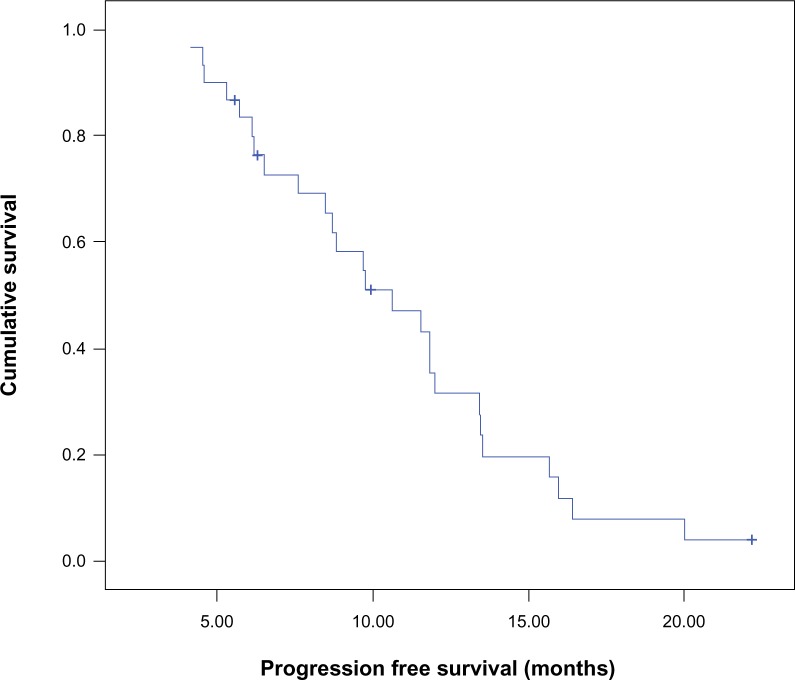
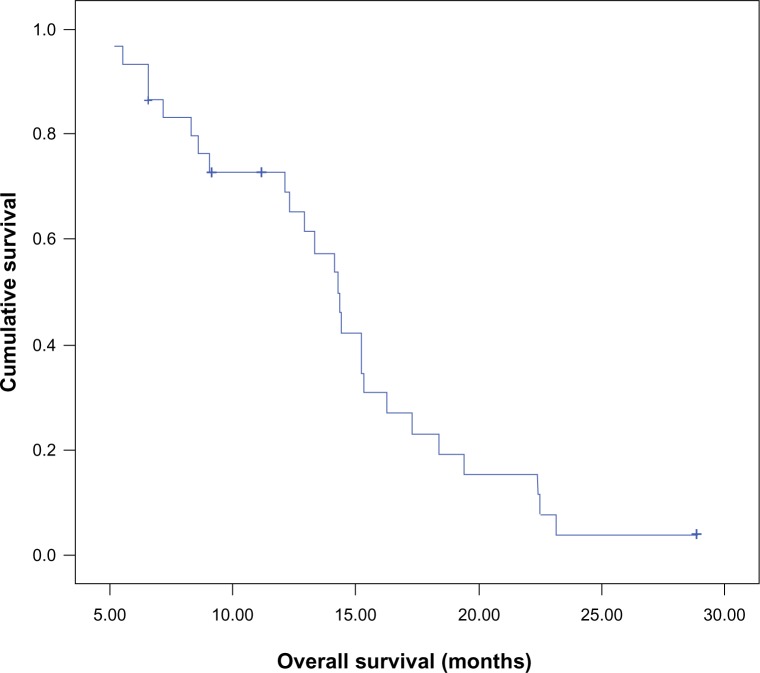
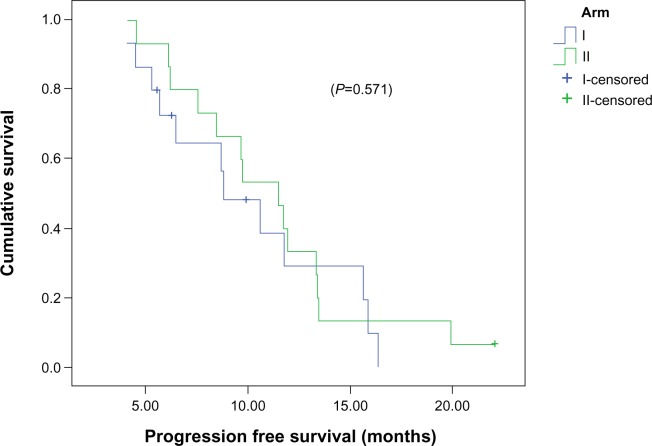
Common grade 1-2 adverse events were malaise in 28 patients (46.7%), followed by alopecia (40%) and nausea (26.7%). Grade 3-4 convulsion and decreased level of consciousness was seen in only four patients who were all from arm I. The median progression-free survival (PFS) for the entire study population was 10.6 months (95% confidence interval [CI] 7.3-14), and PFS at 12 months was 32%. The median PFS in arm I was 8.8 months (95% CI 5.9-11.7) and in arm II 11.5 months (95% CI 8.9-14.2), and PFS at 12 months for both arms was 32% and 30% respectively (P=0.571). The median overall survival (OS) of the whole group of patients was 14.2 months (95% CI 13-15.5), and OS was 70% at 12 months and 25% at 18 months. The median OS for patients in arm I was 12.3 months (95% CI 7.7-16.9), whereas in arm II it was 14.3 months (95% CI 14-14.7) (P=0.83).
Reduced radiosensitizer dosing of temozolomide concomitant with radiotherapy in glioblastoma multiforme exhibited comparable efficacy with a classic continuous daily schedule, though with better tolerability.
鉴于替莫唑胺连续每日放射增敏剂量与胶质母细胞瘤多形性放射治疗的毒性作用已有记载,我们旨在比较不同的短程放射增敏剂量方案。
这是一项在 60 例埃及胶质母细胞瘤多形性患者中比较毒性和生存的随机前瞻性研究。第 I 组患者在手术后 4 周开始接受 75mg/m2 剂量的替莫唑胺,每日一次,同时接受 42 天的放射治疗,达到 60Gy/30 分次/6 周的总放射剂量,而第 II 组患者在同一放射治疗方案的第一周和最后一周每日同时接受 75mg/m2 的替莫唑胺。
常见的 1-2 级不良事件是 28 例患者(46.7%)出现不适,其次是脱发(40%)和恶心(26.7%)。仅 4 例患者出现 3-4 级癫痫发作和意识水平下降,他们均来自第 I 组。整个研究人群的中位无进展生存期(PFS)为 10.6 个月(95%置信区间[CI]7.3-14),12 个月时的 PFS 为 32%。第 I 组的中位 PFS 为 8.8 个月(95%CI5.9-11.7),第 II 组为 11.5 个月(95%CI8.9-14.2),两组 12 个月时的 PFS 分别为 32%和 30%(P=0.571)。整个患者组的中位总生存期(OS)为 14.2 个月(95%CI13-15.5),12 个月时的 OS 为 70%,18 个月时的 OS 为 25%。第 I 组患者的中位 OS 为 12.3 个月(95%CI7.7-16.9),而第 II 组为 14.3 个月(95%CI14-14.7)(P=0.83)。
胶质母细胞瘤多形性中替莫唑胺放射增敏剂量的减少与经典的连续每日方案相比具有相当的疗效,且耐受性更好。