Zhou Guang-Ju, Jiang Shou-Yin, Zhang Mao, Gan Jian-Xin, Jiang Guan-Yu
Department of Emergency Medicine, The Second Affiliated Hospital, Zhejiang University School of Medicine, Hangzhou, Zhejiang 310009, P.R. China.
Exp Ther Med. 2013 Oct;6(4):894-898. doi: 10.3892/etm.2013.1260. Epub 2013 Aug 13.
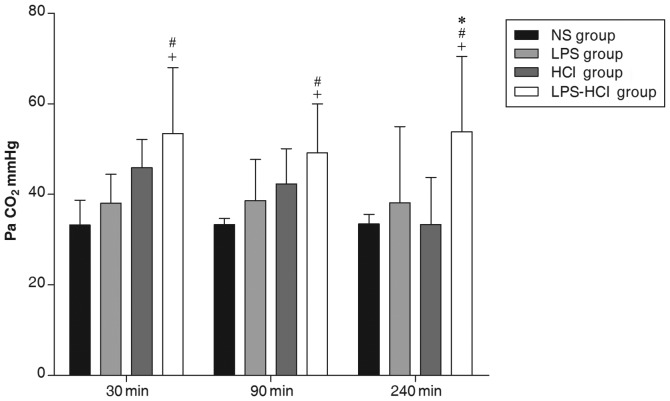
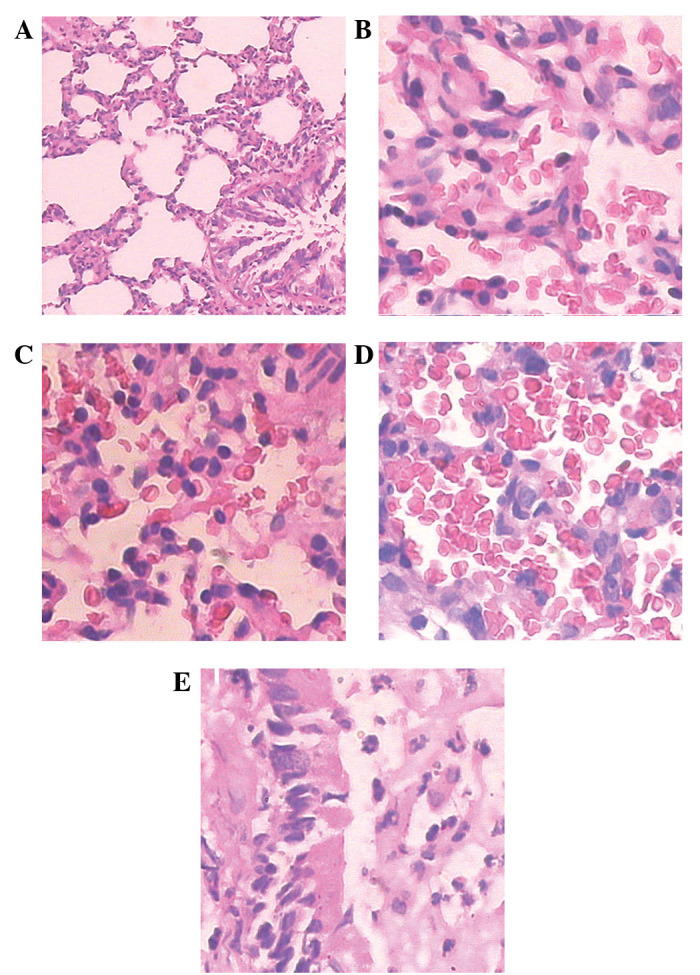
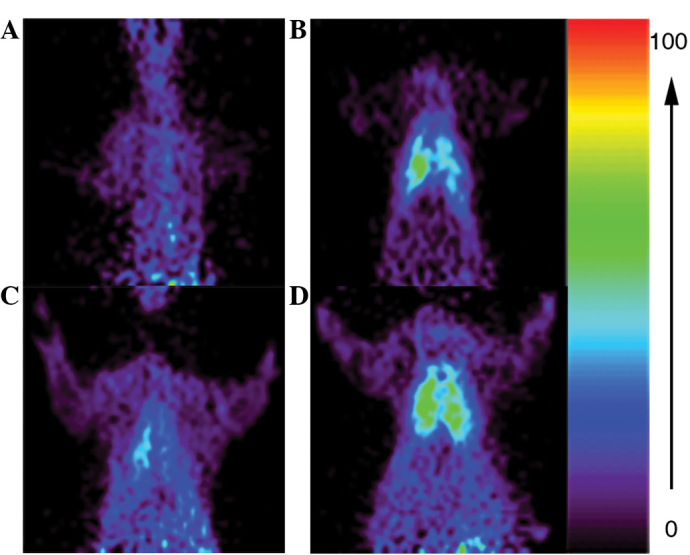
The aim of this study was to investigate whether a two-hit acute lung injury (ALI) model is better than a one-hit model in simulating ALI, and to evaluate the inflammatory response in the lungs in these two models using micro-positron emission tomography (microPET) with [F]fluorodeoxyglucose (FDG). Sprague Dawley rats were divided into four groups; rats in the lipopolysaccharide (LPS; n=10) and LPS-HCl (n=10) groups were challenged by the intraperitoneal administration of 5 mg/kg LPS, while rats in the normal saline (NS; n=3) and HCl (n=10) groups received the same volume of normal saline solution. Sixteen hours following the administration, the rats in the HCl and LPS-HCl groups received an acid instillation (IT) of 0.5 ml/kg HCl (pH=1.2), while the rats in the remaining two groups received the same volume of normal saline solution. The mean arterial blood pressure (MAP) and blood gas concentrations were measured in all four groups. MicroPET was performed 4 h following HCl IT and the lungs were excised for histopathological examination. The rats in the LPS-HCl group exhibited a higher arterial PaO and a lower arterial PaCO compared with the rats in the remaining groups. The MAP decreased markedly in the LPS-HCl group, but remained stable in the LPS, HCl and NS groups. MicroPET results identified that the region of interest ratio in the LPS-HCl group (9.00±1.41) was significantly higher compared with those in the LPS (4.01±0.60) and HCl (3.33±0.55) groups (P<0.01). In addition, histological examination showed that the mean lung injury score in the LPS-HCl group (12.70±0.95) was significantly higher compared with those in the HCl (8.40±1.26) and LPS (7.00±0.82) groups (P<0.01). The present study demonstrates that LPS pretreatment significantly magnifies and prolongs the inflammatory response to subsequent acid IT in the lungs. Moreover, it is simpler to induce ALI using the two-hit model than with the one-hit model, and [F]FDG microPET is a useful tool for evaluating the inflammatory reaction during ALI.
本研究的目的是调查双打击急性肺损伤(ALI)模型在模拟ALI方面是否优于单打击模型,并使用[F]氟脱氧葡萄糖(FDG)微正电子发射断层扫描(microPET)评估这两种模型中肺内的炎症反应。将Sprague Dawley大鼠分为四组;脂多糖(LPS;n = 10)组和LPS-HCl(n = 10)组的大鼠通过腹腔注射5 mg/kg LPS进行刺激,而生理盐水(NS;n = 3)组和HCl(n = 10)组的大鼠接受相同体积的生理盐水溶液。给药16小时后,HCl组和LPS-HCl组的大鼠接受0.5 ml/kg HCl(pH = 1.2)的酸灌注(IT),而其余两组的大鼠接受相同体积的生理盐水溶液。测量所有四组的平均动脉血压(MAP)和血气浓度。在HCl IT后4小时进行microPET检查,并切除肺组织进行组织病理学检查。与其余组的大鼠相比,LPS-HCl组的大鼠表现出更高的动脉血氧分压(PaO)和更低的动脉血二氧化碳分压(PaCO)。LPS-HCl组的MAP显著下降,但在LPS、HCl和NS组中保持稳定。microPET结果显示,LPS-HCl组的感兴趣区比值(9.00±1.41)显著高于LPS组(4.01±0.60)和HCl组(3.33±0.55)(P<0.01)。此外,组织学检查显示,LPS-HCl组的平均肺损伤评分(12.70±0.95)显著高于HCl组(8.40±1.26)和LPS组(7.00±0.82)(P<0.01)。本研究表明,LPS预处理显著放大并延长了肺对随后酸灌注的炎症反应。此外,使用双打击模型诱导ALI比单打击模型更简单,并且[F]FDG microPET是评估ALI期间炎症反应的有用工具。