
乳房切除术后局部区域复发的乳腺癌患者的治疗结果。
Treatment results of breast cancer patients with locoregional recurrence after mastectomy.
作者信息
Jeong Yuri, Kim Su Ssan, Gong Gyungyub, Lee Hee Jin, Ahn Sei Hyun, Son Byung Ho, Lee Jong Won, Choi Eun Kyung, Lee Sang-Wook, Joo Ji Hyeon, Ahn Seung Do
机构信息
Department of Radiation Oncology, Asan Medical Center, University of Ulsan College of Medicine, Seoul, Korea.
出版信息
Radiat Oncol J. 2013 Sep;31(3):138-46. doi: 10.3857/roj.2013.31.3.138. Epub 2013 Sep 30.
PURPOSE
To analyze the results of locoregional and systemic therapy in the breast cancer patients with locoregional recurrence (LRR) after mastectomy.
MATERIALS AND METHODS
Seventy-one patients who received radiotherapy for isolated LRR after mastectomy between January 1999 and December 2009 were retrospectively reviewed. Among the 71 patients, 59 (83.1%) underwent wide excision and radiotherapy and 12 (16.9%) received radiotherapy alone. Adjuvant hormonal therapy was given to 45 patients (63.4%). Oncologic outcomes including locoregional recurrence-free survival, disease-free survival (DFS), and overall survival (OS) and prognostic factors were analyzed.
RESULTS
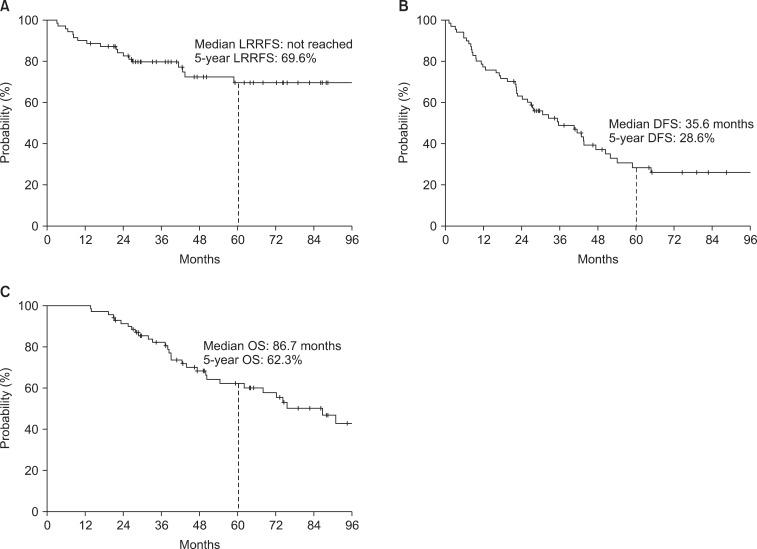
Median follow-up time was 49.2 months. Of the 71 patients, 5 (7%) experienced second isolated LRR, and 40 (56%) underwent distant metastasis (DM). The median DFS was 35.6 months, and the 3- and 5-year DFS were 49.1% and 28.6%, respectively. The median OS was 86.7 months, and the 5-year OS was 62.3%. Patients who received hormone therapy together showed better 5-year DFS and OS than the patients treated with locoregional therapy only (31.6% vs. 22.1%, p = 0.036; 66.5% vs. 55.2%, p = 0.022). In multivariate analysis, higher N stage at recurrence was a significant prognostic factor for DFS and OS. Disease free interval (≤30 months vs. >30 months) from mastectomy to LRR was also significant for OS. The patients who received hormone therapy showed superior DFS and showed trend to better OS.
CONCLUSION
DM was a major pattern of failure after the treatment of LRR after mastectomy. The role of systemic treatment for LRR after mastectomy should be investigated at prospective trials.
目的
分析乳房切除术后局部区域复发(LRR)的乳腺癌患者接受局部区域和全身治疗的结果。
材料与方法
回顾性分析1999年1月至2009年12月间因孤立性LRR接受乳房切除术后放疗的71例患者。71例患者中,59例(83.1%)接受了广泛切除及放疗,12例(16.9%)仅接受了放疗。45例患者(63.4%)接受了辅助激素治疗。分析包括局部区域无复发生存率、无病生存率(DFS)、总生存率(OS)等肿瘤学结局及预后因素。
结果
中位随访时间为49.2个月。71例患者中,5例(7%)出现第二次孤立性LRR,40例(56%)发生远处转移(DM)。中位DFS为35.6个月,3年和5年DFS分别为49.1%和28.6%。中位OS为86.7个月,5年OS为62.3%。联合接受激素治疗的患者5年DFS和OS优于仅接受局部区域治疗的患者(31.6%对22.1%,p = 0.036;66.5%对55.2%,p = 0.022)。多因素分析中,复发时较高的N分期是DFS和OS的显著预后因素。从乳房切除到LRR的无病间期(≤30个月对>30个月)对OS也有显著影响。接受激素治疗的患者DFS更佳且OS有更好的趋势。
结论
DM是乳房切除术后LRR治疗后主要的失败模式。乳房切除术后LRR的全身治疗作用应在前瞻性试验中进行研究。

 Zotero 插件