Smith David Hersi, Christensen Ib Jarle, Jensen Niels Frank, Markussen Bo, Müller Sven, Nielsen Hans Jørgen, Brünner Nils, Nielsen Kirsten Vang
R&D, Dako A/S, Produktionsvej 42, Glostrup DK-2600, Denmark.
BMC Cancer. 2013 Oct 21;13:489. doi: 10.1186/1471-2407-13-489.
Platinum-based chemotherapy has long been used in the treatment of a variety of cancers and functions by inducing DNA damage. ERCC1 and ERCC4 are involved in the removal of this damage and have previously been implicated in resistance to platinum compounds. The aim of the current investigation is to determine the presence, frequency and prognostic impact of ERCC1 or ERCC4 gene copy number alterations in colorectal cancer (CRC).
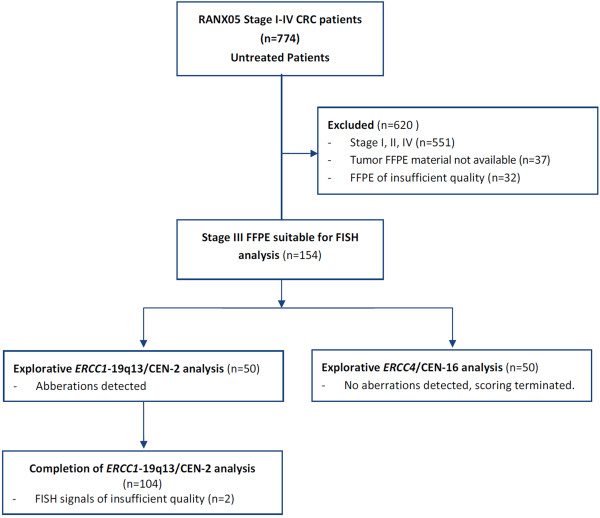
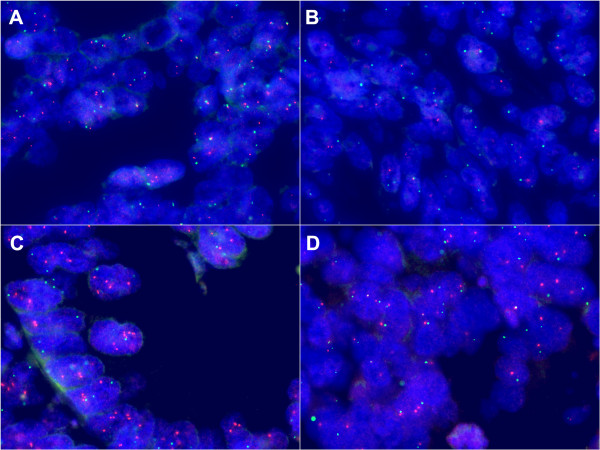
Fluorescent in situ hybridization probes directed at ERCC1 and ERCC4 with relevant reference probes were constructed. Probes were tested in a CRC cell line panel and in tumor sections from 152 stage III CRC chemonaive patients. Relationships between biomarker status and clinical endpoints (overall survival, time to recurrence, and local recurrence in rectal cancer) were analyzed by survival statistics.
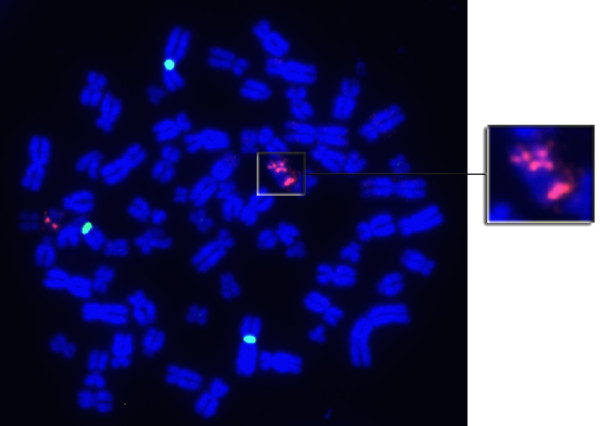
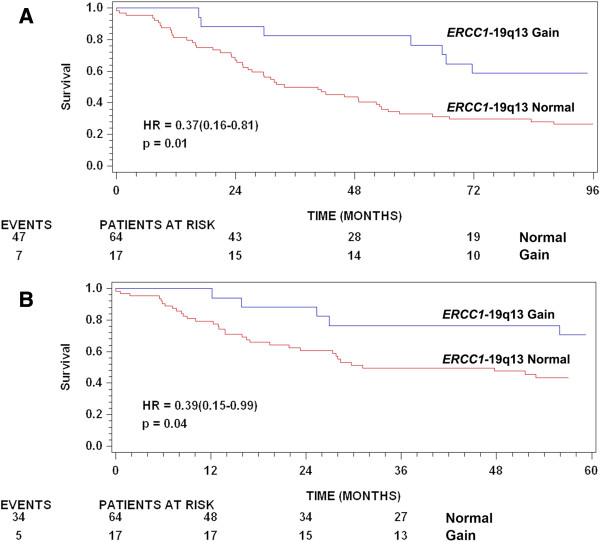
ERCC1-19q13 copy number alterations were observed in a single cell line metaphase (HT29). In patient material, ERCC1-19q13 copy number gains (ERCC1-19q13/CEN-2 ≥ 1.5) were detected in 27.0% of specimens, whereas ERCC1-19q13 deletions (ERCC1-19q13/CEN-2 < 0.8) were only detected in 1.3%. ERCC1-19q13 gain was significantly associated with longer survival (multivariate analysis, HR: 0.45, 95% CI: 0.20-1.00, p = 0.049) in patients with colon tumors, but not rectal tumors. No ERCC4 aberrations were detected and scoring was discontinued after 50 patients.
ERCC1-19q13 copy number gains occur frequently in stage III CRC and influences survival in patients with colon tumors. Future studies will investigate the effect of ERCC1-19q13 aberrations in a platinum-treated patient population with the aim of developing a predictive biomarker profile for oxaliplatin sensitivity in CRC.
铂类化疗长期以来一直用于多种癌症的治疗,其作用机制是诱导DNA损伤。ERCC1和ERCC4参与这种损伤的修复,此前被认为与对铂类化合物的耐药性有关。本研究的目的是确定结直肠癌(CRC)中ERCC1或ERCC4基因拷贝数改变的存在情况、频率及其预后影响。
构建针对ERCC1和ERCC4的荧光原位杂交探针及相关参考探针。将探针在一组CRC细胞系以及152例III期未经化疗的CRC患者的肿瘤切片中进行检测。通过生存统计学分析生物标志物状态与临床终点(总生存期、复发时间和直肠癌局部复发)之间的关系。
在单个细胞系中期(HT29)观察到ERCC1 - 19q13拷贝数改变。在患者样本中,27.0%的标本检测到ERCC1 - 19q13拷贝数增加(ERCC1 - 19q13/CEN - 2≥1.5),而ERCC1 - 19q13缺失(ERCC1 - 19q13/CEN - 2 < 0.8)仅在1.3%的标本中检测到。在结肠肿瘤患者中,ERCC1 - 19q13增加与更长的生存期显著相关(多变量分析,HR:0.45,95%CI:0.20 - 1.00,p = 0.049),但在直肠肿瘤患者中并非如此。未检测到ERCC4异常,在检测50例患者后停止评分。
ERCC1 - 19q13拷贝数增加在III期CRC中频繁出现,并影响结肠肿瘤患者的生存。未来的研究将调查ERCC1 - 19q13异常在铂类治疗患者群体中的作用,旨在开发一种用于预测CRC中奥沙利铂敏感性的生物标志物谱。