Department of Experimental and Clinical Medicine, University of Florence, Florence, Italy.
PLoS One. 2013 Oct 17;8(10):e78918. doi: 10.1371/journal.pone.0078918. eCollection 2013.
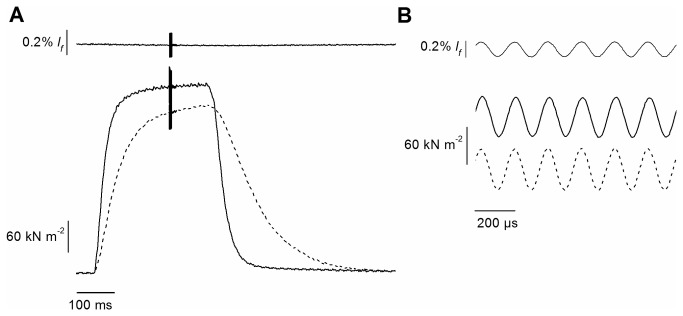
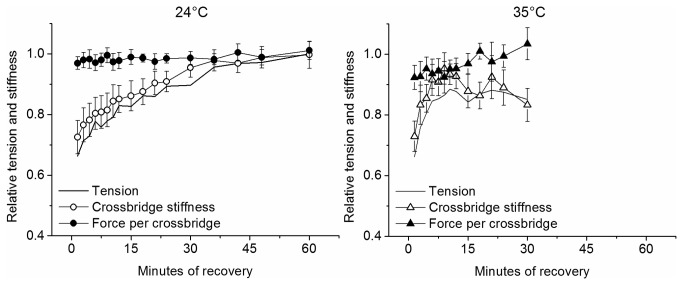
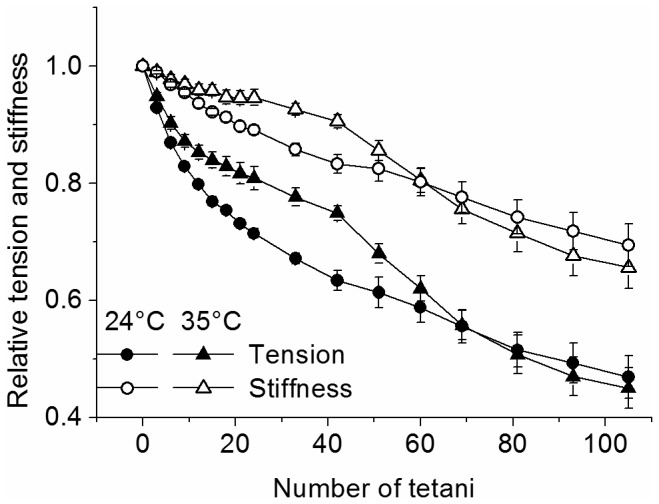
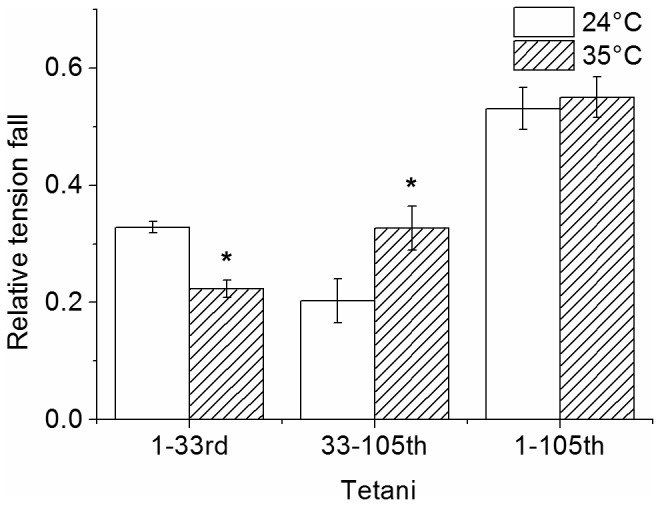
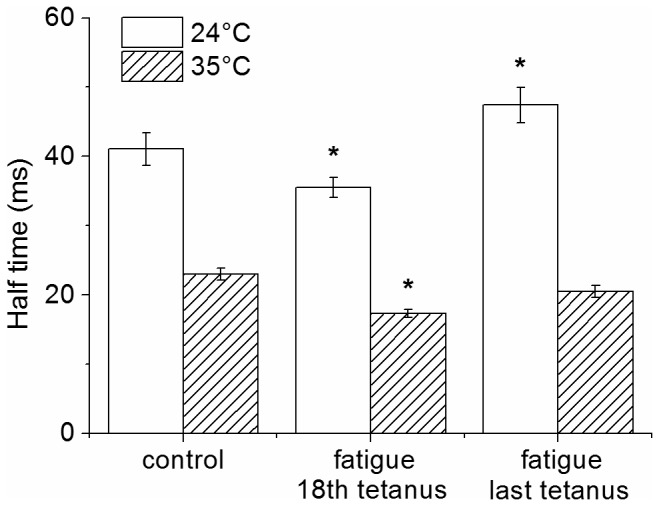
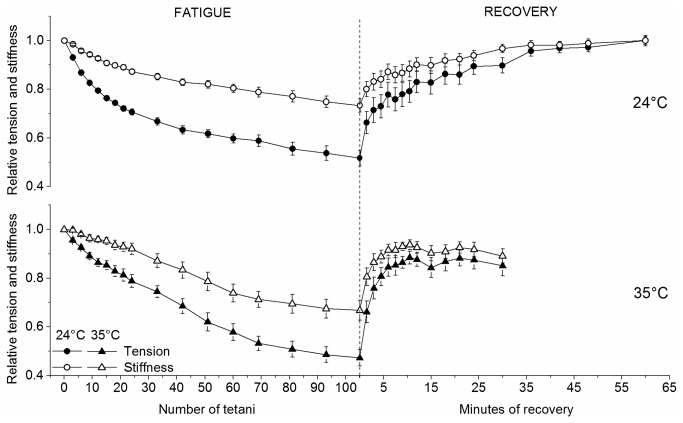
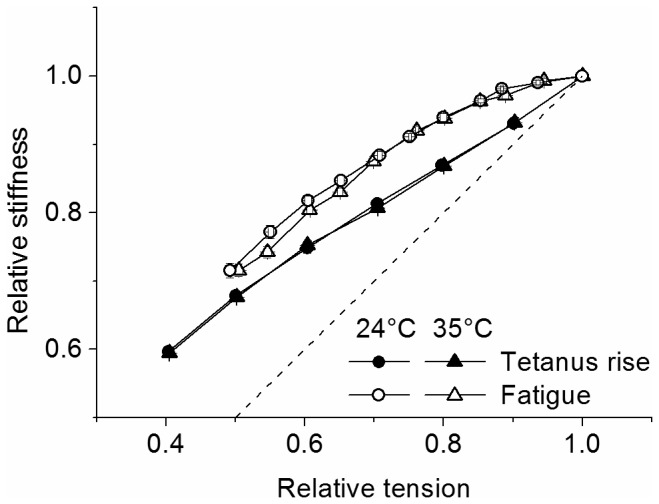
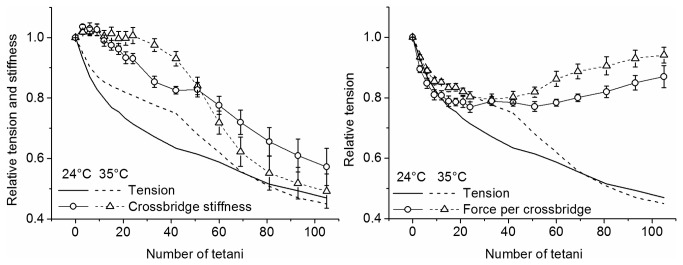
Repetitive or prolonged muscle contractions induce muscular fatigue, defined as the inability of the muscle to maintain the initial tension or power output. In the present experiments, made on intact fiber bundles from FDB mouse, fatigue and recovery from fatigue were investigated at 24°C and 35°C. Force and stiffness were measured during tetani elicited every 90 s during the pre-fatigue control phase and recovery and every 1.5 s during the fatiguing phase made of 105 consecutive tetani. The results showed that force decline could be split in an initial phase followed by a later one. Loss of force during the first phase was smaller and slower at 35°C than at 24°C, whereas force decline during the later phase was greater at 35°C so that total force depression at the end of fatigue was the same at both temperatures. The initial force decline occurred without great reduction of fiber stiffness and was attributed to a decrease of the average force per attached crossbridge. Force decline during the later phase was accompanied by a proportional stiffness decrease and was attributed to a decrease of the number of attached crossbridge. Similarly to fatigue, at both 24 and 35°C, force recovery occurred in two phases: the first associated with the recovery of the average force per attached crossbridge and the second due to the recovery of the pre-fatigue attached crossbridge number. These changes, symmetrical to those occurring during fatigue, are consistent with the idea that, i) initial phase is due to the direct fast inhibitory effect of [Pi]i increase during fatigue on crossbridge force; ii) the second phase is due to the delayed reduction of Ca(2+) release and /or reduction of the Ca(2+) sensitivity of the myofibrils due to high [Pi]i.
重复性或长时间的肌肉收缩会导致肌肉疲劳,即肌肉无法维持初始张力或功率输出。在本实验中,我们在 FDB 小鼠的完整纤维束上进行了研究,在 24°C 和 35°C 下研究了疲劳和疲劳恢复。在预疲劳对照阶段,每 90 秒进行一次强直刺激,在疲劳阶段,每 1.5 秒进行一次由 105 次连续强直刺激组成的刺激,测量力和刚度。结果表明,力的下降可以分为初始阶段和后期阶段。在 35°C 时,力的下降在初始阶段较小且较慢,而在后期阶段较大,因此在疲劳结束时的总力下降在两种温度下相同。初始力下降没有纤维刚度的大幅降低,这归因于每个附着的横桥平均力的降低。在后期阶段,力的下降伴随着与力成比例的刚度下降,这归因于附着的横桥数量的减少。与疲劳相似,在 24°C 和 35°C 下,力的恢复分为两个阶段:第一阶段与附着的横桥平均力的恢复有关,第二阶段与疲劳前附着的横桥数量的恢复有关。这些变化与疲劳时发生的变化对称,与以下观点一致:i)初始阶段是由于疲劳过程中 [Pi]i 增加对横桥力的直接快速抑制作用;ii)第二阶段是由于 [Pi]i 升高导致 Ca(2+)释放减少和/或肌原纤维 Ca(2+)敏感性降低的延迟。