Koo Tae Bon, Han Min-Su, Tadashi Yamashita, Seong Won Joon, Choi Je-Yong
Departments of Biochemistry and Cell Biology, School of Medicine; Departments of WCU and BK21 Plus Program, Kyungpook National University, Daegu 700-422, Korea
BMB Rep. 2013 Oct;46(10):507-12. doi: 10.5483/bmbrep.2013.46.10.223.
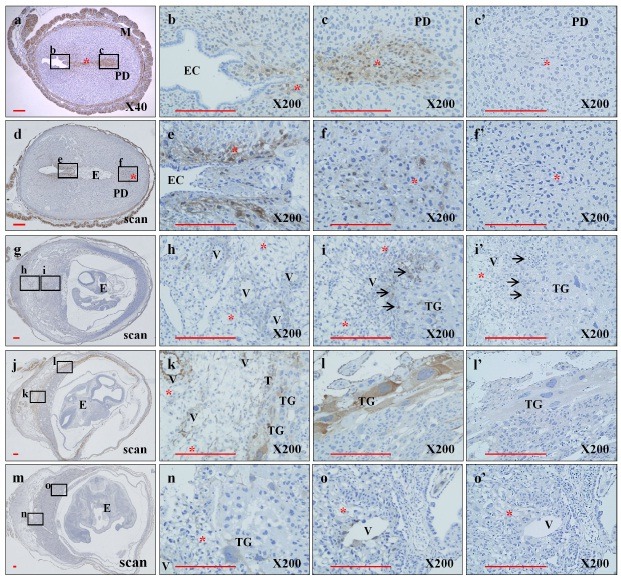
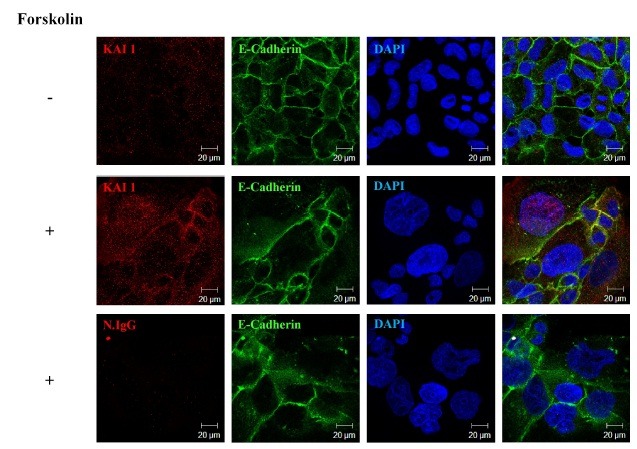
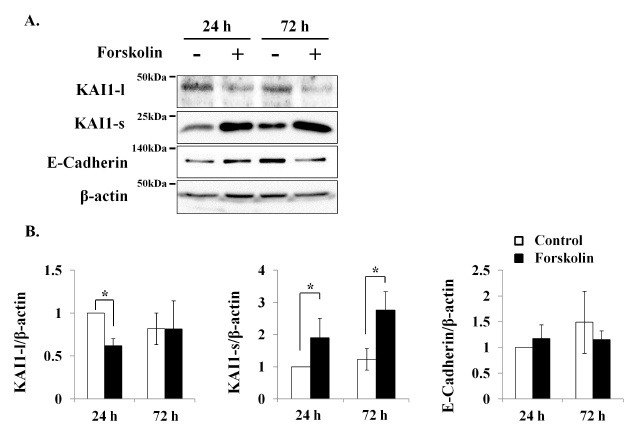
Invasion of trophoblasts into maternal uterine tissue is essential for establishing mature feto-maternal circulation. The trophoblast invasion associated with placentation is similar to tumor invasion. In this study, we investigated the role of KAI1, an antimetastasis factor, at the maternal-fetal interface during placentation. Mouse embryos were obtained from gestational days 5.5 (E5.5) to E13.5. Immunohistochemical analysis revealed that KAI1 was expressed on decidual cells around the track made when a fertilized ovum invaded the endometrium, at days E5.5 and E7.5, and on trophoblast giant cells, along the central maternal artery of the placenta at E9.5. KAI1 in trophoblast giant cells was increased at E11.5, and then decreased at E13.5. Furthermore, KAI1 was upregulated during the forskolin-mediated trophoblastic differentiation of BeWo cells. Collectively, these results indicate that KAI1 is differentially expressed in decidual cells and trophoblasts at the maternal-fetal interface, suggesting that KAI1 prevents trophoblast invasion during placentation.
滋养层细胞侵入母体子宫组织对于建立成熟的母胎循环至关重要。与胎盘形成相关的滋养层细胞侵入类似于肿瘤侵袭。在本研究中,我们调查了抗转移因子KAI1在胎盘形成过程中母胎界面的作用。从小鼠妊娠第5.5天(E5.5)至E13.5获取胚胎。免疫组织化学分析显示,在E5.5和E7.5时,KAI1在受精卵侵入子宫内膜时形成的轨迹周围的蜕膜细胞上表达,在E9.5时在胎盘中央母动脉沿线的滋养层巨细胞上表达。滋养层巨细胞中的KAI1在E11.5时增加,然后在E13.5时减少。此外,在福司可林介导的BeWo细胞滋养层分化过程中KAI1上调。总体而言,这些结果表明KAI1在母胎界面的蜕膜细胞和滋养层细胞中差异表达,提示KAI1在胎盘形成过程中阻止滋养层细胞侵入。