Castañeda Sheila F, Malcarne Vanessa L, Foster-Fishman Pennie G, Davidson William S, Mumman Manpreet K, Riley Natasha, Sadler Georgia R
Institute for Behavioral and Community Health, Graduate School of Public Health, San Diego State University, 9245 Sky Park Court, Suite 110, San Diego, CA, 92123, USA,
J Immigr Minor Health. 2014 Aug;16(4):670-81. doi: 10.1007/s10903-013-9938-x.
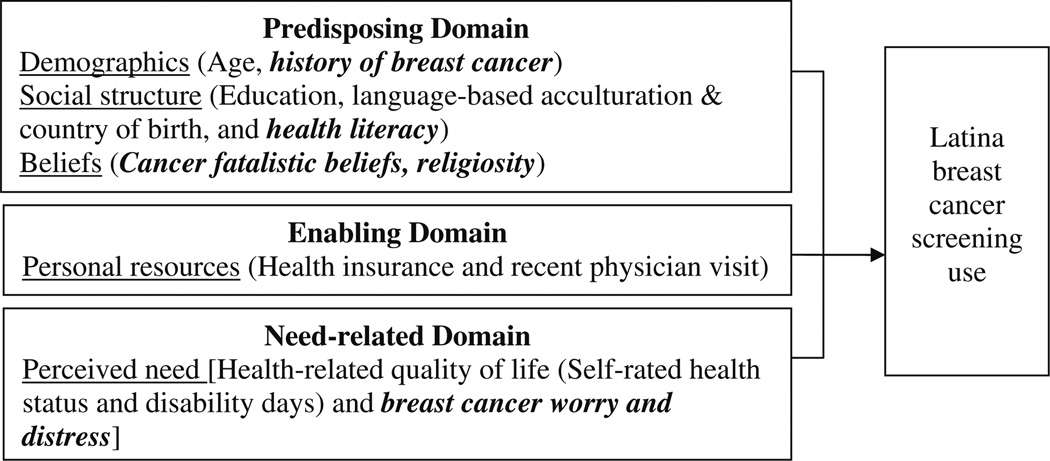
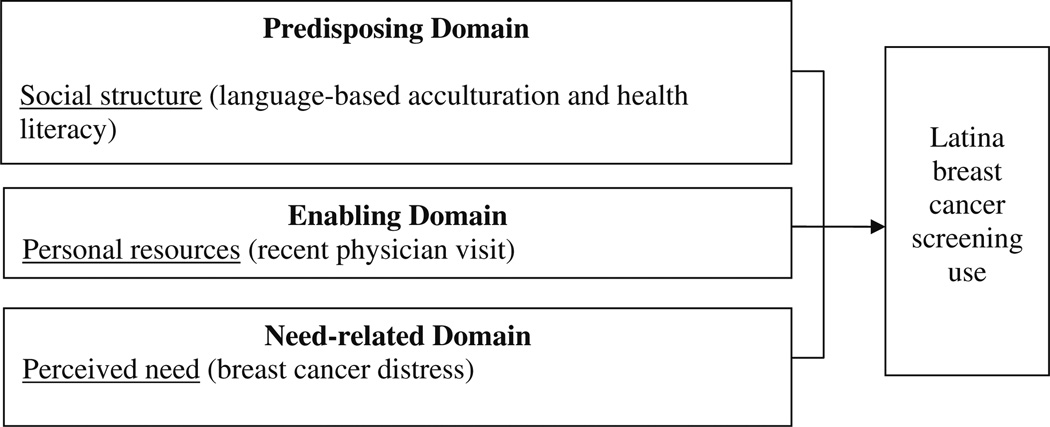
Latinas are more likely to exhibit late stage breast cancers at the time of diagnosis and have lower survival rates compared to white women. A contributing factor may be that Latinas have lower rates of mammography screening. This study was guided by the Behavioral Model of Health Services Use to examine factors associated with mammography screening utilization among middle-aged Latinas. An academic-community health center partnership collected data from community-based sample of 208 Latinas 40 years and older in the San Diego County who completed measures assessing psychosocial factors, health care access, and recent mammography screening. Results showed that 84.6 % had ever had a mammogram and 76.2 % of women had received a mammogram in the past 2 years. Characteristics associated with mammography screening adherence included a lower acculturation (OR 3.663) a recent physician visit in the past year (OR 6.304), and a greater confidence in filling out medical forms (OR 1.743), adjusting for covariates. Results demonstrate that an annual physical examination was the strongest predictor of recent breast cancer screening. Findings suggest that in this community, improving access to care among English-speaking Latinas and addressing health literacy issues are essential for promoting breast cancer screening utilization.
与白人女性相比,拉丁裔女性在确诊时更有可能患有晚期乳腺癌,且生存率较低。一个促成因素可能是拉丁裔女性的乳房X光检查筛查率较低。本研究以卫生服务利用行为模型为指导,旨在探讨与中年拉丁裔女性乳房X光检查筛查利用率相关的因素。一个学术社区健康中心合作伙伴关系从圣地亚哥县208名40岁及以上的拉丁裔女性的社区样本中收集了数据,这些女性完成了评估心理社会因素、医疗保健可及性和近期乳房X光检查筛查的测量。结果显示,84.6%的女性曾进行过乳房X光检查,76.2%的女性在过去两年内接受过乳房X光检查。在调整协变量后,与乳房X光检查筛查依从性相关的特征包括较低的文化适应程度(比值比3.663)、过去一年中最近一次看医生(比值比6.304)以及填写医疗表格时更大的信心(比值比1.743)。结果表明,年度体检是近期乳腺癌筛查的最强预测因素。研究结果表明,在这个社区,改善英语水平较高的拉丁裔女性获得医疗服务的机会并解决健康素养问题对于提高乳腺癌筛查利用率至关重要。