• 文献检索
  • 文档翻译
  • 深度研究
  • 学术资讯
  • Suppr Zotero 插件Zotero 插件
  • 邀请有礼
  • 套餐&价格
  • 历史记录
应用&插件
Suppr Zotero 插件Zotero 插件浏览器插件Mac 客户端Windows 客户端微信小程序
定价
高级版会员购买积分包购买API积分包
服务
文献检索文档翻译深度研究API 文档MCP 服务
关于我们
关于 Suppr公司介绍联系我们用户协议隐私条款
关注我们

Suppr 超能文献

核心技术专利:CN118964589B侵权必究
粤ICP备2023148730 号-1Suppr @ 2026

文献检索

告别复杂PubMed语法,用中文像聊天一样搜索,搜遍4000万医学文献。AI智能推荐,让科研检索更轻松。

立即免费搜索

文件翻译

保留排版,准确专业,支持PDF/Word/PPT等文件格式,支持 12+语言互译。

免费翻译文档

深度研究

AI帮你快速写综述,25分钟生成高质量综述,智能提取关键信息,辅助科研写作。

立即免费体验

后天性面孔失认症中身份变化的残留 fMRI 敏感性。

Residual fMRI sensitivity for identity changes in acquired prosopagnosia.

机构信息

Departments of Medicine (Neurology) and Ophthalmology and Visual Sciences, University of British Columbia Vancouver, BC, Canada.

出版信息

Front Psychol. 2013 Oct 18;4:756. doi: 10.3389/fpsyg.2013.00756. eCollection 2013.

DOI:10.3389/fpsyg.2013.00756
PMID:24151479
原文链接:https://pmc.ncbi.nlm.nih.gov/articles/PMC3799008/
Abstract

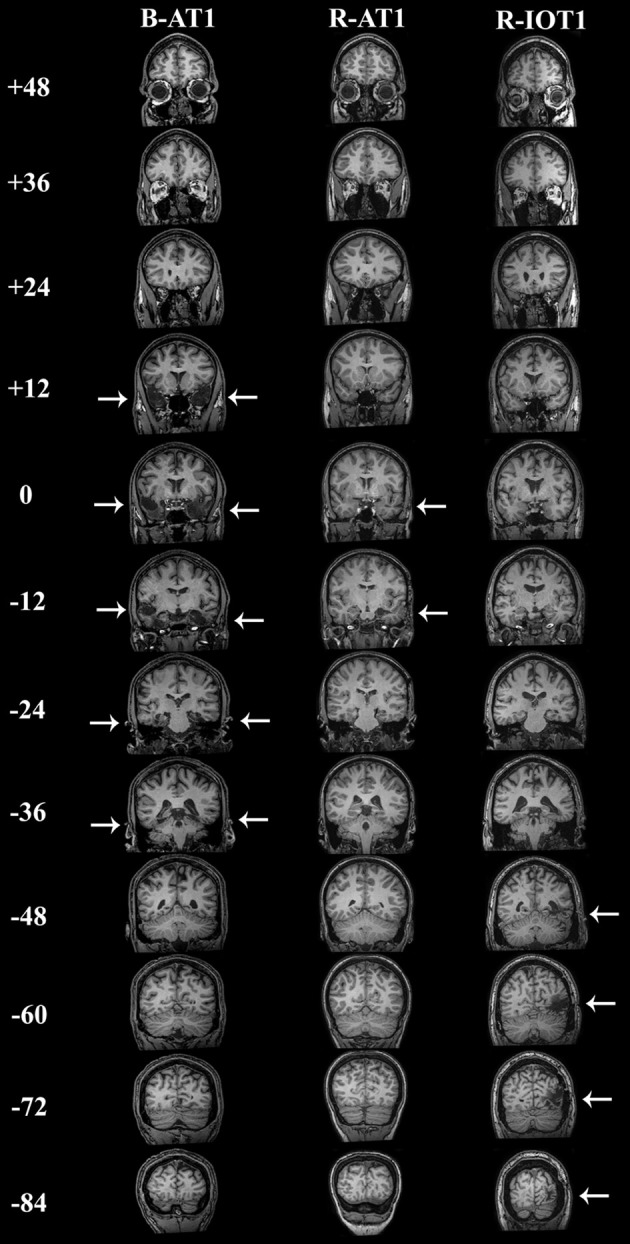
While a network of cortical regions contribute to face processing, the lesions in acquired prosopagnosia are highly variable, and likely result in different combinations of spared and affected regions of this network. To assess the residual functional sensitivities of spared regions in prosopagnosia, we designed a rapid event-related functional magnetic resonance imaging (fMRI) experiment that included pairs of faces with same or different identities and same or different expressions. By measuring the release from adaptation to these facial changes we determined the residual sensitivity of face-selective regions-of-interest. We tested three patients with acquired prosopagnosia, and all three of these patients demonstrated residual sensitivity for facial identity changes in surviving fusiform and occipital face areas of either the right or left hemisphere, but not in the right posterior superior temporal sulcus. The patients also showed some residual capabilities for facial discrimination with normal performance on the Benton Facial Recognition Test, but impaired performance on more complex tasks of facial discrimination. We conclude that fMRI can demonstrate residual processing of facial identity in acquired prosopagnosia, that this adaptation can occur in the same structures that show similar processing in healthy subjects, and further, that this adaptation may be related to behavioral indices of face perception.

摘要

虽然皮质区域网络有助于对面部进行处理,但获得性面孔失认症的病变高度可变,并且可能导致该网络中受影响和未受影响的区域的不同组合。为了评估面孔失认症中未受影响区域的剩余功能敏感性,我们设计了一项快速事件相关功能磁共振成像(fMRI)实验,该实验包括具有相同或不同身份和相同或不同表情的面孔对。通过测量这些面孔变化的适应释放,我们确定了面孔选择性感兴趣区域的剩余敏感性。我们测试了三名获得性面孔失认症患者,这三名患者在右侧或左侧半球的存活的梭状回和枕叶面孔区域中均表现出对面孔身份变化的剩余敏感性,但在右侧后上颞叶沟中没有表现出敏感性。患者在 Benton 面孔识别测试中也表现出一些对面孔识别的剩余能力,表现正常,但在更复杂的面孔识别任务中表现受损。我们的结论是,fMRI 可以证明获得性面孔失认症中对面孔身份的剩余处理,这种适应可以在与健康受试者中相似处理的相同结构中发生,并且进一步,这种适应可能与面孔感知的行为指标有关。
https://cdn.ncbi.nlm.nih.gov/pmc/blobs/025f/3799008/3cee2e295ad7/fpsyg-04-00756-g0006.jpg
https://cdn.ncbi.nlm.nih.gov/pmc/blobs/025f/3799008/d019a4743835/fpsyg-04-00756-g0001.jpg
https://cdn.ncbi.nlm.nih.gov/pmc/blobs/025f/3799008/4cc70ea46fcc/fpsyg-04-00756-g0002.jpg
https://cdn.ncbi.nlm.nih.gov/pmc/blobs/025f/3799008/57256baed6fe/fpsyg-04-00756-g0003.jpg
https://cdn.ncbi.nlm.nih.gov/pmc/blobs/025f/3799008/3defb1e68ab9/fpsyg-04-00756-g0004.jpg
https://cdn.ncbi.nlm.nih.gov/pmc/blobs/025f/3799008/929123d2edf6/fpsyg-04-00756-g0005.jpg
https://cdn.ncbi.nlm.nih.gov/pmc/blobs/025f/3799008/3cee2e295ad7/fpsyg-04-00756-g0006.jpg
https://cdn.ncbi.nlm.nih.gov/pmc/blobs/025f/3799008/d019a4743835/fpsyg-04-00756-g0001.jpg
https://cdn.ncbi.nlm.nih.gov/pmc/blobs/025f/3799008/4cc70ea46fcc/fpsyg-04-00756-g0002.jpg
https://cdn.ncbi.nlm.nih.gov/pmc/blobs/025f/3799008/57256baed6fe/fpsyg-04-00756-g0003.jpg
https://cdn.ncbi.nlm.nih.gov/pmc/blobs/025f/3799008/3defb1e68ab9/fpsyg-04-00756-g0004.jpg
https://cdn.ncbi.nlm.nih.gov/pmc/blobs/025f/3799008/929123d2edf6/fpsyg-04-00756-g0005.jpg
https://cdn.ncbi.nlm.nih.gov/pmc/blobs/025f/3799008/3cee2e295ad7/fpsyg-04-00756-g0006.jpg

相似文献

1
Residual fMRI sensitivity for identity changes in acquired prosopagnosia.后天性面孔失认症中身份变化的残留 fMRI 敏感性。
Front Psychol. 2013 Oct 18;4:756. doi: 10.3389/fpsyg.2013.00756. eCollection 2013.
2
Understanding the functional neuroanatomy of acquired prosopagnosia.了解获得性面孔失认症的功能性神经解剖学。
Neuroimage. 2007 Apr 1;35(2):836-52. doi: 10.1016/j.neuroimage.2006.09.051. Epub 2007 Feb 14.
3
The roles of "face" and "non-face" areas during individual face perception: evidence by fMRI adaptation in a brain-damaged prosopagnosic patient.个体面部感知过程中“面孔”和“非面孔”区域的作用:一位脑损伤面孔失认症患者功能磁共振成像适应的证据
Neuroimage. 2008 Mar 1;40(1):318-32. doi: 10.1016/j.neuroimage.2007.11.012. Epub 2007 Nov 22.
4
Reconstructing dynamic mental models of facial expressions in prosopagnosia reveals distinct representations for identity and expression.重建面孔失认症中面部表情的动态心理模型揭示了身份和表情的不同表征。
Cortex. 2015 Apr;65:50-64. doi: 10.1016/j.cortex.2014.11.015. Epub 2014 Dec 24.
5
The cortical face network of the prosopagnosic patient PS with fast periodic stimulation in fMRI.使用 fMRI 对面孔失认症患者 PS 进行快速周期性刺激后的大脑皮质面孔网络。
Cortex. 2019 Oct;119:528-542. doi: 10.1016/j.cortex.2018.11.008. Epub 2018 Nov 17.
6
Structure and function in acquired prosopagnosia: lessons from a series of 10 patients with brain damage.后天性面孔失认症的结构与功能:来自10例脑损伤患者系列研究的经验教训
J Neuropsychol. 2008 Mar;2(1):197-225. doi: 10.1348/174866407x214172.
7
Perceptual and anatomic patterns of selective deficits in facial identity and expression processing.选择性面部身份和表情处理缺陷的知觉和解剖模式。
Neuropsychologia. 2011 Oct;49(12):3188-200. doi: 10.1016/j.neuropsychologia.2011.07.018. Epub 2011 Jul 22.
8
Covert recognition in acquired and developmental prosopagnosia.获得性和发育性面孔失认症中的隐蔽识别
Neurology. 2001 Oct 9;57(7):1161-8. doi: 10.1212/wnl.57.7.1161.
9
The contribution of the fusiform gyrus and superior temporal sulcus in processing facial attractiveness: neuropsychological and neuroimaging evidence.梭状回和颞上沟在加工面部吸引力中的作用:神经心理学和神经影像学证据。
Neuroscience. 2008 Aug 13;155(2):409-22. doi: 10.1016/j.neuroscience.2008.05.046. Epub 2008 Jun 8.
10
Impaired face discrimination in acquired prosopagnosia is associated with abnormal response to individual faces in the right middle fusiform gyrus.后天性面孔失认症中面部识别受损与右侧梭状回中部对个体面孔的异常反应有关。
Cereb Cortex. 2006 Apr;16(4):574-86. doi: 10.1093/cercor/bhj005. Epub 2005 Jul 20.

引用本文的文献

1
Interrogating an ICD-coded electronic health records database to characterize the epidemiology of prosopagnosia.查询一个使用国际疾病分类编码的电子健康记录数据库,以描述面孔失认症的流行病学特征。
J Clin Transl Sci. 2020 Jun 19;5(1):e11. doi: 10.1017/cts.2020.497.
2
Face Recognition.人脸识别。
Curr Neurol Neurosci Rep. 2019 May 30;19(7):41. doi: 10.1007/s11910-019-0960-9.
3
The Face-Processing Network Is Resilient to Focal Resection of Human Visual Cortex.面部处理网络对人类视觉皮层的局灶性切除具有耐受性。

本文引用的文献

1
Double Dissociation between Overt and Covert Face Recognition.外显和内隐面孔识别的双重分离。
J Cogn Neurosci. 1995 Fall;7(4):425-32. doi: 10.1162/jocn.1995.7.4.425.
2
Motion as a cue to face recognition: evidence from congenital prosopagnosia.运动作为人脸识别的线索:来自先天性面孔失认症的证据。
Neuropsychologia. 2013 Apr;51(5):864-75. doi: 10.1016/j.neuropsychologia.2013.01.022. Epub 2013 Feb 4.
3
Perceptual and anatomic patterns of selective deficits in facial identity and expression processing.选择性面部身份和表情处理缺陷的知觉和解剖模式。
J Neurosci. 2016 Aug 10;36(32):8425-40. doi: 10.1523/JNEUROSCI.4509-15.2016.
4
Dissociable roles of the inferior longitudinal fasciculus and fornix in face and place perception.下纵束和穹窿在面孔与地点感知中的可分离作用。
Elife. 2015 Aug 29;4:e07902. doi: 10.7554/eLife.07902.
5
Voice Recognition in Face-Blind Patients.脸盲症患者的语音识别
Cereb Cortex. 2016 Apr;26(4):1473-1487. doi: 10.1093/cercor/bhu240. Epub 2014 Oct 27.
6
Aftereffects in face processing.面部处理中的后效应。
Front Psychol. 2013 Nov 14;4:854. doi: 10.3389/fpsyg.2013.00854. eCollection 2013.
Neuropsychologia. 2011 Oct;49(12):3188-200. doi: 10.1016/j.neuropsychologia.2011.07.018. Epub 2011 Jul 22.
4
Face-identity change activation outside the face system: "release from adaptation" may not always indicate neuronal selectivity.面部系统外的面孔身份变化激活:“适应释放”并不总是表明神经元的选择性。
Cereb Cortex. 2010 Sep;20(9):2027-42. doi: 10.1093/cercor/bhp272. Epub 2010 Jan 5.
5
Structure and function in acquired prosopagnosia: lessons from a series of 10 patients with brain damage.后天性面孔失认症的结构与功能:来自10例脑损伤患者系列研究的经验教训
J Neuropsychol. 2008 Mar;2(1):197-225. doi: 10.1348/174866407x214172.
6
[Prosop's agnosia; the agnosia of cognition].[人面失认症;认知失认症]
Arch Psychiatr Nervenkr Z Gesamte Neurol Psychiatr. 1947;118(1-2):6-53. doi: 10.1007/BF00352849.
7
The correlates of subjective perception of identity and expression in the face network: an fMRI adaptation study.面部网络中身份和表情主观感知的相关因素:一项功能磁共振成像适应研究。
Neuroimage. 2009 Jan 15;44(2):569-80. doi: 10.1016/j.neuroimage.2008.09.011. Epub 2008 Sep 25.
8
Defining the face processing network: optimization of the functional localizer in fMRI.定义面部处理网络:功能磁共振成像中功能定位器的优化
Hum Brain Mapp. 2009 May;30(5):1637-51. doi: 10.1002/hbm.20630.
9
Prosopagnosia associated with a left occipitotemporal lesion.与左侧枕颞叶病变相关的面孔失认症。
Neuropsychologia. 2008;46(8):2214-24. doi: 10.1016/j.neuropsychologia.2008.02.014. Epub 2008 Mar 10.
10
The roles of "face" and "non-face" areas during individual face perception: evidence by fMRI adaptation in a brain-damaged prosopagnosic patient.个体面部感知过程中“面孔”和“非面孔”区域的作用:一位脑损伤面孔失认症患者功能磁共振成像适应的证据
Neuroimage. 2008 Mar 1;40(1):318-32. doi: 10.1016/j.neuroimage.2007.11.012. Epub 2007 Nov 22.