Department of Biochemistry, Indian Institute of Science, Bangalore 560012, India.
Cancer Cell Int. 2013 Oct 23;13(1):105. doi: 10.1186/1475-2867-13-105.
Taxol (generic name paclitaxel), a plant-derived antineoplastic agent, used widely against breast, ovarian and lung cancer, was originally isolated from the bark of the Pacific yew, Taxus brevifolia. The limited supply of the drug has prompted efforts to find alternative sources, such as chemical synthesis, tissue and cell cultures of the Taxus species both of which are expensive and yield low levels. Fermentation processes with microorganisms would be the methods of choice to lower the costs and increase yields. Previously we have reported that F. solani isolated from T. celebica produced taxol and its precursor baccatin III in liquid grown cultures J Biosci 33:259-67, 2008. This study was performed to evaluate the inhibition of proliferation and induction of apoptosis of cancer cell lines by the fungal taxol and fungal baccatin III of F. solani isolated from T. celebica.
Cell lines such as HeLa, HepG2, Jurkat, Ovcar3 and T47D were cultured individually and treated with fungal taxol, baccatin III with or without caspase inhibitors according to experimental requirements. Their efficacy on apoptotic induction was examined.
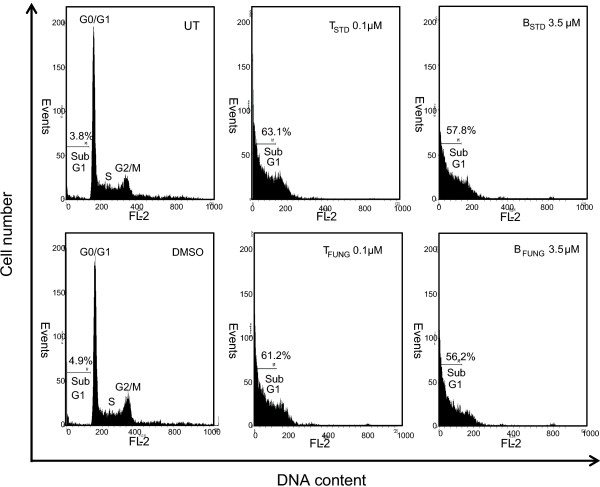
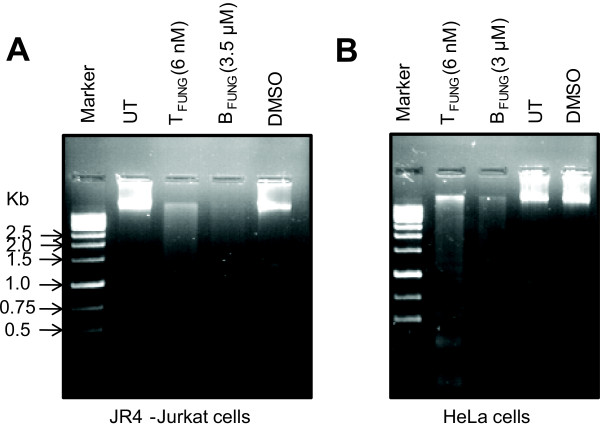
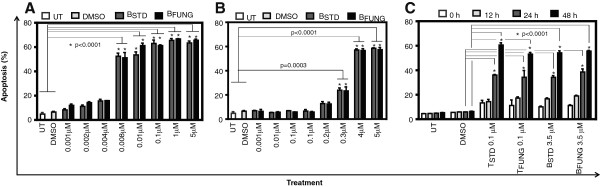
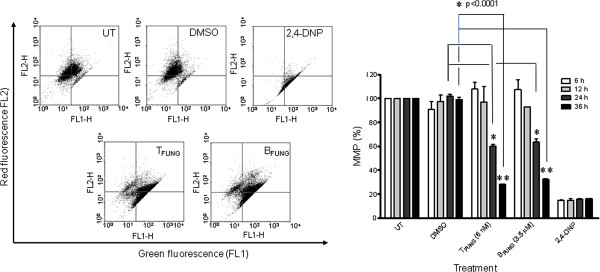
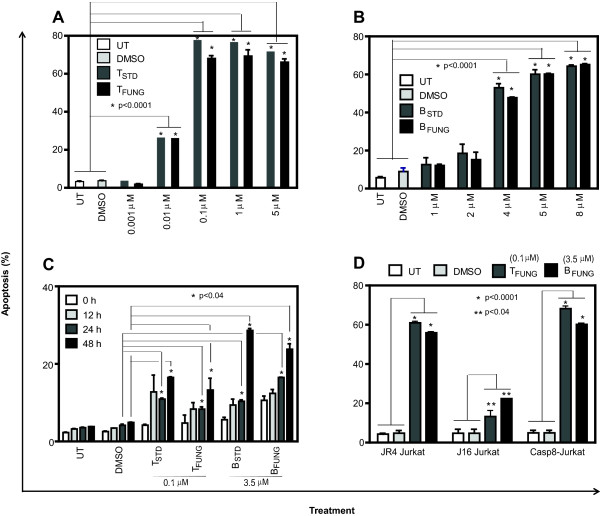
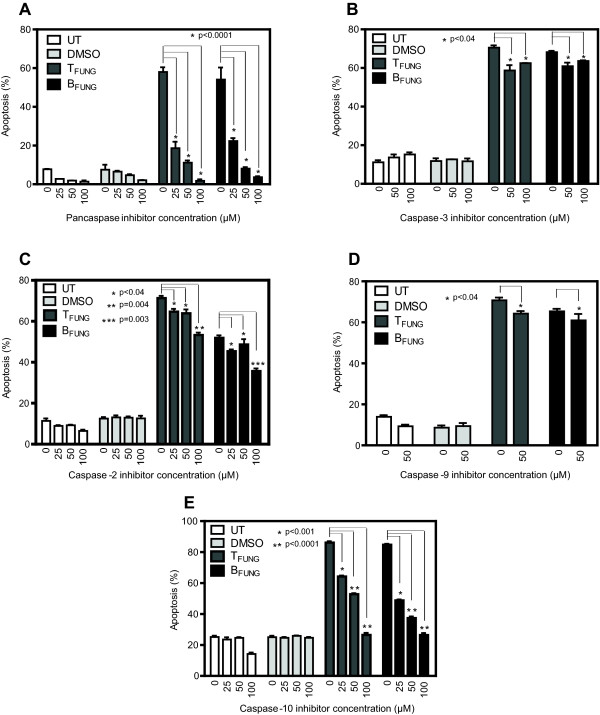
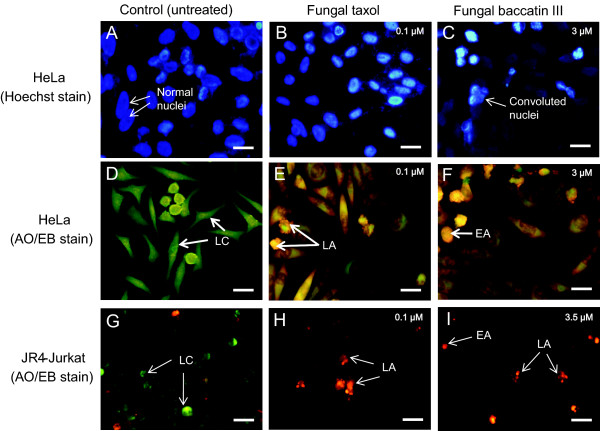
Both fungal taxol and baccatin III inhibited cell proliferation of a number of cancer cell lines with IC50 ranging from 0.005 to 0.2 μM for fungal taxol and 2 to 5 μM for fungal baccatin III. They also induced apoptosis in JR4-Jurkat cells with a possible involvement of anti-apoptotic Bcl2 and loss in mitochondrial membrane potential, and was unaffected by inhibitors of caspase-9,-2 or -3 but was prevented in presence of caspase-10 inhibitor. DNA fragmentation was also observed in cells treated with fungal taxol and baccatin III.
The cytotoxic activity exhibited by fungal taxol and baccatin III involves the same mechanism, dependent on caspase-10 and membrane potential loss of mitochondria, with taxol having far greater cytotoxic potential.
紫杉醇(通用名紫杉醇),一种源自植物的抗肿瘤药物,广泛用于治疗乳腺癌、卵巢癌和肺癌,最初从太平洋紫杉(Taxus brevifolia)的树皮中分离出来。由于药物供应有限,人们努力寻找替代来源,如化学合成、紫杉属植物的组织和细胞培养,这些方法都很昂贵,产量也很低。利用微生物进行发酵是降低成本和提高产量的首选方法。我们之前曾报道过,从短叶红豆杉中分离出的 F. solani 在液体培养中产生紫杉醇及其前体巴卡丁 III。本研究旨在评估真菌紫杉醇和 F. solani 从短叶红豆杉中分离出的真菌巴卡丁 III 对癌细胞系增殖的抑制作用和诱导凋亡作用。
单独培养 HeLa、HepG2、Jurkat、Ovcar3 和 T47D 等细胞系,并根据实验要求用真菌紫杉醇、巴卡丁 III 及其 caspase 抑制剂处理。检测它们对诱导凋亡的效果。
真菌紫杉醇和巴卡丁 III 均抑制了多种癌细胞系的增殖,IC50 范围为真菌紫杉醇 0.005 至 0.2 μM,真菌巴卡丁 III 为 2 至 5 μM。它们还诱导了 JR4-Jurkat 细胞凋亡,可能涉及抗凋亡 Bcl2 和线粒体膜电位丧失,而 caspase-9、-2 或 -3 的抑制剂对其无影响,但 caspase-10 抑制剂可阻止其发生。用真菌紫杉醇和巴卡丁 III 处理的细胞也观察到了 DNA 片段化。
真菌紫杉醇和巴卡丁 III 表现出的细胞毒性活性涉及相同的机制,依赖于 caspase-10 和线粒体膜电位的丧失,其中紫杉醇具有更强的细胞毒性潜力。