Materials Sciences Division, E. O. Lawrence Berkeley National Laboratory, 1 Cyclotron Road, Berkeley, California 94720, USA.
Nat Commun. 2013;4:2643. doi: 10.1038/ncomms3643.
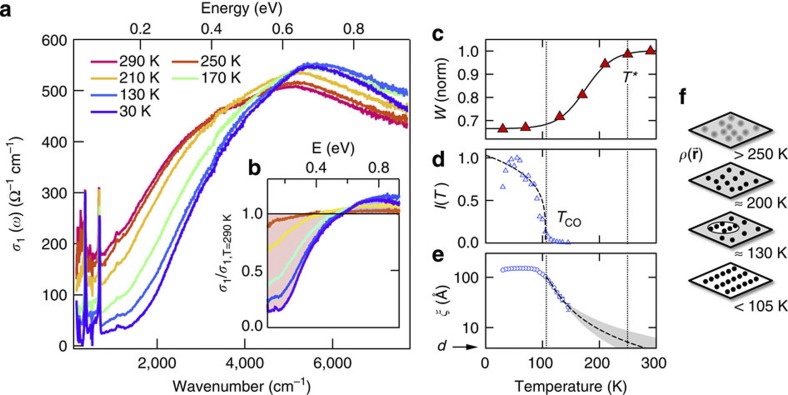
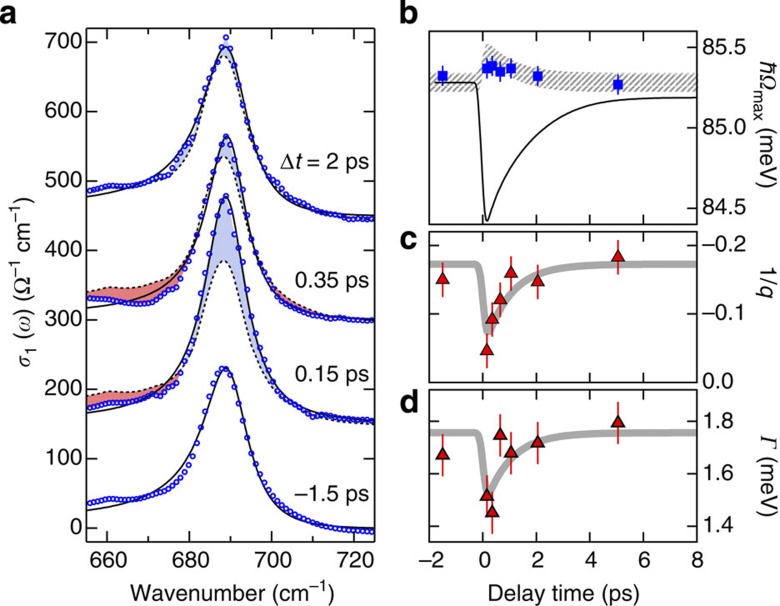
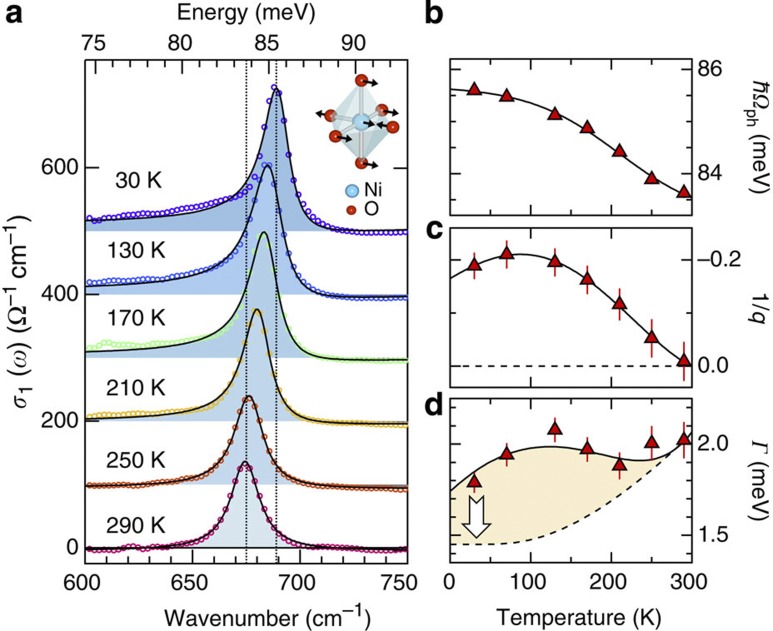
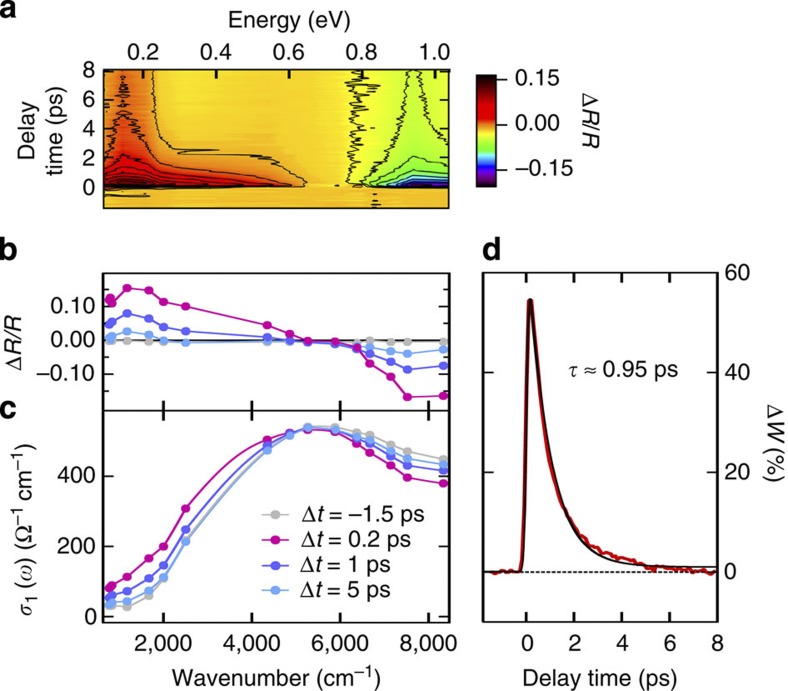
Self-organized electronically ordered phases are a recurring feature in correlated materials, resulting in, for example, fluctuating charge stripes whose role in high-TC superconductivity is under debate. However, the relevant cause-effect relations between real-space charge correlations and low-energy excitations remain hidden in time-averaged studies. Here we reveal ultrafast charge localization and lattice vibrational coupling as dynamic precursors of stripe formation in the model compound La(1.75)Sr(0.25)NiO4, using ultrafast and equilibrium mid-infrared spectroscopy. The opening of a pseudogap at a crossover temperature T* far above long-range stripe formation establishes the onset of electronic localization, which is accompanied by an enhanced Fano asymmetry of Ni-O stretch vibrations. Ultrafast excitation triggers a sub-picosecond dynamics exposing the synchronous modulation of electron-phonon coupling and charge localization. These results illuminate the role of localization in forming the pseudogap in nickelates, opening a path to understanding this mysterious phase in a broad class of complex oxides.
自组织的电子有序相是关联材料中反复出现的特征,导致例如电荷条纹的涨落,其在高温超导中的作用仍存在争议。然而,在时间平均研究中,实空间电荷关联和低能激发之间的相关因果关系仍然隐藏着。在这里,我们使用超快和平衡中红外光谱揭示了模型化合物 La(1.75)Sr(0.25)NiO4 中条纹形成的超快电荷局域化和晶格振动耦合的动态前体。在远高于长程条纹形成的交叉温度 T*处赝能隙的打开确立了电子局域化的开始,这伴随着 Ni-O 伸缩振动的增强的 Fano 不对称性。超快激发引发了亚皮秒动力学,暴露了电子-声子耦合和电荷局域化的同步调制。这些结果阐明了局域化在镍酸盐中形成赝能隙的作用,为理解这一在广泛的复杂氧化物类中的神秘相开辟了一条途径。