Division of Medical Oncology, Department of Internal Medicine, Yonsei University College of Medicine, Seoul, Korea.
Cancer Res Treat. 2013 Sep;45(3):226-33. doi: 10.4143/crt.2013.45.3.226. Epub 2013 Sep 30.
A population-based study was conducted in order to examine the characteristics of family members of cancer patients in comparison with the general population and also to evaluate the psychosocial impact of cancer patients on their family members.
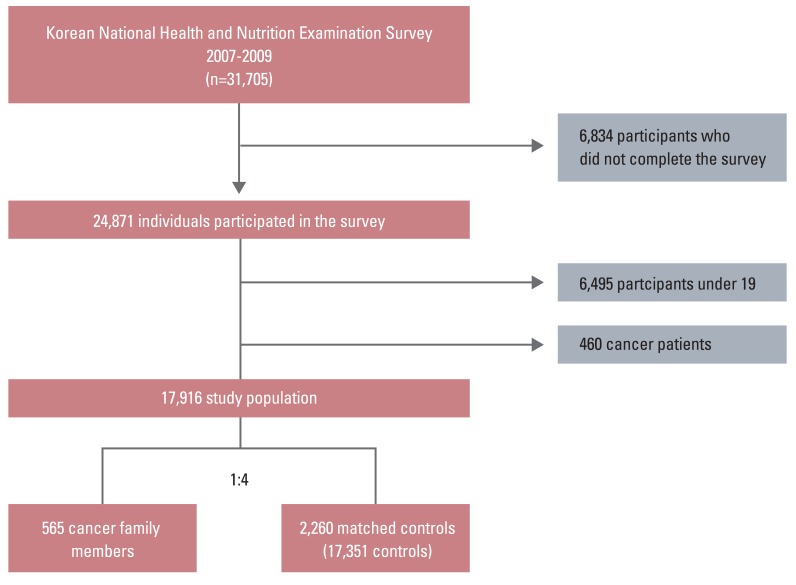
From the Fourth Korea National Health and Nutrition Examination Surveys (KNHANES IV) (2007-2009) dataset, we identified 460 cancer patients and then selected family members of these patients who were aged 20 years or older (n=565). The control group was sampled from members of families without a cancer patient with matching for sex and age (n=2,260). Serial conditional logistic regression models were used for comparison of characteristics between family members of cancer patients and subjects in the control group.
Family members of cancer patients were less employed (57.9% vs. 63.0%, p<0.001), more functionally limited (20.2% vs. 16.5%, p=0.032), and had lower self-rated health (p=0.023) compared with sex and age-matched control subjects. They also had a significantly higher level of stress (79.7% vs. 76.1%, p=0.008), history of depression (12.9% vs. 10.2%, p=0.035), and current depressive symptoms (5.5% vs. 3.5%, p=0.038). However, higher physical activity was reported in family members of cancer patients (13.6% vs. 9.6%, p=0.003) than in control subjects. The presence of a cancer patient in the family showed an association with current depressive symptoms (odds ratio, 1.62; 95% confidence interval, 1.05 to 2.48; p=0.028), however, the association was no longer significant after adjustment for household income, education level, and employment status (p=0.304).
Family members of cancer patients are more susceptible to depression, probably due to adverse change in socioeconomic status. Use of multidisciplinary approaches for promotion of psychological health and well-being is essential.
本研究旨在通过对癌症患者家庭成员与普通人群的特征进行比较,评估癌症患者对其家庭成员的心理社会影响。
我们从第四次韩国国家健康和营养检查调查(KNHANES IV)(2007-2009 年)的数据集中确定了 460 名癌症患者,然后选择了这些患者年龄在 20 岁及以上的家庭成员(n=565)。对照组是从没有癌症患者的家庭中选择的,与性别和年龄相匹配的家庭成员(n=2260)。采用连续条件逻辑回归模型比较癌症患者家庭成员和对照组之间的特征。
与性别和年龄匹配的对照组相比,癌症患者的家庭成员的就业率较低(57.9% vs. 63.0%,p<0.001),功能受限程度较高(20.2% vs. 16.5%,p=0.032),自我健康评估较低(p=0.023)。他们的压力水平也显著较高(79.7% vs. 76.1%,p=0.008),有抑郁史的比例较高(12.9% vs. 10.2%,p=0.035),当前抑郁症状的比例较高(5.5% vs. 3.5%,p=0.038)。然而,癌症患者家庭成员报告的身体活动水平较高(13.6% vs. 9.6%,p=0.003)。家庭中有癌症患者与当前抑郁症状有关(比值比,1.62;95%置信区间,1.05 至 2.48;p=0.028),但在调整家庭收入、教育水平和就业状况后,关联不再显著(p=0.304)。
癌症患者的家庭成员更容易患抑郁症,可能是由于社会经济地位的不利变化。因此,有必要采用多学科方法促进他们的心理健康和幸福感。