Lenzken Silvia C, Loffreda Alessia, Barabino Silvia M L
Department of Biotechnology and Biosciences, University of Milano-Bicocca, Piazza della Scienza 2, I-20126 Milan, Italy.
Int J Cell Biol. 2013;2013:153634. doi: 10.1155/2013/153634. Epub 2013 Sep 12.
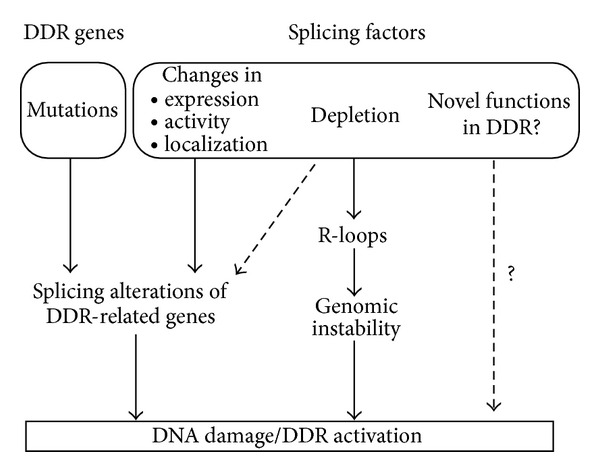
It is widely accepted that tumorigenesis is a multistep process characterized by the sequential accumulation of genetic alterations. However, the molecular basis of genomic instability in cancer is still partially understood. The observation that hereditary cancers are often characterized by mutations in DNA repair and checkpoint genes suggests that accumulation of DNA damage is a major contributor to the oncogenic transformation. It is therefore of great interest to identify all the cellular pathways that contribute to the response to DNA damage. Recently, RNA processing has emerged as a novel pathway that may contribute to the maintenance of genome stability. In this review, we illustrate several different mechanisms through which pre-mRNA splicing and genomic stability can influence each other. We specifically focus on the role of splicing factors in the DNA damage response and describe how, in turn, activation of the DDR can influence the activity of splicing factors.
人们普遍认为肿瘤发生是一个多步骤过程,其特征是基因改变的逐步积累。然而,癌症中基因组不稳定的分子基础仍未完全明了。遗传性癌症常以DNA修复和检查点基因的突变为特征,这一观察结果表明DNA损伤的积累是致癌转化的主要因素。因此,确定所有参与DNA损伤反应的细胞途径具有重要意义。最近,RNA加工已成为一种可能有助于维持基因组稳定性的新途径。在这篇综述中,我们阐述了前体mRNA剪接和基因组稳定性相互影响的几种不同机制。我们特别关注剪接因子在DNA损伤反应中的作用,并描述DNA损伤反应的激活如何反过来影响剪接因子的活性。