The School of Biomedical Sciences and Pharmacy, The University of Newcastle Callaghan, NSW, Australia.
Front Pharmacol. 2013 Oct 24;4:132. doi: 10.3389/fphar.2013.00132. eCollection 2013.
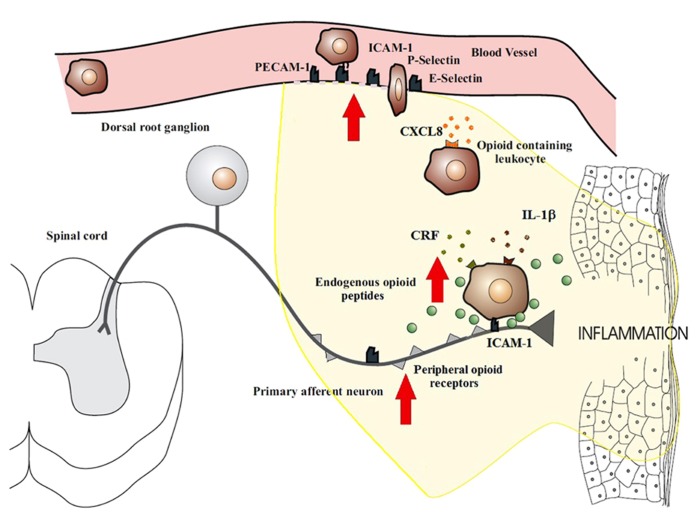
Mechanisms of endogenous pain control are significant. Increasing studies have clearly produced evidence for the clinical usefulness of opioids in peripheral analgesia. The immune system uses mechanisms of cell migration not only to fight pathogens but also to control pain and inflammation within injured tissue. It has been demonstrated that peripheral inflammatory pain can be effectively controlled by an interaction of immune cell-derived opioid peptides with opioid receptors on peripheral sensory nerve terminals. Experimental and clinical studies have clearly shown that activation of peripheral opioid receptors with exogenous opioid agonists and endogenous opioid peptides are able to produce significant analgesic and anti-inflammatory effects, without central opioid mediated side effects (e.g., respiratory depression, sedation, tolerance, dependence). This article will focus on the role of opioids in peripheral inflammatory conditions and the clinical implications of targeting peripheral opioid receptors.
内源性疼痛控制机制非常重要。越来越多的研究清楚地证明了阿片类药物在外周镇痛中的临床应用价值。免疫系统利用细胞迁移的机制不仅可以对抗病原体,还可以控制受伤组织内的疼痛和炎症。已经证明,外周炎性疼痛可以通过免疫细胞衍生的阿片肽与外周感觉神经末梢上的阿片受体相互作用得到有效控制。实验和临床研究清楚地表明,用外源性阿片类激动剂和内源性阿片肽激活外周阿片受体,可以产生显著的镇痛和抗炎作用,而不会产生中枢阿片介导的副作用(例如,呼吸抑制、镇静、耐受、依赖)。本文将重点介绍阿片类药物在外周炎症中的作用,以及针对外周阿片受体的临床意义。