
赖氨酰氧化酶原肽中新型 SH3 结构域结合基序抑制 CIN85 介导的侵袭。
Inhibition of CIN85-mediated invasion by a novel SH3 domain binding motif in the lysyl oxidase propeptide.
机构信息
Department of Developmental, Molecular and Chemical Biology, Tufts University School of Medicine, Boston, Massachusetts, United States of America.
出版信息
PLoS One. 2013 Oct 22;8(10):e77288. doi: 10.1371/journal.pone.0077288. eCollection 2013.
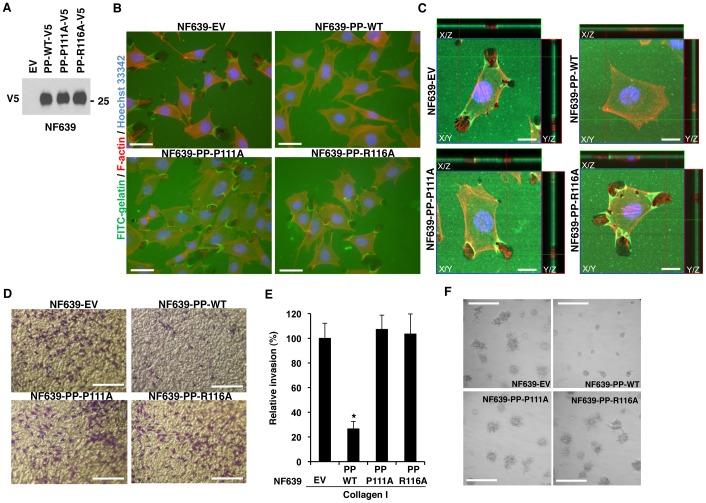
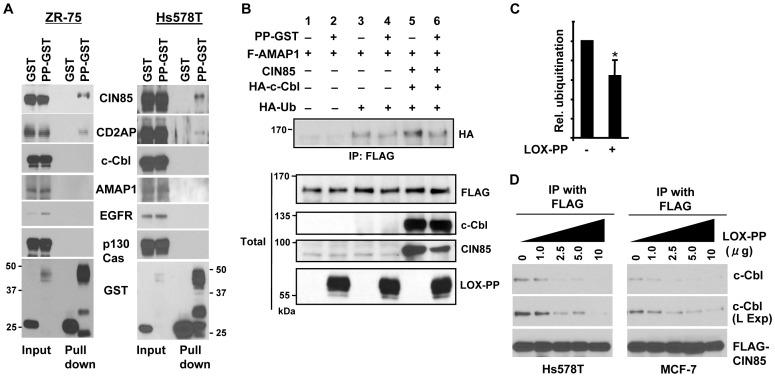
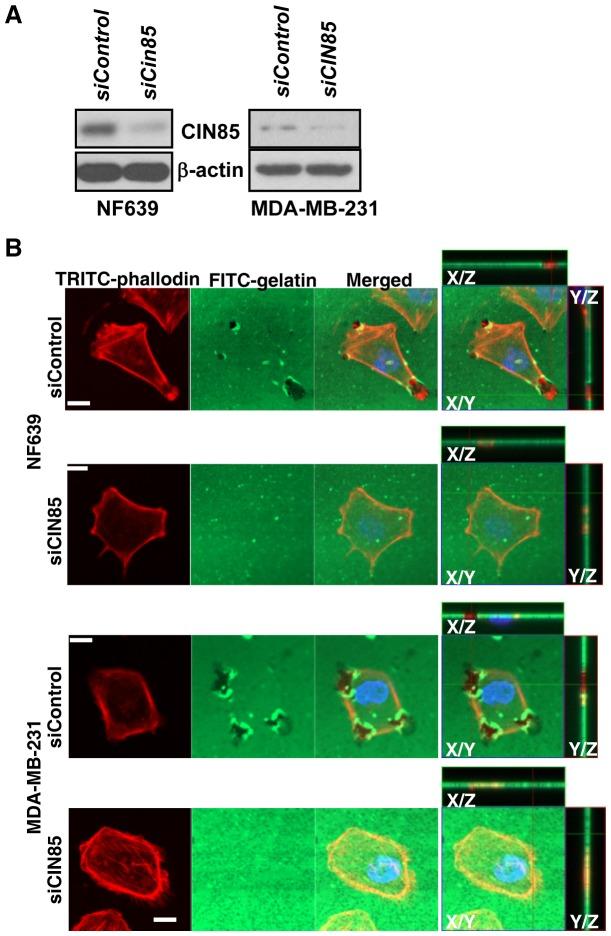
The lysyl oxidase gene inhibits Ras signaling in transformed fibroblasts and breast cancer cells. Its activity was mapped to the 162 amino acid propeptide domain (LOX-PP) of the lysyl oxidase precursor protein. LOX-PP inhibited the Her-2/Ras signaling axis in breast cancer cells, and reduced the Her-2-driven breast tumor burden in a xenograft model. Since its mechanism of action is largely unknown, co-affinity-purification/mass spectrometry was performed and the "Cbl-interacting protein of 85-kDa" (CIN85) identified as an associating protein. CIN85 is an SH3-containing adapter protein that is overexpressed in invasive breast cancers. The CIN85 SH3 domains interact with c-Cbl, an E3 ubiquitin ligase, via an unconventional PxxxPR ligand sequence, with the highest affinity displayed by the SH3-B domain. Interaction with CIN85 recruits c-Cbl to the AMAP1 complex where its ubiquitination activity is necessary for cancer cells to develop an invasive phenotype and to degrade the matrix. Direct interaction of LOX-PP with CIN85 was confirmed using co-immunoprecipitation analysis of lysates from breast cancer cells and of purified expressed proteins. CIN85 interaction with c-Cbl was reduced by LOX-PP. Domain specific CIN85 regions and deletion mutants of LOX-PP were prepared and used to map the sites of interaction to the SH3-B domain of CIN85 and to an epitope encompassing amino acids 111 to 116 of LOX-PP. Specific LOX-PP point mutant proteins P111A and R116A failed to interact with CIN85 or to compete for CIN85 binding with c-Cbl. Structural modeling identified a new atypical PxpxxRh SH3-binding motif in this region of LOX-PP. The LOX-PP interaction with CIN85 was shown to reduce the invasive phenotype of breast cancer cells, including their ability to degrade the surrounding extracellular matrix and for Matrigel outgrowth. Thus, LOX-PP interacts with CIN85 via a novel SH3-binding motif and this association reduces CIN85-promoted invasion by breast cancer cells.
赖氨酰氧化酶基因抑制转化成纤维细胞和乳腺癌细胞中的 Ras 信号。其活性被映射到赖氨酰氧化酶前体蛋白的 162 个氨基酸原肽结构域(LOX-PP)。LOX-PP 抑制乳腺癌细胞中的 Her-2/Ras 信号轴,并减少异种移植模型中 Her-2 驱动的乳腺肿瘤负担。由于其作用机制在很大程度上尚不清楚,因此进行了共亲和纯化/质谱分析,并鉴定出“Cbl 相互作用的 85kDa 蛋白”(CIN85)为相关蛋白。CIN85 是一种含有 SH3 的衔接蛋白,在侵袭性乳腺癌中过度表达。CIN85 的 SH3 结构域通过非传统的 PxxxPR 配体序列与 E3 泛素连接酶 c-Cbl 相互作用,其中 SH3-B 结构域显示出最高的亲和力。与 CIN85 的相互作用将 c-Cbl 招募到 AMAP1 复合物中,在该复合物中,其泛素化活性对于癌细胞发展侵袭表型和降解基质是必需的。使用来自乳腺癌细胞的裂解物的共免疫沉淀分析和纯化表达蛋白直接证实了 LOX-PP 与 CIN85 的直接相互作用。LOX-PP 降低了 CIN85 与 c-Cbl 的相互作用。制备了特定的 CIN85 区域和 LOX-PP 的缺失突变体,并用于将相互作用位点映射到 CIN85 的 SH3-B 结构域和 LOX-PP 的包含氨基酸 111 到 116 的表位上。特定的 LOX-PP 点突变蛋白 P111A 和 R116A 未能与 CIN85 相互作用或与 c-Cbl 竞争 CIN85 结合。结构建模在 LOX-PP 的该区域中鉴定出一个新的非典型 PxpxxRh SH3 结合基序。LOX-PP 与 CIN85 的相互作用降低了乳腺癌细胞的侵袭表型,包括它们降解周围细胞外基质和 Matrigel 外生的能力。因此,LOX-PP 通过新型 SH3 结合基序与 CIN85 相互作用,这种关联降低了 CIN85 促进的乳腺癌细胞侵袭。



 Zotero 插件