Amylin Pharmaceuticals LLC, San Diego, California, United States of America.
PLoS One. 2013 Oct 22;8(10):e78154. doi: 10.1371/journal.pone.0078154. eCollection 2013.
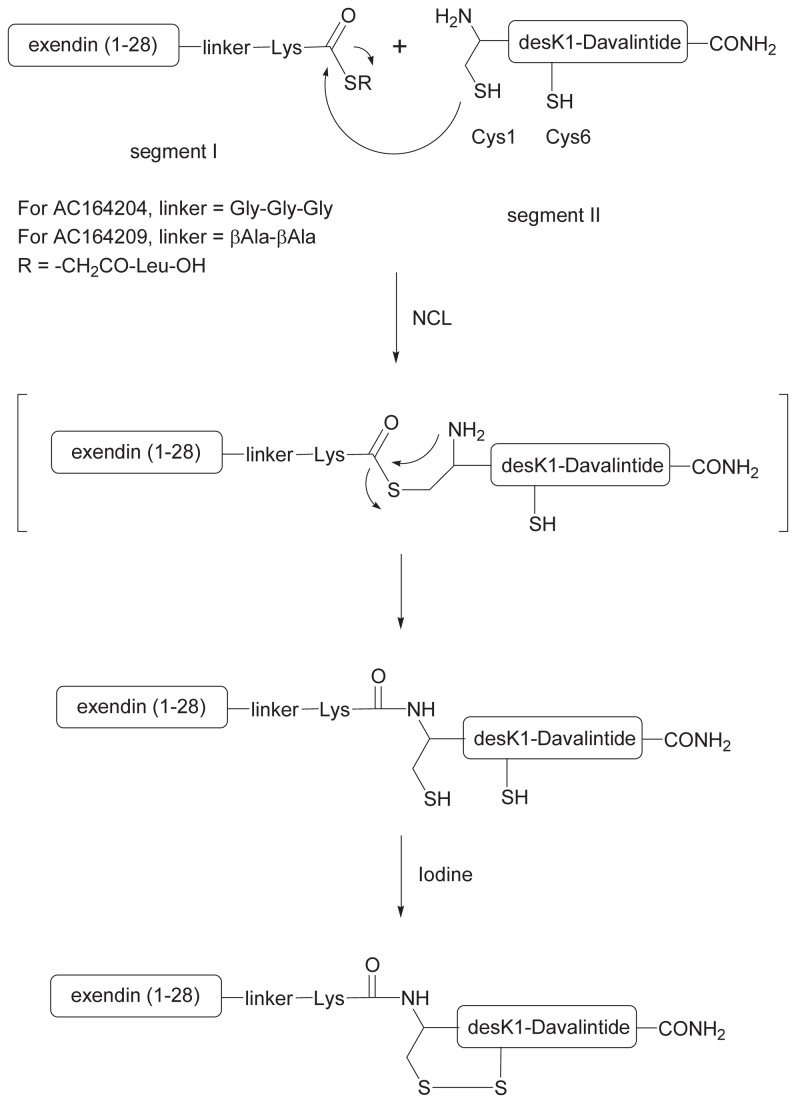
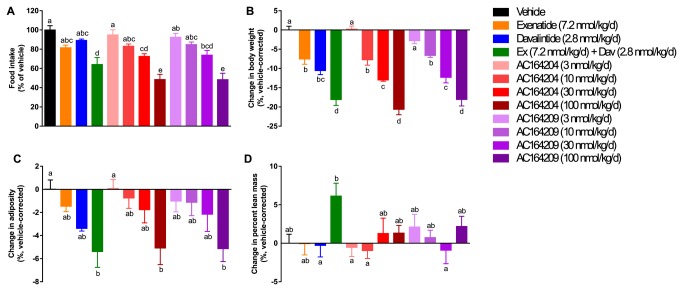
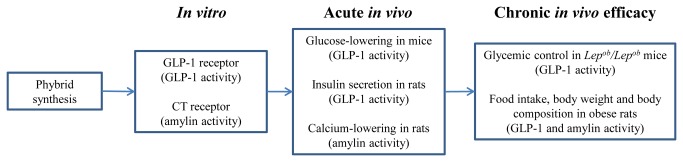
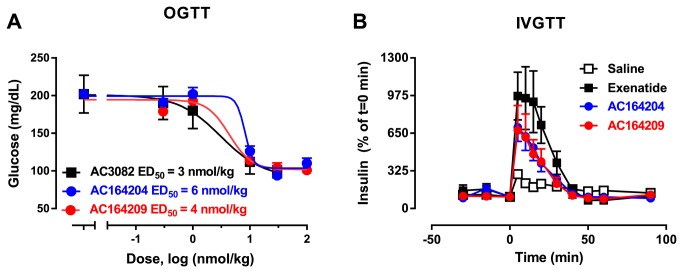
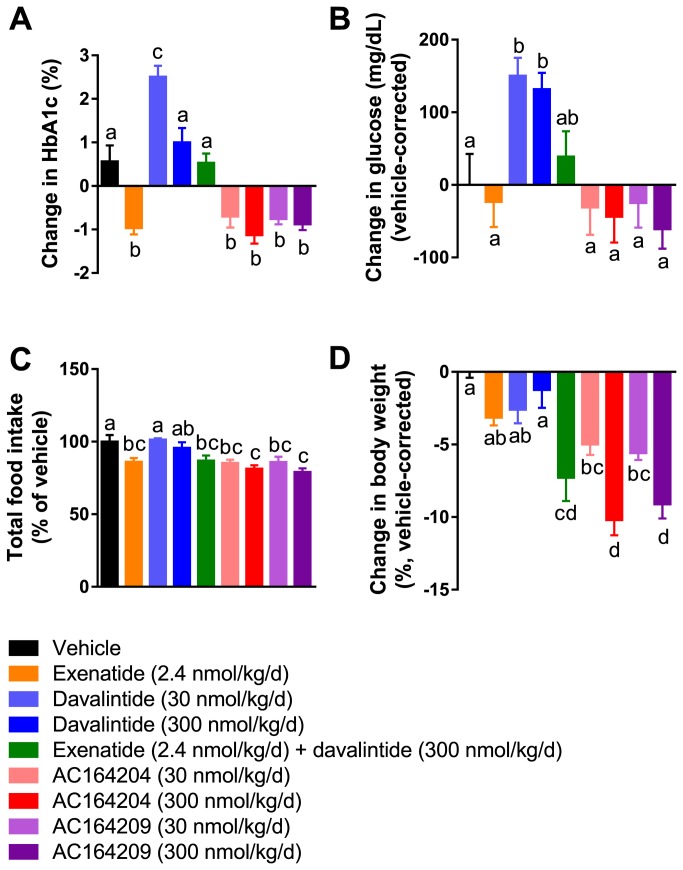
Combination therapy is being increasingly used as a treatment paradigm for metabolic diseases such as diabetes and obesity. In the peptide therapeutics realm, recent work has highlighted the therapeutic potential of chimeric peptides that act on two distinct receptors, thereby harnessing parallel complementary mechanisms to induce additive or synergistic benefit compared to monotherapy. Here, we extend this hypothesis by linking a known anti-diabetic peptide with an anti-obesity peptide into a novel peptide hybrid, which we termed a phybrid. We report on the synthesis and biological activity of two such phybrids (AC164204 and AC164209), comprised of a glucagon-like peptide-1 receptor (GLP1-R) agonist, and exenatide analog, AC3082, covalently linked to a second generation amylin analog, davalintide. Both molecules acted as full agonists at their cognate receptors in vitro, albeit with reduced potency at the calcitonin receptor indicating slightly perturbed amylin agonism. In obese diabetic Lep(ob)/Lep (ob) mice sustained infusion of AC164204 and AC164209 reduced glucose and glycated haemoglobin (HbA1c) equivalently but induced greater weight loss relative to exenatide administration alone. Weight loss was similar to that induced by combined administration of exenatide and davalintide. In diet-induced obese rats, both phybrids dose-dependently reduced food intake and body weight to a greater extent than exenatide or davalintide alone, and equal to co-infusion of exenatide and davalintide. Phybrid-mediated and exenatide + davalintide-mediated weight loss was associated with reduced adiposity and preservation of lean mass. These data are the first to provide in vivo proof-of-concept for multi-pathway targeting in metabolic disease via a peptide hybrid, demonstrating that this approach is as effective as co-administration of individual peptides.
联合治疗作为一种治疗糖尿病和肥胖症等代谢疾病的治疗模式,其应用越来越广泛。在肽类治疗领域,最近的研究强调了作用于两个不同受体的嵌合肽的治疗潜力,从而利用平行互补机制与单药治疗相比,诱导附加或协同益处。在这里,我们通过将一种已知的抗糖尿病肽与一种抗肥胖肽连接成一种新型的肽杂合体(我们称之为 phybrid),扩展了这一假说。我们报告了两种 phybrid(AC164204 和 AC164209)的合成和生物学活性,它们由胰高血糖素样肽-1 受体(GLP1-R)激动剂和 exenatide 类似物 AC3082 与第二代胰淀素类似物 davalintide 共价连接而成。这两种分子在体外均作为其同源受体的完全激动剂,但在降钙素受体上的效力降低,表明胰淀素激动作用略有改变。在肥胖型糖尿病 Lep(ob)/Lep (ob) 小鼠中,AC164204 和 AC164209 的持续输注可降低血糖和糖化血红蛋白(HbA1c),但与单独给予 exenatide 相比,诱导的体重减轻更大。体重减轻与联合给予 exenatide 和 davalintide 诱导的体重减轻相似。在饮食诱导的肥胖大鼠中,两种 phybrid 均以剂量依赖的方式降低食物摄入量和体重,其效果大于单独给予 exenatide 或 davalintide,与 exenatide 和 davalintide 共同输注的效果相当。phybrid 介导的和 exenatide +davalintide 介导的体重减轻与减少肥胖和保持瘦体重有关。这些数据首次提供了体内证据,证明通过肽杂合体对代谢疾病进行多途径靶向治疗是有效的,与单独给予个体肽一样有效。