Delft Bioinformatics Lab, Delft University of Technology, Mekelweg 4, 2628 CD Delft, The Netherlands, Department of Clinical Genetics, VU University Medical Center Amsterdam, van der Boechorststraat 7 (BS7/J377), 1081 BT Amsterdam, The Netherlands and Department of Clinical Chemistry, VU University Medical Center Amsterdam, van der Boechorststraat 7 (BS7/J377), 1081 BT Amsterdam, The Netherlands.
Nucleic Acids Res. 2014 Mar;42(5):e31. doi: 10.1093/nar/gkt992. Epub 2013 Oct 28.
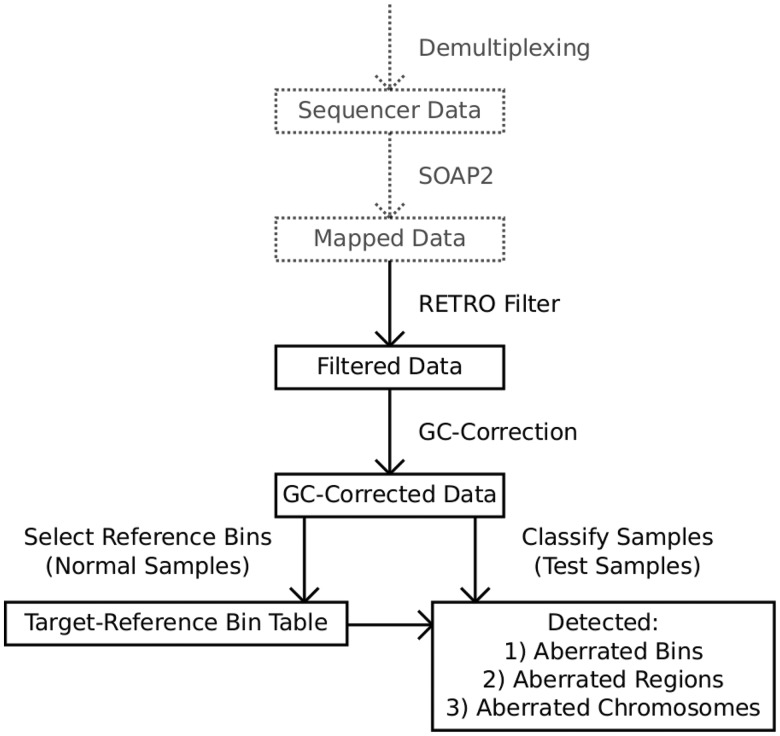
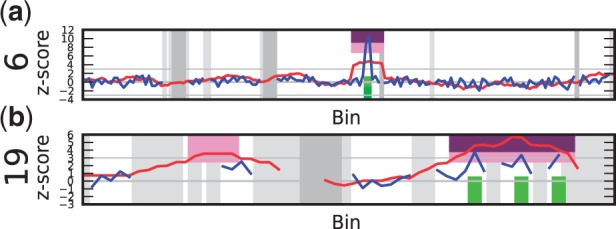
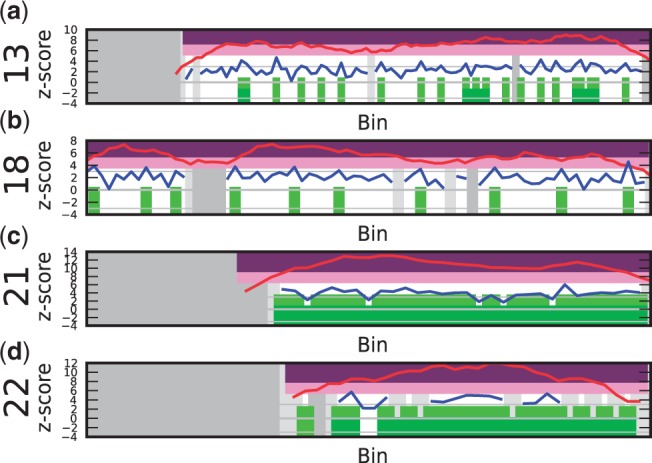
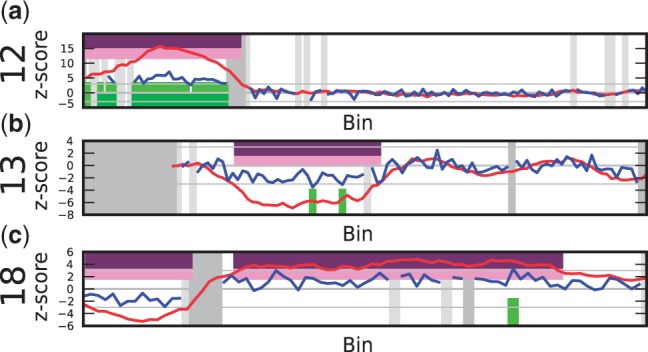
Genetic disorders can be detected by prenatal diagnosis using Chorionic Villus Sampling, but the 1:100 chance to result in miscarriage restricts the use to fetuses that are suspected to have an aberration. Detection of trisomy 21 cases noninvasively is now possible owing to the upswing of next-generation sequencing (NGS) because a small percentage of fetal DNA is present in maternal plasma. However, detecting other trisomies and smaller aberrations can only be realized using high-coverage NGS, making it too expensive for routine practice. We present a method, WISECONDOR (WIthin-SamplE COpy Number aberration DetectOR), which detects small aberrations using low-coverage NGS. The increased detection resolution was achieved by comparing read counts within the tested sample of each genomic region with regions on other chromosomes that behave similarly in control samples. This within-sample comparison avoids the need to re-sequence control samples. WISECONDOR correctly identified all T13, T18 and T21 cases while coverages were as low as 0.15-1.66. No false positives were identified. Moreover, WISECONDOR also identified smaller aberrations, down to 20 Mb, such as del(13)(q12.3q14.3), +i(12)(p10) and i(18)(q10). This shows that prevalent fetal copy number aberrations can be detected accurately and affordably by shallow sequencing maternal plasma. WISECONDOR is available at bioinformatics.tudelft.nl/wisecondor.
遗传疾病可以通过绒毛膜绒毛取样进行产前诊断,但 1:100 的流产风险限制了该方法仅用于疑似存在异常的胎儿。由于新一代测序(NGS)的兴起,现在可以无创检测三体 21 病例,因为母体血浆中存在少量胎儿 DNA。然而,要检测其他三体和较小的异常,只能使用高覆盖率的 NGS,这使得其在常规实践中过于昂贵。我们提出了一种方法,WISECONDOR(Within-Sample COpy Number aberration DetectOR),它使用低覆盖率 NGS 检测小的异常。通过比较每个基因组区域的测试样本中的读取计数与在对照样本中表现相似的其他染色体上的区域,提高了检测分辨率。这种样本内比较避免了重新测序对照样本的需要。WISECONDOR 正确识别了所有 T13、T18 和 T21 病例,而覆盖率低至 0.15-1.66。未发现假阳性。此外,WISECONDOR 还可以识别更小的异常,低至 20Mb,如 del(13)(q12.3q14.3)、+i(12)(p10)和 i(18)(q10)。这表明,可以通过浅层测序母体血浆准确且经济地检测到常见的胎儿拷贝数异常。WISECONDOR 可在 bioinformatics.tudelft.nl/wisecondor 上获得。