Institute of Gerontology, Universiti Putra Malaysia, Serdang, Selangor, Malaysia.
Clin Interv Aging. 2013;8:1413-20. doi: 10.2147/CIA.S51877. Epub 2013 Oct 21.
There is a growing body of literature indicating that attitudes toward aging significantly affect older adults' psychological well-being. However, there is a paucity of scientific investigations examining the role of older adults' attitudes toward aging on their spouses' psychological well-being. Therefore, the present study aimed to examine the dyadic effects of attitude toward aging on the psychological well-being of older couples.
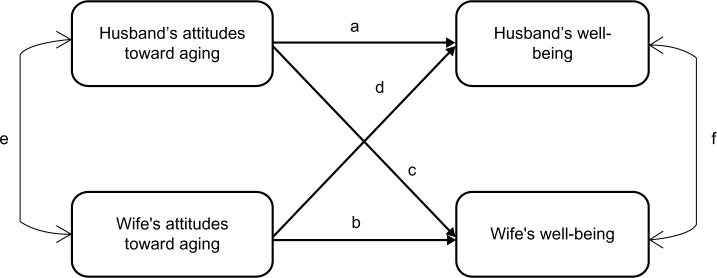
Data for the present study, consisting of 300 couples aged 50 years and older, were drawn from a community-based survey entitled "Poverty among Elderly Women: Case Study of Amanah Ikhtiar" conducted in Peninsular Malaysia. An actor-partner interdependence model using AMOS version 20 (Europress Software, Cheshire, UK) was used to analyze the dyadic data.
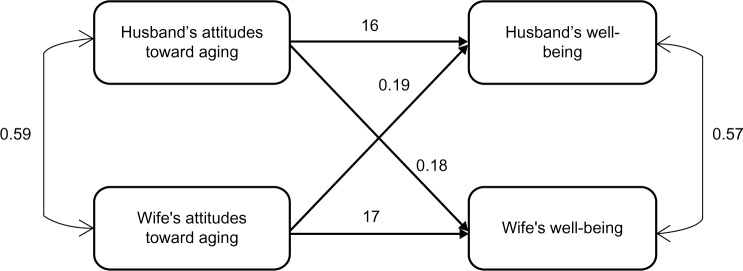
The mean ages of the husbands and wives in this sample were 60.37 years (±6.55) and 56.33 years (±5.32), respectively. Interdependence analyses revealed significant association between older adults' attitudes toward aging and the attitudes of their spouses (intraclass correlation =0.59; P<0.001), and similar interdependence was found for psychological well-being (intraclass correlation =0.57; P<0.001). The findings from AMOS revealed that the proposed model fits the data (CMIN/degrees of freedom =3.23; goodness-of-fit index =0.90; confirmatory fit index =0.91; root mean square error of approximation =0.08). Results of the actor-partner independence model indicated that older adults' psychological well-being is significantly predicted by their spouses' attitudes toward aging, both among older men (critical ratio =2.92; P<0.01) and women (critical ratio =2.70; P<0.01). Husbands' and wives' own reports of their attitudes toward aging were significantly correlated with their own and their spouses' psychological well-being.
The findings from this study supported the proposed Spousal Attitude-Well-Being Model, where older adults' attitudes toward aging significantly affected their own and their spouses' psychological well-being. The theoretical and practical implications of the findings are discussed.
越来越多的文献表明,对衰老的态度会显著影响老年人的心理健康。然而,目前科学研究中,检验老年人对衰老的态度对其配偶心理健康影响的研究还很少。因此,本研究旨在检验老年夫妇对衰老的态度的对双方心理健康的影响。
本研究的数据来自马来西亚半岛一项名为“老年人伊赫塔投资计划贫困状况:案例研究”的社区调查,共包括 300 对年龄在 50 岁及以上的夫妇。使用 AMOS 版本 20(英国柴郡 Europress 软件公司)的 actor-partner interdependence model 对这些数据进行了分析。
本研究样本中丈夫和妻子的平均年龄分别为 60.37 岁(±6.55)和 56.33 岁(±5.32)。相互依存关系分析显示,老年人对衰老的态度与配偶的态度之间存在显著关联(组内相关系数=0.59;P<0.001),心理健康状况也存在类似的相互依存关系(组内相关系数=0.57;P<0.001)。AMOS 的分析结果表明,所提出的模型拟合数据(CMIN/自由度=3.23;拟合优度指数=0.90;验证性拟合指数=0.91;均方根误差逼近值=0.08)。独立 actor-partner 模型的结果表明,老年人的心理健康状况可以由配偶对衰老的态度显著预测,这在男性(关键比率=2.92;P<0.01)和女性(关键比率=2.70;P<0.01)中都是如此。丈夫和妻子对衰老的态度的自我报告与他们自己和配偶的心理健康状况显著相关。
本研究的结果支持了所提出的配偶态度-幸福感模型,即老年人对衰老的态度显著影响他们自己和配偶的心理健康。讨论了这些发现的理论和实践意义。