Department of Biology, Center for Bionanotechnology and Environmental Research, Texas Southern University Houston, TX, USA ; Department of Environmental and Interdisciplinary Sciences, Texas Southern University Houston, TX, USA.
Front Cell Infect Microbiol. 2013 Oct 30;3:70. doi: 10.3389/fcimb.2013.00070. eCollection 2013.
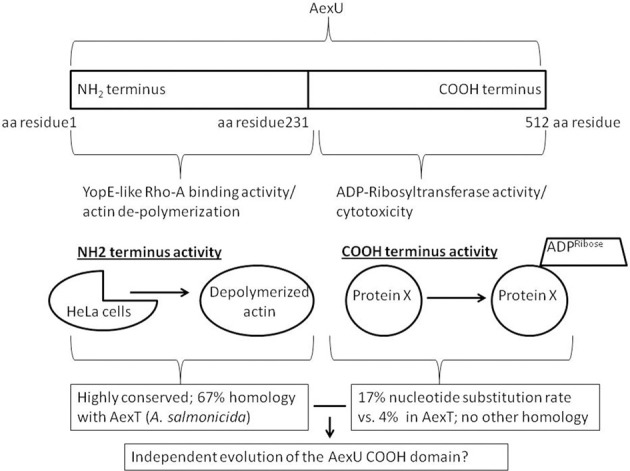
Like other pathogenic bacteria, Yersinia and Aeromonas species have been continuously co-evolving with their respective hosts. Although the former is a bonafide human pathogen, the latter has gained notararity as an emerging disease-causing agent. In response to immune cell challenges, bacterial pathogens have developed diverse mechanism(s) enabling their survival, and, at times, dominance over various host immune defense systems. The bacterial type three secretion system (T3SS) is evolutionarily derived from flagellar subunits and serves as a vehicle by which microbes can directly inject/translocate anti-host factors/effector proteins into targeted host immune cells. A large number of Gram-negative bacterial pathogens possess a T3SS empowering them to disrupt host cell signaling, actin cytoskeleton re-arrangements, and even to induce host-cell apoptotic and pyroptotic pathways. All pathogenic yersiniae and most Aeromonas species possess a T3SS, but they also possess T2- and T6-secreted toxins/effector proteins. This review will focus on the mechanisms by which the T3SS effectors Yersinia outer membrane protein J (YopJ) and an Aeromonas hydrophila AexU protein, isolated from the diarrheal isolate SSU, mollify host immune system defenses. Additionally, the mechanisms that are associated with host cell apoptosis/pyroptosis by Aeromonas T2SS secreted Act, a cytotoxic enterotoxin, and Hemolysin co-regulated protein (Hcp), an A. hydrophila T6SS effector, will also be discussed.
与其他病原菌一样,耶尔森菌和气单胞菌属一直在与其各自的宿主持续共同进化。虽然前者是一种真正的人类病原体,但后者已成为一种新兴的致病因子而被认可。为了应对免疫细胞的挑战,细菌病原体已经发展出多种机制,使它们能够在各种宿主免疫防御系统中生存下来,有时甚至占主导地位。细菌 III 型分泌系统(T3SS)是从鞭毛亚基进化而来的,是微生物可以直接将抗宿主因子/效应蛋白注入/转位到靶向宿主免疫细胞的工具。大量革兰氏阴性细菌病原体拥有 T3SS,使它们能够破坏宿主细胞信号、肌动蛋白细胞骨架重排,甚至诱导宿主细胞凋亡和焦亡途径。所有致病性耶尔森菌和大多数气单胞菌属都拥有 T3SS,但它们也拥有 T2 和 T6 分泌的毒素/效应蛋白。本综述将重点讨论 T3SS 效应蛋白耶尔森菌外膜蛋白 J(YopJ)和从腹泻分离株 SSU 中分离出的嗜水气单胞菌 AexU 蛋白如何缓解宿主免疫系统防御的机制。此外,还将讨论气单胞菌 T2SS 分泌的细胞毒素 Act,一种细胞毒性肠毒素,以及嗜水气单胞菌 T6SS 效应蛋白 Hcp 与宿主细胞凋亡/焦亡相关的机制。