Division of Human Nutrition, Faculty of Medicine and Health Sciences, Stellenbosch University, P,O Box 19063, Tygerberg 7505, South Africa.
BMC Med Res Methodol. 2013 Nov 13;13:137. doi: 10.1186/1471-2288-13-137.
There is little or no information available on the impact of funding by the food industry on trial outcomes and methodological quality of synbiotics, probiotics and prebiotics research in infants. The objective of this study was to compare the methodological quality, outcomes of food industry sponsored trials versus non industry sponsored trials, with regards to supplementation of synbiotics, probiotics and prebiotics in infant formula.
A comprehensive search was conducted to identify published and unpublished randomized clinical trials (RCTs). Cochrane methodology was used to assess the risk of bias of included RCTs in the following domains: 1) sequence generation; 2) allocation concealment; 3) blinding; 4) incomplete outcome data; 5) selective outcome reporting; and 6) other bias. Clinical outcomes and authors' conclusions were reported in frequencies and percentages. The association between source of funding, risk of bias, clinical outcomes and conclusions were assessed using Pearson's Chi-square test and the Fisher's exact test. A p-value < 0.05 was statistically significant.
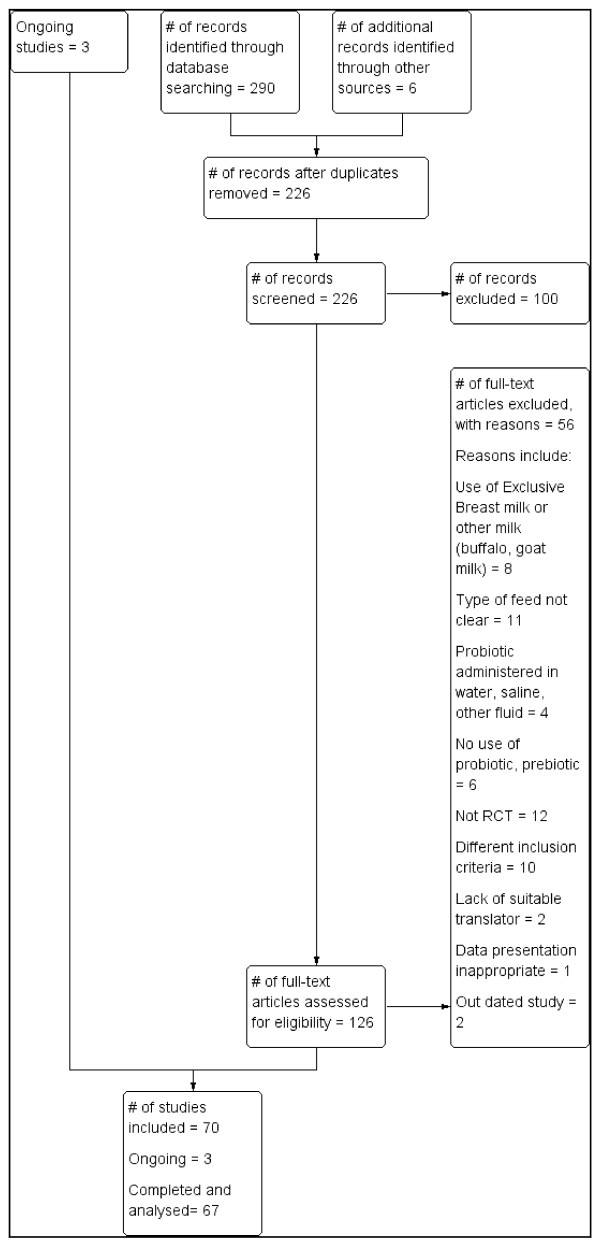
Sixty seven completed and 3 on-going RCTs were included. Forty (59.7%) were funded by food industry, 11 (16.4%) by non-industry entities and 16 (23.9%) did not specify source of funding. Several risk of bias domains, especially sequence generation, allocation concealment and blinding, were not adequately reported. There was no significant association between the source of funding and sequence generation, allocation concealment, blinding and selective reporting, majority of reported clinical outcomes or authors' conclusions. On the other hand, source of funding was significantly associated with the domains of incomplete outcome data, free of other bias domains as well as reported antibiotic use and conclusions on weight gain.
In RCTs on infants fed infant formula containing probiotics, prebiotics or synbiotics, the source of funding did not influence the majority of outcomes in favour of the sponsors' products. More non-industry funded research is needed to further assess the impact of funding on methodological quality, reported clinical outcomes and authors' conclusions.
关于食品行业的资金投入对婴儿用共生元、益生菌和益生元研究的试验结果和方法学质量的影响,目前信息很少或几乎没有。本研究的目的是比较食品行业赞助的试验与非行业赞助的试验在婴儿配方中添加共生元、益生菌和益生元的方法学质量、试验结果,以及行业赞助试验与非行业赞助试验在补充共生元、益生菌和益生元方面的结果差异。
进行了全面的搜索,以确定已发表和未发表的随机临床试验(RCT)。采用 Cochrane 方法评估纳入 RCT 的以下领域的偏倚风险:1)序列生成;2)分配隐藏;3)盲法;4)结局数据不完整;5)选择性报告结果;6)其他偏倚。以频率和百分比报告临床结局和作者的结论。使用 Pearson 卡方检验和 Fisher 确切检验评估资金来源、偏倚风险、临床结局和结论之间的关联。p 值<0.05 具有统计学意义。
纳入了 67 项已完成和 3 项正在进行的 RCT。其中 40 项(59.7%)由食品行业资助,11 项(16.4%)由非行业实体资助,16 项(23.9%)未说明资金来源。几个偏倚风险领域,特别是序列生成、分配隐藏和盲法,未得到充分报告。资金来源与序列生成、分配隐藏、盲法和选择性报告、大多数报告的临床结局或作者的结论之间没有显著关联。另一方面,资金来源与结局数据不完整、无其他偏倚领域以及报告的抗生素使用和体重增加的结论显著相关。
在婴儿配方中添加益生菌、益生元或共生元的 RCT 中,资金来源并没有影响大多数有利于赞助商产品的结局。需要更多的非行业资助研究来进一步评估资金对方法学质量、报告的临床结局和作者结论的影响。