
玻利维亚神经外科及圣克鲁斯德拉谢拉儿科神经外科的历史。
The history of neurosurgery in Bolivia and pediatric neurosurgery in Santa Cruz de la Sierra.
作者信息
Dabdoub Carlos F, Dabdoub Carlos B
机构信息
Division of Neurosurgery, Japanese University Hospital, Santa Cruz de la Sierra, Bolivia.
出版信息
Surg Neurol Int. 2013 Sep 25;4:123. doi: 10.4103/2152-7806.118937.
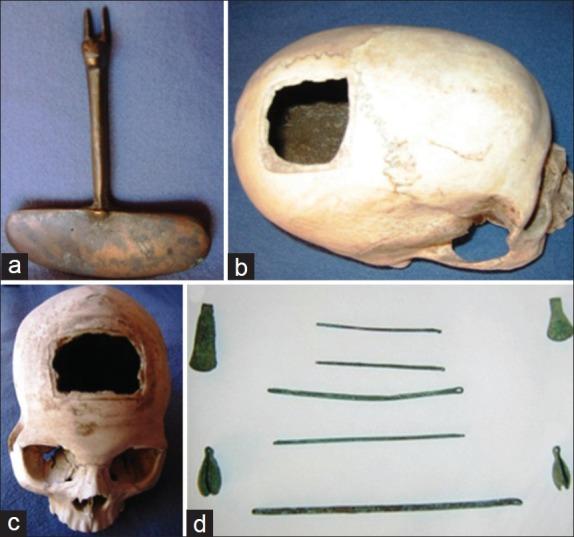
The practice of neurosurgery in Bolivia began thousands of years ago with skull trepanation. This procedure dates from the earliest period of the Tiwanaku culture, a preInca civilization. Neurosurgical development in Bolivia has its origins in the late 19(th) century and can be divided in two stages. At the beginning, before the advent of neurosurgery as a discipline, some general surgeons performed procedures on the skull and brain. Formal neurosurgery in Bolivia was developed with the arrival of neurosurgeons trained in the United States and some countries of South America. The Bolivian Neurosurgical Society was created in 1975. Nowadays, our national society has 74 members. It is affiliated with the World Federation of Neurosurgical Societies and the Latin American Federation of Neurosurgical Societies. Presently, neurosurgery in Bolivia is similar to that seen in developed countries. In this sense, government programs should dedicate more financial support to establish specialized healthcare centers where the management of complex central nervous system lesions could be offered. In contrast, we believe that encouraging the local training of young neurosurgeons is one of the most important factors in the development of neurosurgery in Bolivia or any other country.
玻利维亚的神经外科实践始于数千年前的颅骨环锯术。这一手术可追溯到蒂瓦纳库文化的早期,即印加文明之前的一个文明。玻利维亚的神经外科发展起源于19世纪后期,可分为两个阶段。起初,在神经外科作为一门学科出现之前,一些普通外科医生就对颅骨和脑部进行手术。随着在美国和南美洲一些国家接受培训的神经外科医生的到来,玻利维亚的正规神经外科得以发展。玻利维亚神经外科学会于1975年成立。如今,我们的全国性学会有74名成员。它隶属于世界神经外科学会联合会和拉丁美洲神经外科学会联合会。目前,玻利维亚的神经外科水平与发达国家相当。从这个意义上说,政府项目应提供更多财政支持,以建立专门的医疗中心,提供复杂中枢神经系统病变的治疗。相比之下,我们认为鼓励当地年轻神经外科医生的培训是玻利维亚或其他任何国家神经外科发展的最重要因素之一。




 Zotero 插件