Clinical Dementia Center and National Reference Center for TSE at Department of Neurology Georg-August University, , Göttingen, Germany.
J Neurol Neurosurg Psychiatry. 2014 Jun;85(6):654-9. doi: 10.1136/jnnp-2013-305978. Epub 2013 Nov 18.
In absence of a positive family history, the diagnosis of fatal familial insomnia (FFI) might be difficult because of atypical clinical features and low sensitivity of diagnostic tests. FFI patients usually do not fulfil the established classification criteria for Creutzfeldt-Jakob disease (CJD); therefore, a prion disease is not always suspected.
To propose an update of diagnostic pathway for the identification of patients for the analysis of D178-M129 mutation.
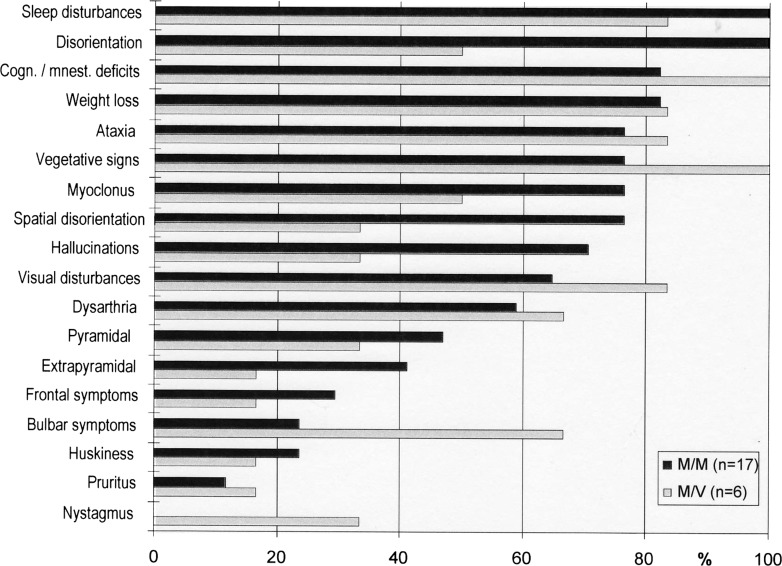
Data on 41 German FFI patients were analysed. Clinical symptoms and signs, MRI, PET, SPECT, polysomnography, EEG and cerebrospinal fluid biomarkers were studied.
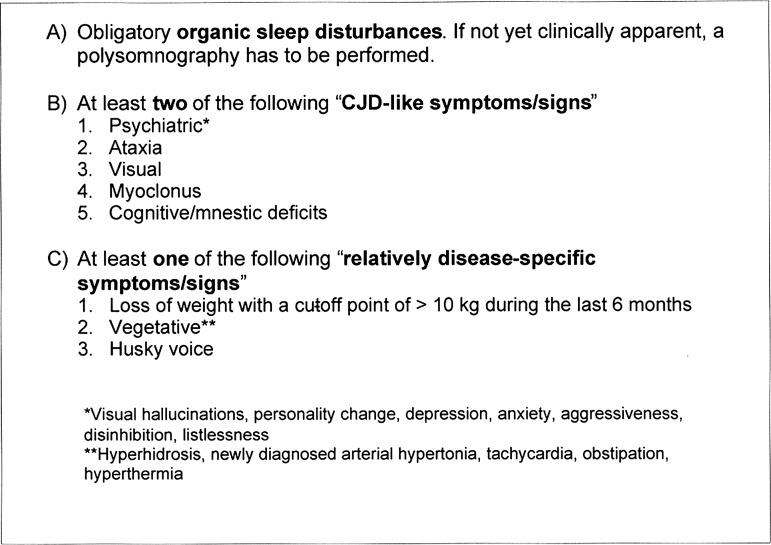
An algorithm was developed which correctly identified at least 81% of patients with the FFI diagnosis during early disease stages. It is based on the detection of organic sleep disturbances, either verified clinically or by a polysomnography, and a combination of vegetative and focal neurological signs and symptoms. Specificity of the approach was tested on three cohorts of patients (MM1 sporadic CJD patients, non-selected sporadic CJD and other neurodegenerative diseases).
The proposed scheme may help to improve the clinical diagnosis of FFI. As the sensitivity of all diagnostic tests investigated but polysomnography is low in FFI, detailed clinical investigation is of special importance.
由于缺乏阳性家族史,致命家族性失眠症(FFI)的诊断可能较为困难,因为其临床表现不典型且诊断测试的敏感性较低。FFI 患者通常不符合已确立的克雅氏病(CJD)分类标准;因此,并不总是怀疑存在朊病毒病。
提出一种更新的诊断途径,以识别需要分析 D178-M129 突变的患者。
分析了 41 名德国 FFI 患者的数据。研究了临床症状和体征、MRI、PET、SPECT、多导睡眠图、脑电图和脑脊液生物标志物。
开发了一种算法,该算法在疾病早期阶段正确识别出至少 81%的 FFI 诊断患者。它基于有机睡眠障碍的检测,要么通过多导睡眠图临床证实,要么通过多导睡眠图临床证实,结合植物神经和局灶性神经症状和体征。该方法的特异性已在三组患者(MM1 散发性 CJD 患者、非选择性散发性 CJD 和其他神经退行性疾病)中进行了测试。
所提出的方案可能有助于改善 FFI 的临床诊断。由于所研究的所有诊断测试的敏感性均较低,但多导睡眠图除外,因此详细的临床调查尤为重要。