Assumpção Juliana Godoy, Paula Francisco Danilo Ferreira, Xavier Sandra Guerra, Murao Mitiko, de Aguirre Joaquim Caetano, Dutra Alvaro Pimenta, Lima Eduardo Ribeiro, de Oliveira Benigna Maria, Viana Marcos Borato
Universidade Federal de Minas Gerais - UFMG, Belo Horizonte, MG, Brazil.
Rev Bras Hematol Hemoter. 2013;35(5):337-42. doi: 10.5581/1516-8484.20130115.
To detect markers for minimal residual disease monitoring based on conventional polymerase chain reaction for immunoglobulin, T-cell receptor rearrangements and the Sil-Tal1 deletion in patients with acute lymphocytic leukemia.
Fifty-nine children with acute lymphocytic leukemia from three institutions in Minas Gerais, Brazil, were prospectively studied. Clonal rearrangements were detected by polymerase chain reaction followed by homo/heteroduplex clonality analysis in DNA samples from diagnostic bone marrow. Follow-up samples were collected on Days 14 and 28-35 of the induction phase. The Kaplan-Meier and multivariate Cox methods were used for survival analysis.
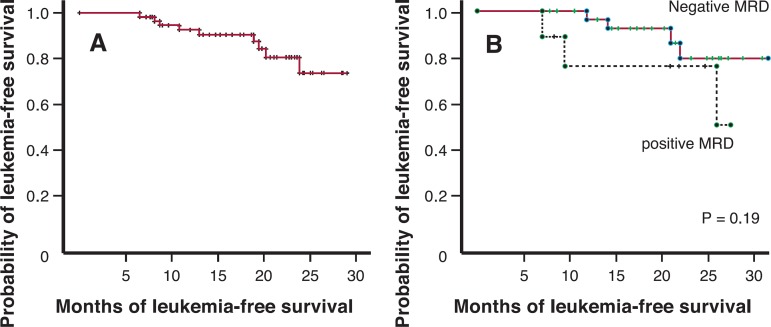
Immunoglobulin/T-cell receptor rearrangements were not detected in 5/55 children screened (9.0%). For precursor-B acute lymphocytic leukemia, the most frequent rearrangement was IgH (72.7%), then TCRG (61.4%), and TCRD and IgK (47.7%); for T-acute lymphocytic leukemia, TCRG (80.0%), and TCRD and Sil-Tal deletion (20.0%) were the most common. Minimal residual disease was detected in 35% of the cases on Day 14 and in 22.5% on Day 28-35. Minimal residual disease on Day 28-35, T-acute lymphocytic leukemia, and leukocyte count above 50 x 10(9)/L at diagnosis were bad prognostic factors for leukemia-free survival in univariate analysis. Relapse risk for minimal residual disease positive relative to minimal residual disease negative children was 8.5 times higher (95% confidence interval: 1.02-70.7).
Immunoglobulin/T-cell receptor rearrangement frequencies were similar to those reported before. Minimal residual disease is an independent prognostic factor for leukemia-free survival, even when based on a non-quantitative technique, but longer follow-ups are needed.
基于免疫球蛋白、T细胞受体重排及急性淋巴细胞白血病患者中Sil-Tal1缺失的常规聚合酶链反应,检测微小残留病监测的标志物。
对来自巴西米纳斯吉拉斯州三个机构的59例急性淋巴细胞白血病儿童进行前瞻性研究。通过聚合酶链反应检测克隆重排,随后对诊断性骨髓的DNA样本进行同源/异源双链克隆性分析。在诱导期的第14天和第28 - 35天收集随访样本。采用Kaplan-Meier法和多变量Cox法进行生存分析。
在55例筛查儿童中有5例(9.0%)未检测到免疫球蛋白/T细胞受体重排。对于前体B急性淋巴细胞白血病,最常见的重排是IgH(72.7%),然后是TCRG(61.4%),以及TCRD和IgK(47.7%);对于T急性淋巴细胞白血病,TCRG(80.0%)以及TCRD和Sil-Tal缺失(20.0%)最为常见。在第14天35%的病例中检测到微小残留病,在第28 - 35天为22.5%。单因素分析显示,第28 - 35天的微小残留病、T急性淋巴细胞白血病以及诊断时白细胞计数高于50×10⁹/L是无白血病生存的不良预后因素。微小残留病阳性儿童相对于微小残留病阴性儿童的复发风险高8.5倍(95%置信区间:1.02 - 70.7)。
免疫球蛋白/T细胞受体重排频率与之前报道的相似。微小残留病是无白血病生存的独立预后因素,即使基于非定量技术,但仍需要更长时间的随访。