
PAK 依赖性 STAT5 丝氨酸磷酸化是 BCR-ABL 诱导白血病发生所必需的。
PAK-dependent STAT5 serine phosphorylation is required for BCR-ABL-induced leukemogenesis.
机构信息
Institute of Pharmacology and Toxicology, University of Veterinary Medicine Vienna, Vienna, Austria.
GICC CNRS UMR 7292, Université François Rabelais, Tours, France.
出版信息
Leukemia. 2014 Mar;28(3):629-41. doi: 10.1038/leu.2013.351. Epub 2013 Nov 22.
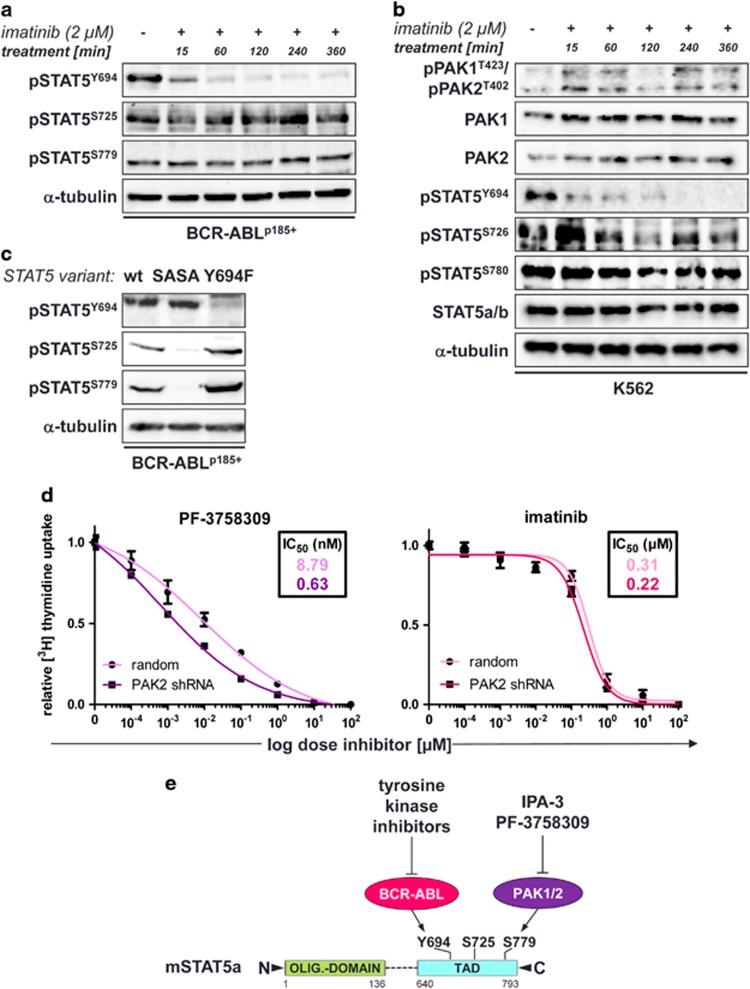
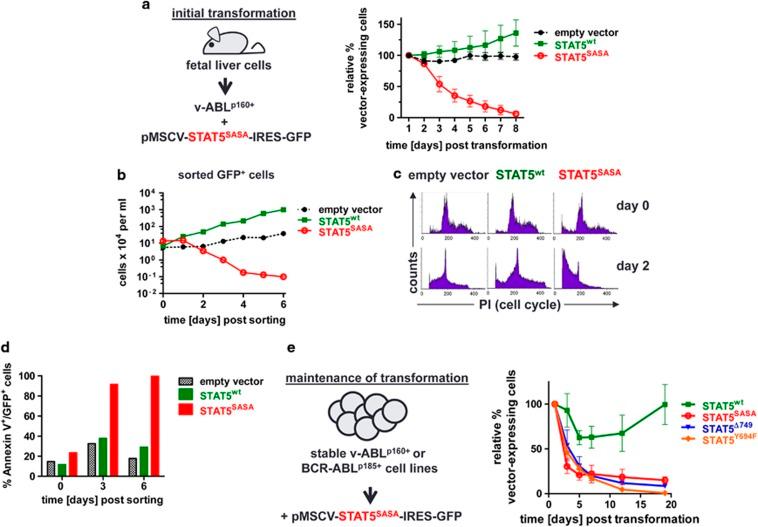
The transcription factor STAT5 (signal transducer and activator of transcription 5) is frequently activated in hematological malignancies and represents an essential signaling node downstream of the BCR-ABL oncogene. STAT5 can be phosphorylated at three positions, on a tyrosine and on the two serines S725 and S779. We have investigated the importance of STAT5 serine phosphorylation for BCR-ABL-induced leukemogenesis. In cultured bone marrow cells, expression of a STAT5 mutant lacking the S725 and S779 phosphorylation sites (STAT5(SASA)) prohibits transformation and induces apoptosis. Accordingly, STAT5(SASA) BCR-ABL(+) cells display a strongly reduced leukemic potential in vivo, predominantly caused by loss of S779 phosphorylation that prevents the nuclear translocation of STAT5. Three distinct lines of evidence indicate that S779 is phosphorylated by group I p21-activated kinase (PAK). We show further that PAK-dependent serine phosphorylation of STAT5 is unaffected by BCR-ABL tyrosine kinase inhibitor treatment. Interfering with STAT5 phosphorylation could thus be a novel therapeutic approach to target BCR-ABL-induced malignancies.
转录因子 STAT5(信号转导和转录激活因子 5)在血液系统恶性肿瘤中经常被激活,是 BCR-ABL 癌基因下游的一个重要信号节点。STAT5 可以在三个位置被磷酸化,即酪氨酸和两个丝氨酸 S725 和 S779。我们研究了 STAT5 丝氨酸磷酸化对 BCR-ABL 诱导的白血病发生的重要性。在培养的骨髓细胞中,表达缺乏 S725 和 S779 磷酸化位点的 STAT5 突变体(STAT5(SASA))可阻止转化并诱导细胞凋亡。因此,STAT5(SASA)BCR-ABL(+)细胞在体内的白血病形成潜能显著降低,主要是由于 S779 磷酸化的丧失,从而阻止了 STAT5 的核转位。有三条证据表明,STAT5 的 S779 由 I 组 p21 激活激酶(PAK)磷酸化。我们进一步表明,BCR-ABL 酪氨酸激酶抑制剂治疗不影响 PAK 依赖性 STAT5 丝氨酸磷酸化。因此,干扰 STAT5 磷酸化可能是一种针对 BCR-ABL 诱导的恶性肿瘤的新的治疗方法。


 Zotero 插件