School of Medicine, Deakin University, Pigdons Road, Geelong, VIC, 3216, Australia.
Institue of Mental and Physical Health and Clinical Translation (IMPACT), Deakin University, Geelong, VIC, Australia.
J Hematol Oncol. 2021 Nov 22;14(1):198. doi: 10.1186/s13045-021-01214-y.
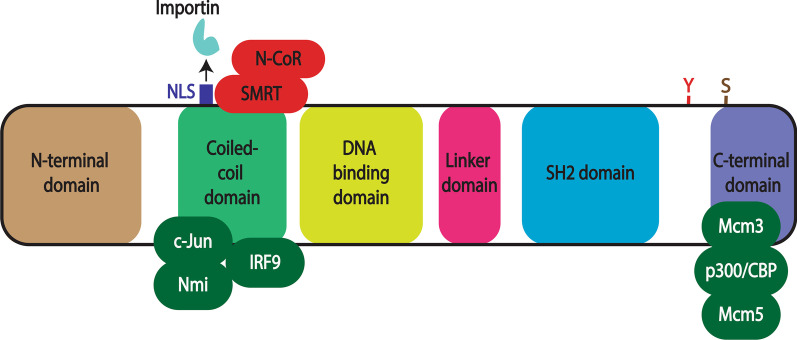
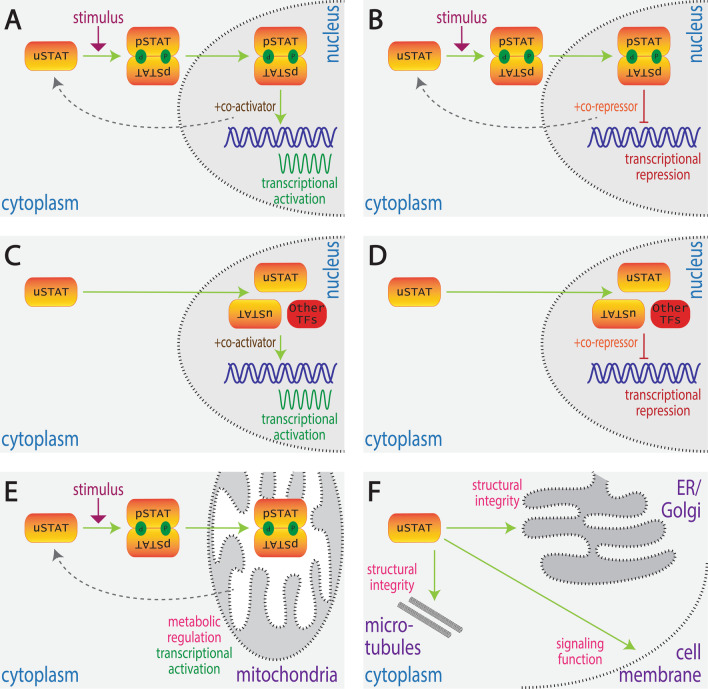
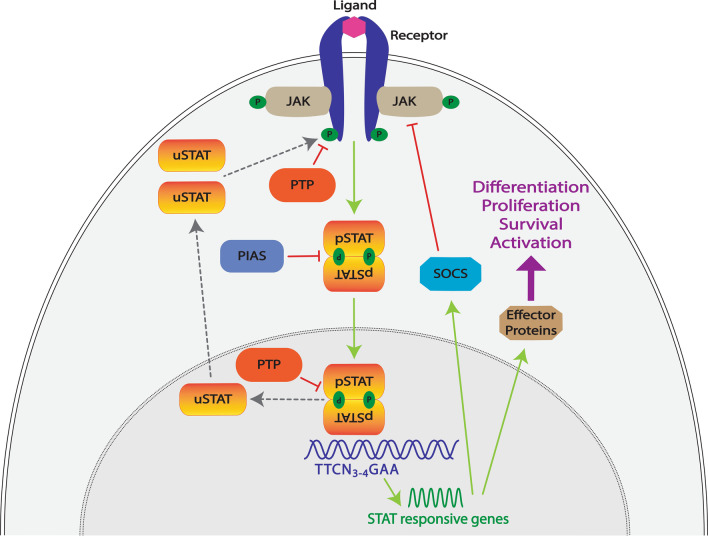
STAT proteins represent an important family of evolutionarily conserved transcription factors that play key roles in diverse biological processes, notably including blood and immune cell development and function. Classically, STAT proteins have been viewed as inducible activators of transcription that mediate cellular responses to extracellular signals, particularly cytokines. In this 'canonical' paradigm, latent STAT proteins become tyrosine phosphorylated following receptor activation, typically via downstream JAK proteins, facilitating their dimerization and translocation into the nucleus where they bind to specific sequences in the regulatory region of target genes to activate transcription. However, growing evidence has challenged this paradigm and identified alternate 'non-canonical' functions, such as transcriptional repression and roles outside the nucleus, with both phosphorylated and unphosphorylated STATs involved. This review provides a revised framework for understanding the diverse kaleidoscope of STAT protein functional modalities. It further discusses the implications of this framework for our understanding of STAT proteins in normal blood and immune cell biology and diseases such as cancer, and also provides an evolutionary context to place the origins of these alternative functional modalities.
STAT 蛋白是一类进化上保守的转录因子,在多种生物学过程中发挥着关键作用,特别是在血液和免疫细胞的发育和功能中。经典地,STAT 蛋白被视为转录的诱导激活物,介导细胞对外界信号,特别是细胞因子的反应。在这个“经典”模式中,潜伏的 STAT 蛋白在受体激活后被酪氨酸磷酸化,通常通过下游的 JAK 蛋白,促进它们的二聚化和易位到细胞核内,在那里它们与靶基因调控区的特定序列结合,激活转录。然而,越来越多的证据挑战了这一模式,并确定了替代的“非经典”功能,如转录抑制和核外作用,涉及磷酸化和非磷酸化的 STAT 蛋白。这篇综述提供了一个理解 STAT 蛋白功能多样性的修订框架。它进一步讨论了这一框架对我们理解 STAT 蛋白在正常血液和免疫细胞生物学以及癌症等疾病中的作用的意义,并提供了一个进化背景,以确定这些替代功能模式的起源。