Institute of Environmental Health Sciences, Wayne State University, Detroit, MI 48201, USA.
Pharmaceuticals (Basel). 2012 Aug 30;5(9):890-8. doi: 10.3390/ph5090890.
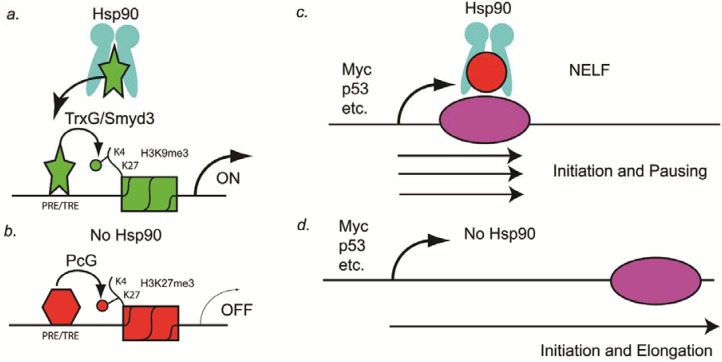
In this review, we focus on how inhibitors of Hsp90 can help prevent the resistance to anti-cancer drugs by synergistically increasing their cancer killing abilities and thereby allowing them to function at much lower concentrations than normally used. Hsp90 helps to fold numerous client proteins, such as Akt, Raf, Src, chromatin-modifying proteins, nuclear hormone receptors, and kinetochore assembly proteins. We discuss four mechanisms by which Hsp90 inhibitors can potentially synergize with anti-cancer drugs: by making a drug-resistant protein that is a client for Hsp90 more sensitive to the drug, by increasing chromosomal aneuploidy and the effectiveness of DNA-damaging drugs, by inhibiting Trithorax proteins which trimethylate histone 3 at lysine 4 (H3K4me3) and thereby decreasing expression of tumor promoter genes, and by interacting with the negative elongation factor (NELF) complex in tumors. We also explain how the evolutionary capacitor function of Hsp90 can be exploited with inhibitors of Hsp90 by exposing new protein variants that can be targeted with other drugs, thereby opening new avenues of combination drug therapy to treat cancer. We believe that inhibition of these processes can increase the efficacy of Hsp90 inhibitors with other anti-cancer drugs.
在这篇综述中,我们重点讨论了 Hsp90 抑制剂如何通过协同增强其抗癌能力来帮助预防抗癌药物的耐药性,从而使它们能够以比通常使用的浓度低得多的浓度发挥作用。Hsp90 有助于折叠许多客户蛋白,如 Akt、Raf、Src、染色质修饰蛋白、核激素受体和着丝粒组装蛋白。我们讨论了 Hsp90 抑制剂与抗癌药物协同作用的四种机制:使 Hsp90 的客户蛋白中具有耐药性的蛋白对药物更敏感,增加染色体非整倍性和 DNA 损伤药物的有效性,抑制三甲基化组蛋白 3 在赖氨酸 4(H3K4me3)的 Trithorax 蛋白,从而降低肿瘤促进基因的表达,以及与肿瘤中的负延伸因子 (NELF) 复合物相互作用。我们还解释了如何通过抑制 Hsp90 的进化电容器功能来利用 Hsp90 的抑制剂,暴露可以用其他药物靶向的新蛋白变体,从而为治疗癌症的联合药物治疗开辟新途径。我们相信,抑制这些过程可以提高 Hsp90 抑制剂与其他抗癌药物的疗效。