Department of Clinical Pathology, University Hospital of North Norway, Tromsø, Norway; Research group for Gynaecological Cancer, Department of Medical Biology, Faculty of Health Sciences, University of Tromsø, Tromsø, Norway.
BJOG. 2014 Mar;121(4):477-86. doi: 10.1111/1471-0528.12499. Epub 2013 Nov 28.
The purpose of this study was to investigate if the levonorgestrel-impregnated intrauterine device (LNG-IUS, Mirena(®) ) is safe and effective as therapy for low-risk and medium-risk endometrial hyperplasia compared with oral medroxyprogesterone (MPA).
A multicentre randomised trial.
Norway.
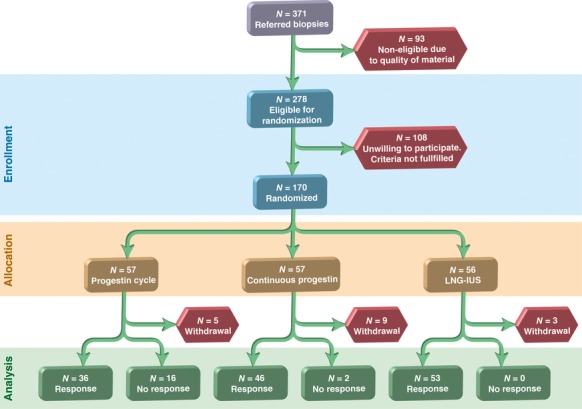
In all, 170 women aged 30-70 years with low- or medium-risk endometrial hyperplasia who met inclusion criteria.
Patients were randomly assigned to one of three treatment arms: LNG-IUS; oral MPA 10 mg administered for 10 days per cycle, or continuous oral MPA 10 mg daily, for 6 months.
The primary outcome measure was normalisation or persisting hyperplasia.
After 6 months all three treatment regimens showed significant effect when the outcome was evaluated as therapy response or not (P < 0.001). Responses were obtained for all the women in the LNG-IUS group (53/53, 95% CI 0.93-1.0) and for 96% of the women in the continuous oral group (46/48, 95% CI 0.86-0.99). Only 69% of the women in the cyclic oral group were responders (36/52, 95% CI 0.55-0.81). Adverse effects were relatively common with minimal differences between therapy groups.
In the first trial of its kind, women treated with the LNG-IUS showed histologically normal endometrium after 6 months of therapy for endometrial hyperplasia. Cyclical progestogens are found to be less effective compared with continuous oral therapy and LNG-IUS and should not be used for this purpose.
本研究旨在探讨左炔诺孕酮宫内节育系统(LNG-IUS,Mirena®)作为低风险和中风险子宫内膜增生的治疗方法是否安全有效,与口服安宫黄体酮(MPA)相比。
多中心随机试验。
挪威。
共纳入 170 名年龄在 30-70 岁之间、符合纳入标准的低风险或中风险子宫内膜增生患者。
患者被随机分配到三个治疗组之一:LNG-IUS;每周期口服 MPA10mg,连续 10 天,或每日连续口服 MPA10mg,共 6 个月。
主要观察指标是正常化或持续增生。
6 个月后,所有三种治疗方案的疗效均有显著差异(P<0.001)。LNG-IUS 组所有女性(53/53,95%可信区间 0.93-1.0)和连续口服组 96%的女性(46/48,95%可信区间 0.86-0.99)均获得了应答。仅 69%的周期性口服组女性(36/52,95%可信区间 0.55-0.81)为应答者。不良反应较为常见,但各治疗组之间差异较小。
在第一项此类试验中,接受 LNG-IUS 治疗的女性在 6 个月的子宫内膜增生治疗后,组织学上出现正常子宫内膜。与连续口服治疗和 LNG-IUS 相比,周期性孕激素治疗效果较差,不应将其用于该目的。