Department of Medical Cell BioPhysics, MIRA Institute, University of Twente, Carre Room C4437, Hallenweg 23, 7522 NH Enschede, The Netherlands.
Janssen Research & Development, Janssen Pharmaceutical Companies of Johnson & Johnson, Beerse, Belgium.
Genome Med. 2013 Nov 29;5(11):106. doi: 10.1186/gm510. eCollection 2013.
Tumor cells in the blood of patients with metastatic carcinomas are associated with poor survival. Knowledge of the cells' genetic make-up can help to guide targeted therapy. We evaluated the efficiency and quality of isolation and amplification of DNA from single circulating tumor cells (CTC).
The efficiency of the procedure was determined by spiking blood with SKBR-3 cells, enrichment with the CellSearch system, followed by single cell sorting by fluorescence-activated cell sorting (FACS) and whole genome amplification. A selection of single cell DNA from fixed and unfixed SKBR-3 cells was exome sequenced and the DNA quality analyzed. Single CTC from patients with lung cancer were used to demonstrate the potential of single CTC molecular characterization.
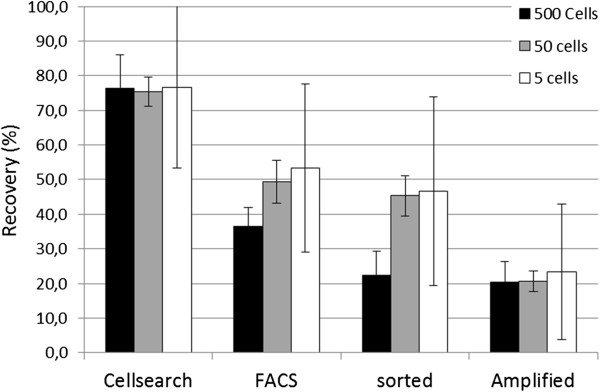
The overall efficiency of the procedure from spiked cell to amplified DNA was approximately 20%. Losses attributed to the CellSearch system were around 20%, transfer to FACS around 25%, sorting around 5% and DNA amplification around 25%. Exome sequencing revealed that the quality of the DNA was affected by the fixation of the cells, amplification, and the low starting quantity of DNA. A single fixed cell had an average coverage at 20× depth of 30% when sequencing to an average of 40× depth, whereas a single unfixed cell had 45% coverage. GenomiPhi-amplified genomic DNA had a coverage of 72% versus a coverage of 87% of genomic DNA. Twenty-one percent of the CTC from patients with lung cancer identified by the CellSearch system could be isolated individually and amplified.
CTC enriched by the CellSearch system were sorted by FACS, and DNA retrieved and amplified with an overall efficiency of 20%. Analysis of the sequencing data showed that this DNA could be used for variant calling, but not for quantitative measurements such as copy number detection. Close to 55% of the exome of single SKBR-3 cells were successfully sequenced to 20× depth making it possible to call 72% of the variants. The overall coverage was reduced to 30% at 20× depth, making it possible to call 56% of the variants in CellSave-fixed cells.
患有转移性癌的患者血液中的肿瘤细胞与不良预后相关。了解这些细胞的遗传构成有助于指导靶向治疗。我们评估了从单个循环肿瘤细胞(CTC)中分离和扩增 DNA 的效率和质量。
通过将 SKBR-3 细胞掺入血液中,用 CellSearch 系统进行富集,然后通过荧光激活细胞分选(FACS)进行单细胞分选和全基因组扩增来确定该过程的效率。对固定和未固定的 SKBR-3 细胞的单细胞 DNA 进行了外显子组测序,并分析了 DNA 质量。从肺癌患者的单个 CTC 中证明了单个 CTC 分子特征分析的潜力。
从掺入细胞到扩增 DNA 的整个过程的总效率约为 20%。归因于 CellSearch 系统的损失约为 20%,转移到 FACS 约为 25%,分选约为 5%,DNA 扩增约为 25%。外显子组测序显示,细胞固定、扩增和 DNA 起始量低都会影响 DNA 的质量。当对单个固定细胞进行测序以达到平均 40×的深度时,单个固定细胞的平均覆盖率为 20×深度的 30%,而单个未固定细胞的覆盖率为 45%。GenomiPhi 扩增的基因组 DNA 的覆盖率为 72%,而基因组 DNA 的覆盖率为 87%。通过 CellSearch 系统鉴定的 21%的肺癌患者的 CTC 可以单独分离和扩增。
通过 CellSearch 系统富集的 CTC 通过 FACS 进行分选,并且 DNA 以 20%的总效率进行回收和扩增。对测序数据的分析表明,该 DNA 可用于变体调用,但不能用于定量测量,例如拷贝数检测。单个 SKBR-3 细胞的近 55%的外显子组成功地测序到 20×的深度,从而可以调用 72%的变体。在 20×的深度下,总体覆盖率降低到 30%,使得可以在 CellSave 固定细胞中调用 56%的变体。