Wy Ip Winnie, Qasim Waseem
Molecular Immunology Unit, UCL Institute of Child Health, 30 Guildford Street, London WC1N 1EH, UK.
Adv Hematol. 2013;2013:176418. doi: 10.1155/2013/176418. Epub 2013 Oct 28.
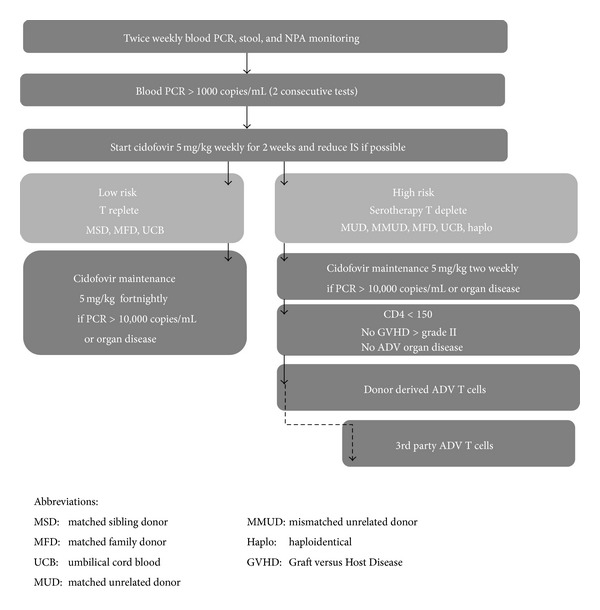
Adenovirus (ADV) can cause significant morbidity and mortality in children following haematopoietic stem cell transplantation (HSCT), with an incidence of up to 27% and notable associated morbidity and mortality. T-cell depleted grafts and severe lymphopenia are major risk factors for the development of adenovirus disease after HSCT. Current antiviral treatments are at best virostatic and may have significant side effects. Adoptive transfer of donor-derived virus-specific T cells has been shown to be an effective strategy for the prevention and treatment of ADV infection after HSCT. Here we review progress in the field and present a pathway for the management of adenovirus in the posttransplant setting.
腺病毒(ADV)可在造血干细胞移植(HSCT)后的儿童中导致显著的发病率和死亡率,发病率高达27%,且伴有明显的相关发病率和死亡率。T细胞去除的移植物和严重淋巴细胞减少是HSCT后腺病毒疾病发生的主要危险因素。目前的抗病毒治疗充其量只是抑制病毒复制,且可能有显著的副作用。供体来源的病毒特异性T细胞的过继转移已被证明是预防和治疗HSCT后ADV感染的有效策略。在此,我们综述该领域的进展,并提出移植后腺病毒管理的途径。