Department of Pathology, Biological Science Centre, State University of Londrina, Rodovia Celso Garcia Cid Pr 445, Km 380. Cx. Postal 6001, 86051-990 Londrina PR, Brazil.
Biomed Res Int. 2013;2013:627046. doi: 10.1155/2013/627046. Epub 2013 Oct 31.
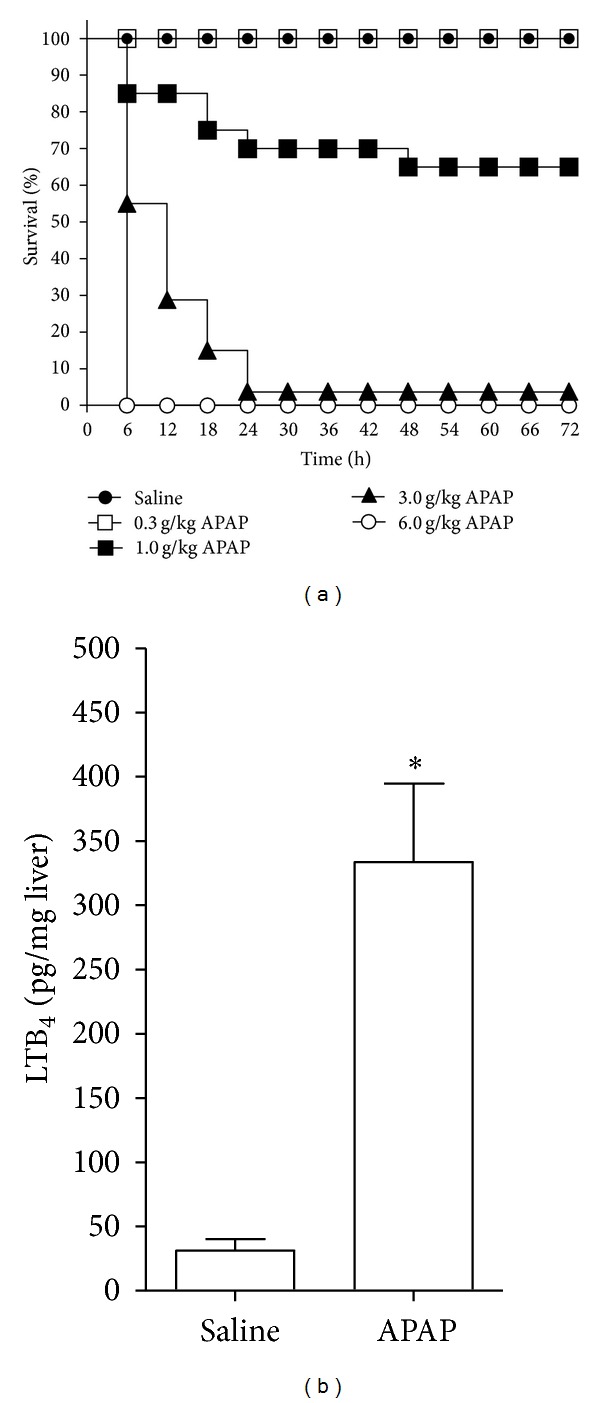
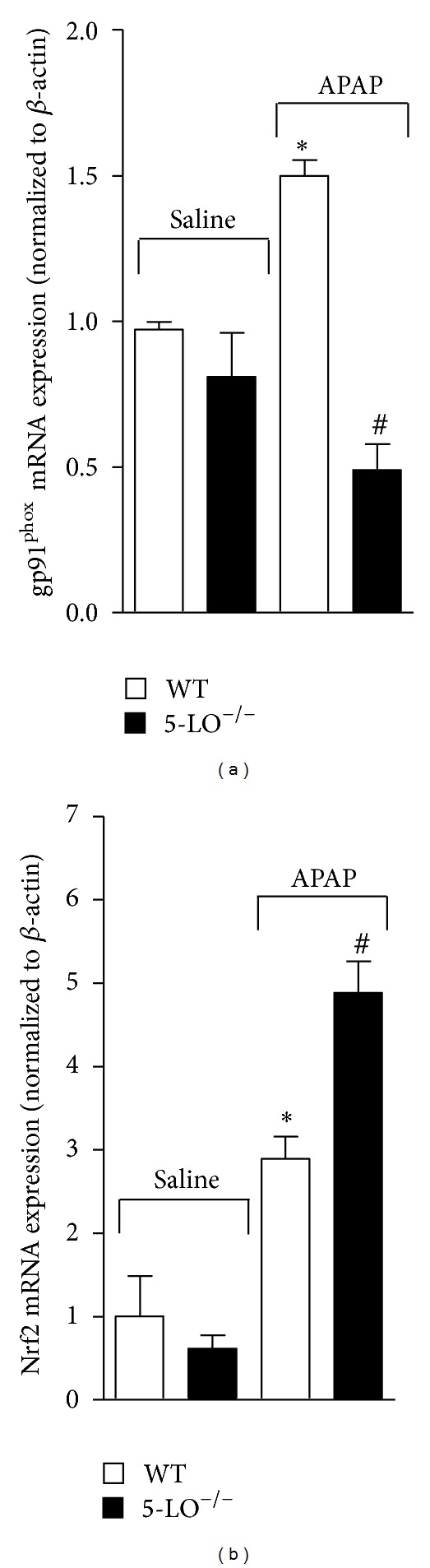
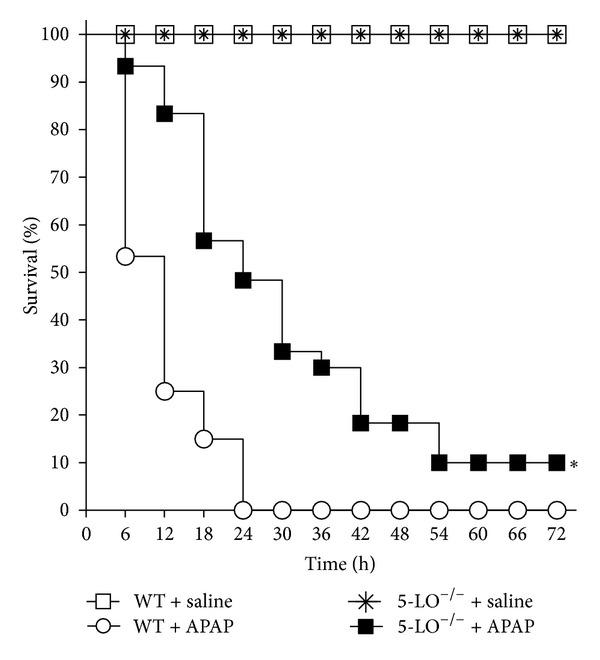
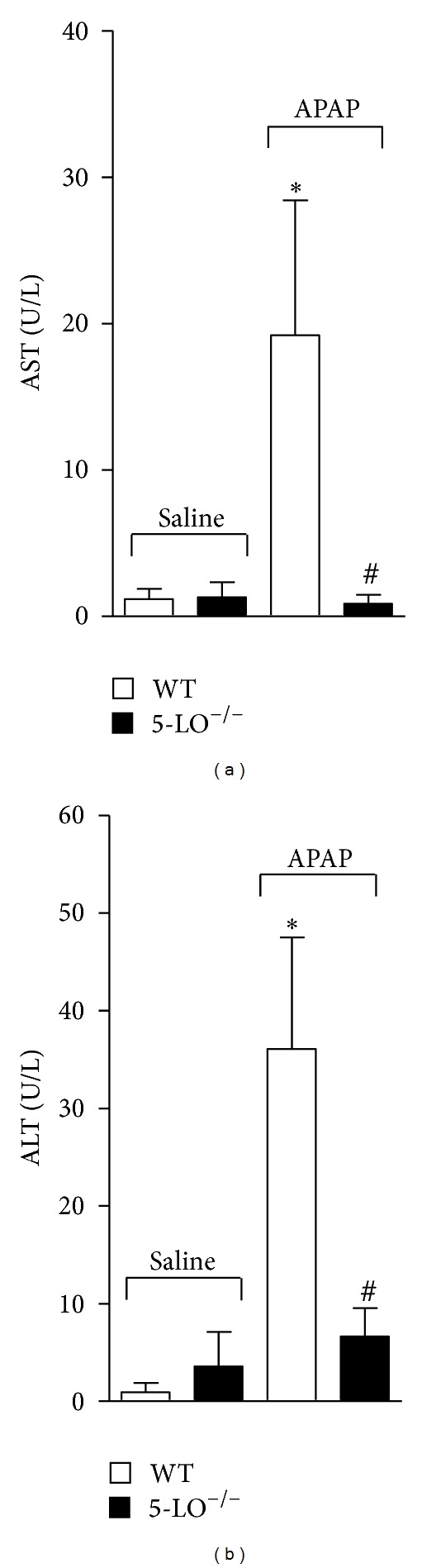
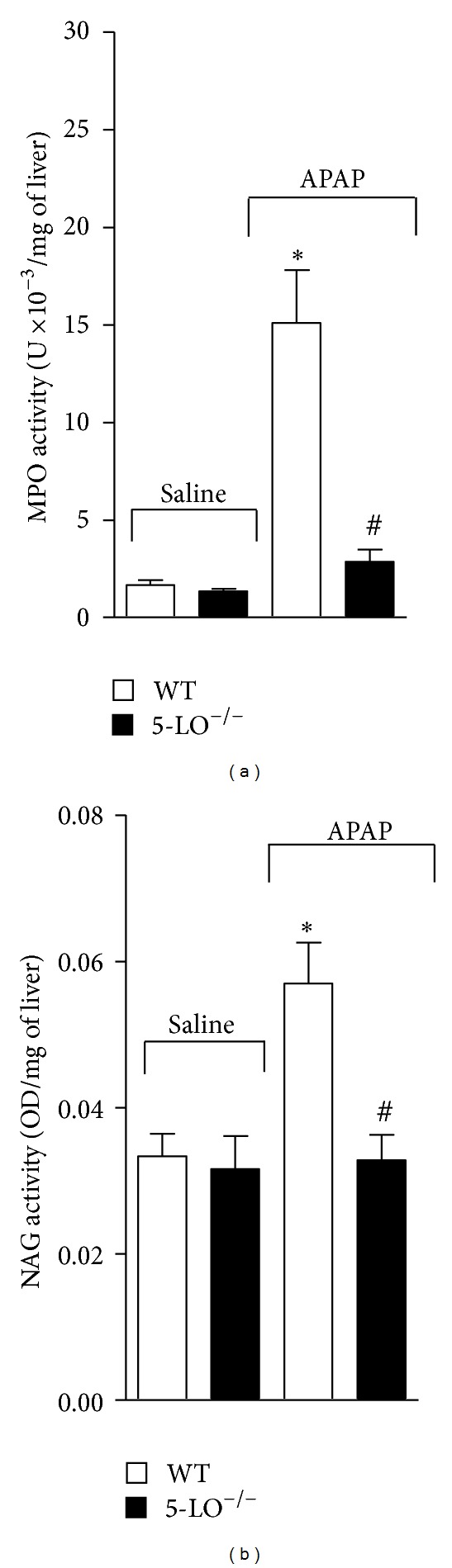
5-Lipoxygenase (5-LO) converts arachidonic acid into leukotrienes (LTs) and is involved in inflammation. At present, the participation of 5-LO in acetaminophen (APAP)-induced hepatotoxicity and liver damage has not been addressed. 5-LO deficient (5-LO⁻/⁻) mice and background wild type mice were challenged with APAP (0.3-6 g/kg) or saline. The lethality, liver damage, neutrophil and macrophage recruitment, LTB₄, cytokine production, and oxidative stress were assessed. APAP induced a dose-dependent mortality, and the dose of 3 g/kg was selected for next experiments. APAP induced LTB4 production in the liver, the primary target organ in APAP toxicity. Histopathological analysis revealed that 5-LO⁻/⁻ mice presented reduced APAP-induced liver necrosis and inflammation compared with WT mice. APAP-induced lethality, increase of plasma levels of aspartate aminotransferase and alanine aminotransferase, liver cytokine (IL-1β, TNF-α , IFN- γ, and IL-10), superoxide anion, and thiobarbituric acid reactive substances production, myeloperoxidase and N-acetyl-β-D-glucosaminidase activity, Nrf2 and gp91(phox) mRNA expression, and decrease of reduced glutathione and antioxidant capacity measured by 2,2'-azinobis(3-ethylbenzothiazoline 6-sulfonate) assay were prevented in 5-LO⁻/⁻ mice compared to WT mice. Therefore, 5-LO deficiency resulted in reduced mortality due to reduced liver inflammatory and oxidative damage, suggesting 5-LO is a promising target to reduce APAP-induced lethality and liver inflammatory/oxidative damage.
5-脂氧合酶(5-LO)将花生四烯酸转化为白三烯(LTs),并参与炎症反应。目前,5-LO 在对乙酰氨基酚(APAP)诱导的肝毒性和肝损伤中的作用尚未得到解决。使用 5-LO 缺陷(5-LO⁻/⁻)小鼠和背景野生型(WT)小鼠进行 APAP(0.3-6 g/kg)或盐水挑战。评估了死亡率、肝损伤、中性粒细胞和巨噬细胞募集、LTB₄、细胞因子产生和氧化应激。APAP 诱导剂量依赖性死亡率,选择 3 g/kg 剂量进行下一步实验。APAP 在肝脏中诱导 LTB4 产生,肝脏是 APAP 毒性的主要靶器官。组织病理学分析显示,与 WT 小鼠相比,5-LO⁻/⁻ 小鼠的 APAP 诱导的肝坏死和炎症减少。APAP 诱导的致死率、血浆天冬氨酸转氨酶和丙氨酸转氨酶水平升高、肝细胞因子(IL-1β、TNF-α、IFN-γ和 IL-10)、超氧阴离子和硫代巴比妥酸反应物质产生、髓过氧化物酶和 N-乙酰-β-D-氨基葡萄糖苷酶活性、Nrf2 和 gp91(phox)mRNA 表达以及通过 2,2'-联氮双(3-乙基苯并噻唑啉-6-磺酸)测定的还原型谷胱甘肽和抗氧化能力降低在 5-LO⁻/⁻ 小鼠中得到预防与 WT 小鼠相比。因此,5-LO 缺乏导致死亡率降低,原因是肝炎症和氧化损伤减少,这表明 5-LO 是降低 APAP 诱导的致死率和肝炎症/氧化损伤的有希望的靶点。