Department of Child and Adolescent Psychiatry, Assistance Publique-Hôpitaux de Paris (AP-HP), Groupe Hospitalier Pitié-Salpêtrière, Université Pierre et Marie Curie, 47 bd de l'Hôpital, 75013 Paris, France.
Mol Autism. 2013 Dec 1;4(1):47. doi: 10.1186/2040-2392-4-47.
Autism spectrum disorders (ASD) and epilepsy frequently occur together. Prevalence rates are variable, and have been attributed to age, gender, comorbidity, subtype of pervasive developmental disorder (PDD) and risk factors. Recent studies have suggested disparate clinical and genetic settings depending on simplex or multiplex autism. The aim of this study was to assess: 1) the prevalence of epilepsy in multiplex autism and its association with genetic and non-genetic risk factors of major effect, intellectual disability and gender; and 2) whether autism and epilepsy cosegregate within multiplex autism families.
We extracted from the Autism Genetic Resource Exchange (AGRE) database (n = 3,818 children from 1,264 families) all families with relevant medical data (n = 664 children from 290 families). The sample included 478 children with ASD and 186 siblings without ASD. We analyzed the following variables: seizures, genetic and non-genetic risk factors, gender, and cognitive functioning as assessed by Raven's Colored Progressive Matrices (RCPM) and Vineland Adaptive Behavior Scales (VABS).
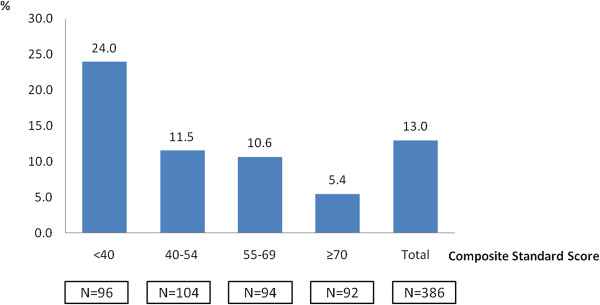
The prevalence of epilepsy was 12.8% in cases with ASD and 2.2% in siblings without ASD (P <10-5). With each RCPM or VABS measure, the risk of epilepsy in multiplex autism was significantly associated with intellectual disability, but not with gender. Identified risk factors (genetic or non-genetic) of autism tended to be significantly associated with epilepsy (P = 0.052). When children with prematurity, pre- or perinatal insult, or cerebral palsy were excluded, a genetic risk factor was reported for 6/59 (10.2%) of children with epilepsy and 12/395 (3.0%) of children without epilepsy (P = 0.002). Finally, using a permutation test, there was significant evidence that the epilepsy phenotype co-segregated within families (P <10-4).
Epilepsy in multiplex autism may define a different subgroup in terms of clinical characteristics and genetic risk.
自闭症谱系障碍(ASD)和癫痫经常同时发生。患病率各不相同,其归因于年龄、性别、共病、广泛发育障碍(PDD)亚型和危险因素。最近的研究表明,根据单纯或多重自闭症,存在不同的临床和遗传环境。本研究旨在评估:1)多重自闭症中癫痫的患病率及其与主要效应、智力障碍和性别相关的遗传和非遗传危险因素的关联;2)自闭症和癫痫是否在多重自闭症家庭中共同分离。
我们从自闭症遗传资源交换(AGRE)数据库(来自 1264 个家庭的 3818 名儿童)中提取了所有具有相关医疗数据的家庭(来自 290 个家庭的 664 名儿童)。样本包括 478 名自闭症儿童和 186 名无自闭症兄弟姐妹。我们分析了以下变量:癫痫发作、遗传和非遗传危险因素、性别以及通过瑞文彩色渐进矩阵(RCPM)和文兰适应行为量表(VABS)评估的认知功能。
自闭症儿童中癫痫的患病率为 12.8%,无自闭症兄弟姐妹为 2.2%(P<10-5)。在多重自闭症中,RCPM 或 VABS 测量的每个指标与智力障碍显著相关,但与性别无关。自闭症的已识别危险因素(遗传或非遗传)往往与癫痫显著相关(P=0.052)。当排除早产儿、产前或围产期损伤或脑瘫的儿童时,6/59(10.2%)癫痫发作儿童和 12/395(3.0%)无癫痫发作儿童报告了遗传危险因素(P=0.002)。最后,通过置换检验,有显著证据表明癫痫表型在家庭中共同分离(P<10-4)。
多重自闭症中的癫痫可能在临床特征和遗传风险方面定义了一个不同的亚组。