Department of Geriatrics, Mount Sinai School of Medicine, New York, NY, USA.
Curr Diab Rep. 2014 Jan;14(1):453. doi: 10.1007/s11892-013-0453-1.
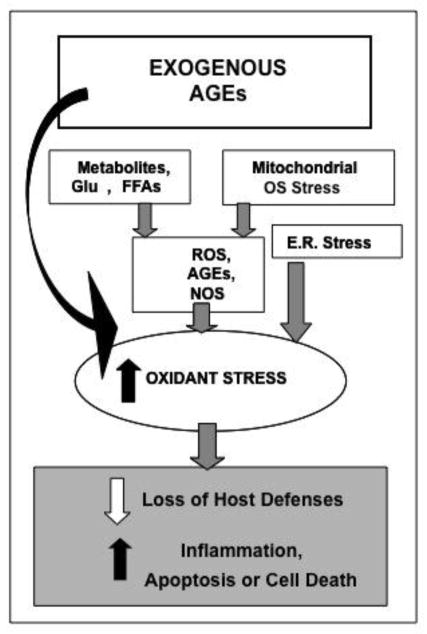
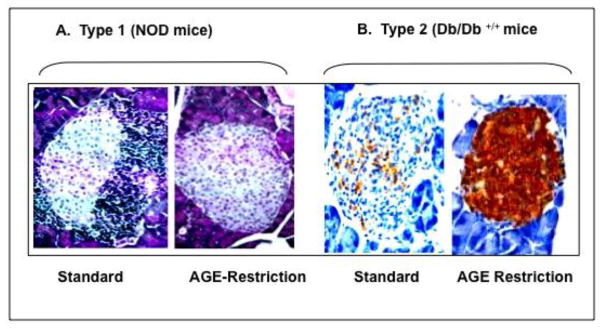
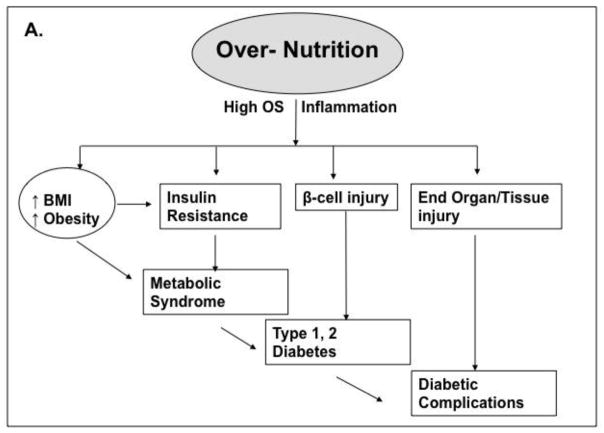
Despite new and effective drug therapies, insulin resistance (IR), type 2 diabetes mellitus (T2D) and its complications remain major medical challenges. It is accepted that IR, often associated with over-nutrition and obesity, results from chronically elevated oxidant stress (OS) and chronic inflammation. Less acknowledged is that a major cause for this inflammation is excessive consumption of advanced glycation end products (AGEs) with the standard western diet. AGEs, which were largely thought as oxidative derivatives resulting from diabetic hyperglycemia, are increasingly seen as a potential risk for islet β-cell injury, peripheral IR and diabetes. Here we discuss the relationships between exogenous AGEs, chronic inflammation, IR, and T2D. We propose that under chronic exogenous oxidant AGE pressure the depletion of innate defense mechanisms is an important factor, which raises susceptibility to inflammation, IR, T2D and its complications. Finally we review evidence on dietary AGE restriction as a nonpharmacologic intervention, which effectively lowers AGEs, restores innate defenses and improves IR, thus, offering new perspectives on diabetes etiology and therapy.
尽管有新的和有效的药物治疗方法,但胰岛素抵抗(IR)、2 型糖尿病(T2D)及其并发症仍然是主要的医学挑战。人们普遍认为,IR 通常与营养过剩和肥胖有关,是由慢性氧化应激(OS)和慢性炎症引起的。不太被认可的是,这种炎症的一个主要原因是过量摄入标准西方饮食中的晚期糖基化终产物(AGEs)。AGEs 曾被认为主要是糖尿病高血糖产生的氧化衍生物,但越来越多的证据表明,AGEs 是胰岛β细胞损伤、外周 IR 和糖尿病的潜在风险因素。在这里,我们讨论了外源性 AGEs、慢性炎症、IR 和 T2D 之间的关系。我们提出,在慢性外源性氧化剂 AGE 压力下,先天防御机制的耗竭是一个重要因素,这增加了炎症、IR、T2D 及其并发症的易感性。最后,我们回顾了饮食 AGE 限制作为一种非药物干预的证据,它可以有效降低 AGEs、恢复先天防御并改善 IR,从而为糖尿病的病因和治疗提供了新的视角。